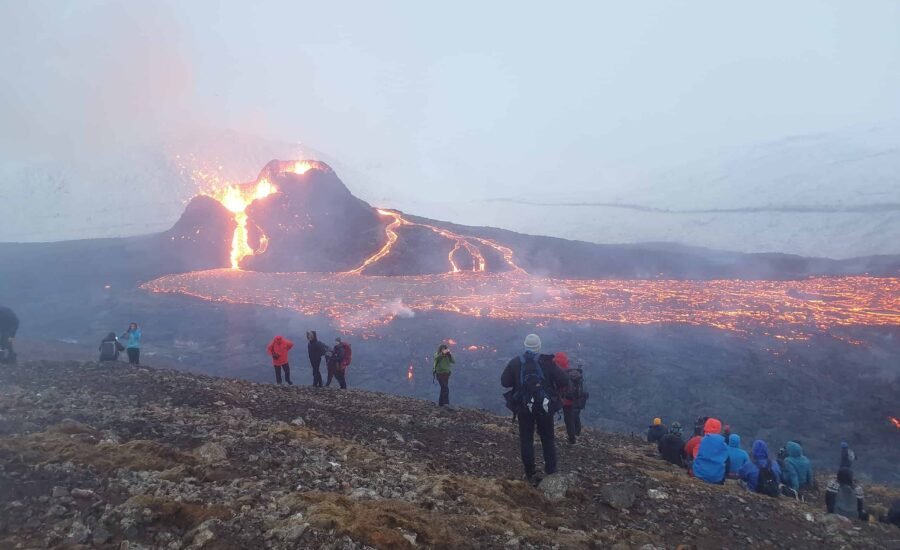
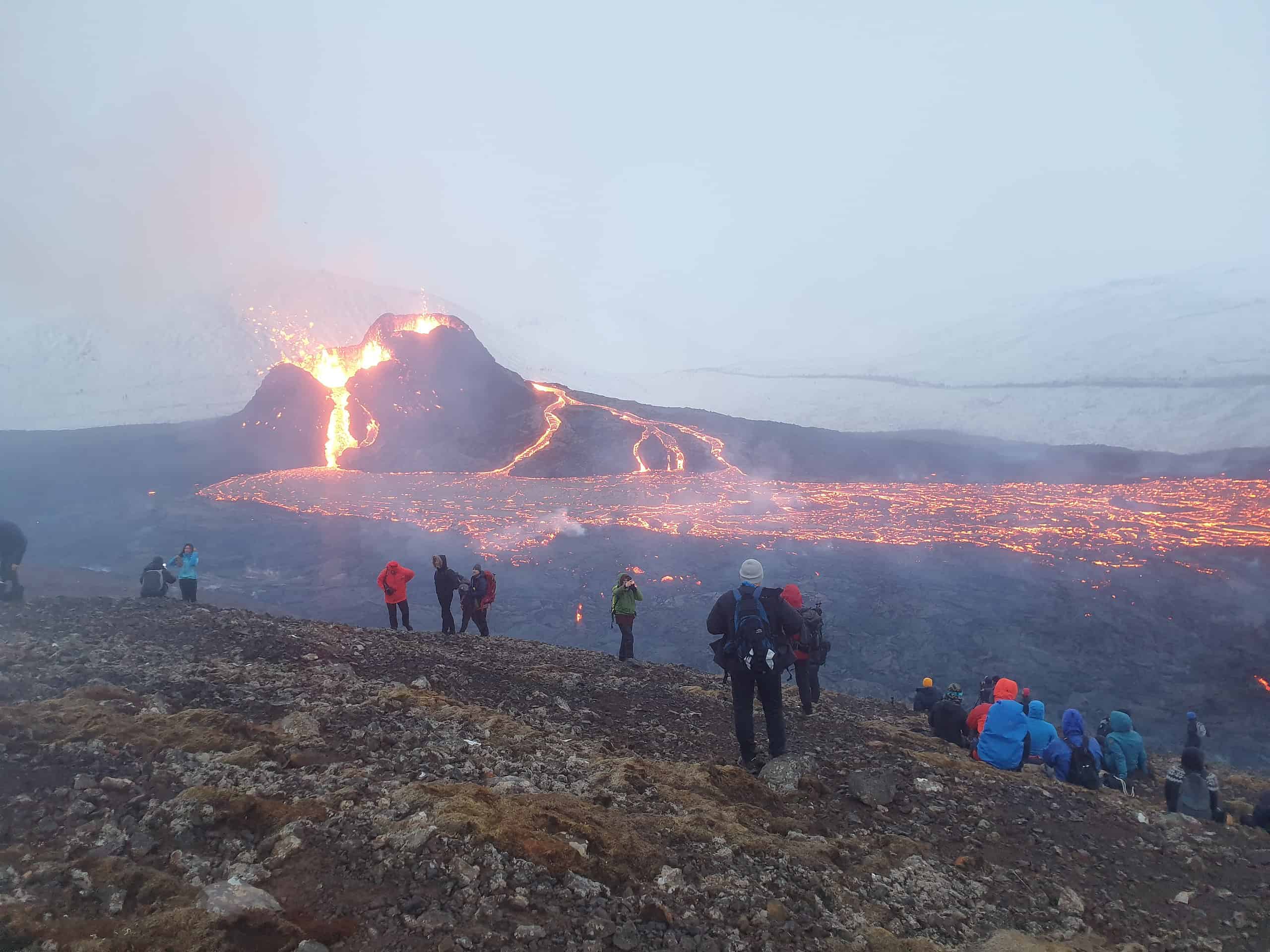
The Fagradalsfjall volcano area in Iceland erupted spectacularly in 2021, creating a dazzling and fearsome display of lava. But the lava didn’t just flow neatly from the volcano. It gushed and spewed, creating striking “lava fountains”. Now, a new study has shed light on the mechanisms behind this lava fountaining, showing how exactly this spectacular phenomenon can form when gas and magma interact in the shallow plumbing beneath a volcano..
Pumping lava
Lava fountains are not just visually mesmerizing; they are also key to understanding volcanic behavior. Typically extending from a few tens of meters to over a kilometer, these fountains differ from explosive and effusive eruption styles. At Fagradalsfjall, a unique pattern was observed: short, intense fountaining episodes followed by equally brief periods of repose. This rhythmic pattern, lasting over six weeks, presented a rare opportunity to analyze the underlying processes in unprecedented detail.
A team of volcanologists conducted detailed spectroscopic measurements of volcanic gases during these fountaining episodes. They used a special method called Open-path Fourier Transform Infrared (OP-FTIR) spectroscopy. This approach is well-suited for rapid observations of large areas (from square meters to square kilometers).
“Exceptional conditions on 5 May 2021 permitted close-range (~300 m), highly time-resolved (every ~ 2 s) spectroscopic measurement of emitted gases during 16 fountain-repose cycles,” the researchers write in the article.

By studying the chemical composition of the gases released by the lava fountain, the research team argued that the lava fountaining resulted from pressure cycles within a shallow, magma-filled cavity. As magma ascended, the increasing gas content led to the formation of a foam layer at the cavity’s roof. The collapse of this layer and the subsequent rise and expansion of gas bubbles created the dynamic overpressure driving the fountains.
In simpler terms, the volcano may have been acting a bit like a natural pressure pump. Gas built up near the surface, pressure rose, and then the system released that pressure in a burst of lava. Then the process reset and began again. That helps explain why the eruption pulsed so regularly instead of simply pouring out lava at a steady rate.
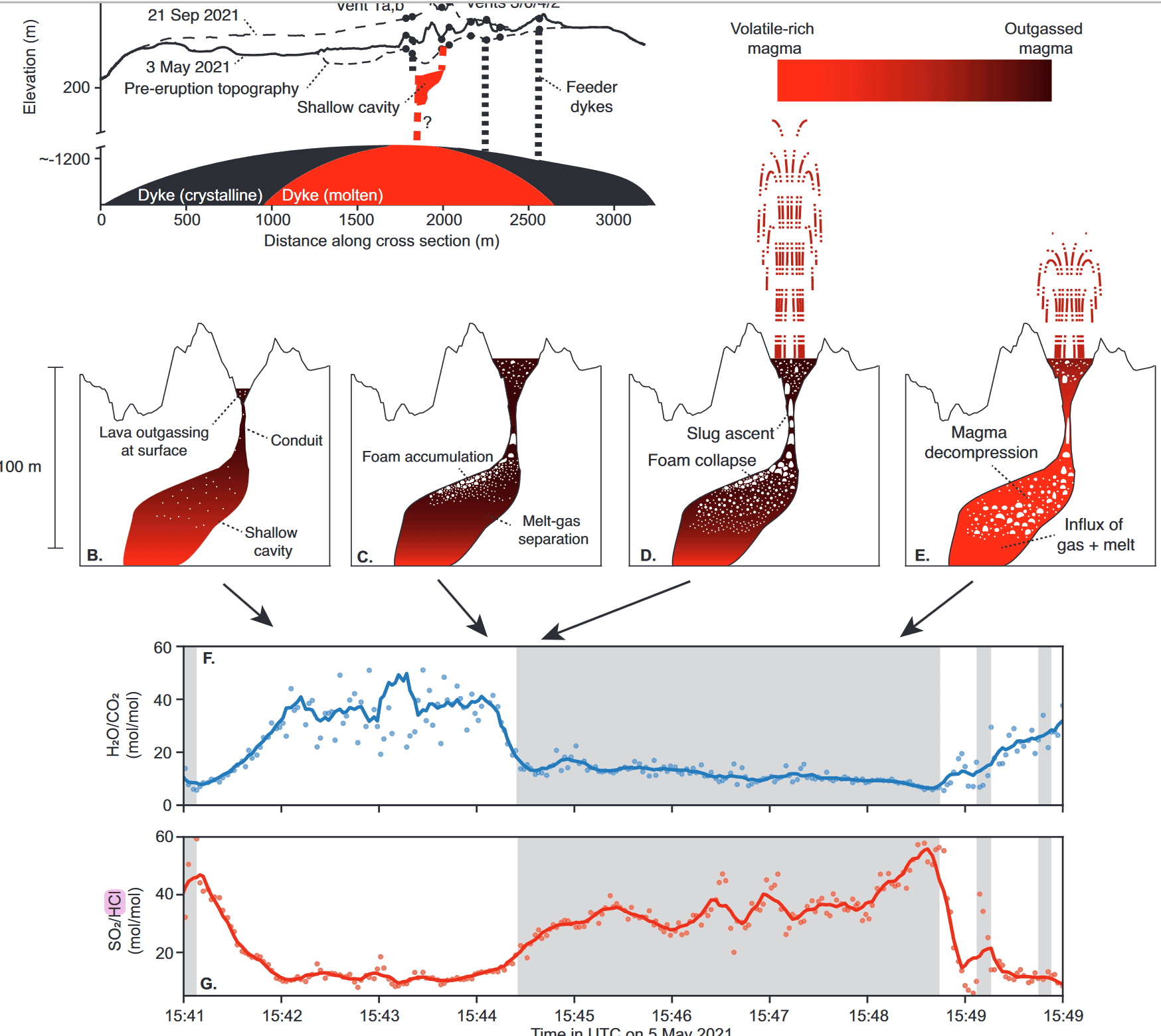
This work challenges traditional models of lava fountaining, which often emphasize the role of rapid magma ascent and gas-magma flow dynamics. The study at Fagradalsfjall points to a more complex interplay of factors, including magma degassing at shallow depths and the build-up and release of pressure in near-surface cavities.
Fagradalsfjall itself is a subglacially formed table mountain, shaped by eruptions beneath an Ice Age ice sheet. But the 2021 eruption was not an eruption through ice. It was a basaltic fissure eruption in a newly reactivated volcanic region. The findings from Fagradalsfjall have broad implications for our understanding of volcanic behavior, particularly in basaltic eruptions. They highlight the importance of near-surface processes and the role of gas dynamics in shaping eruption styles.
The new Reykjanes activity adds another layer of relevance. The Icelandic Meteorological Office says the peninsula’s current reactivation began in December 2019, after a long quiet period. Fagradalsfjall was the first major eruptive focus, but since late 2023, the most disruptive activity has been near Svartsengi and the Sundhnúkur crater row, where eruptions and intrusions have repeatedly threatened Grindavík and nearby infrastructure. As of July 2026, magma was still accumulating beneath Svartsengi, and officials warned that another intrusion or eruption remained possible, potentially with only a short warning time.
This study not only unravels the mystery behind the Fagradalsfjall volcano’s unique behavior but also sets the stage for further exploration into the depths of volcanic phenomena. The continued study of such dynamic natural processes is crucial for advancing our knowledge of Earth’s geology and improving our ability to forecast and mitigate the impacts of volcanic eruptions.
That is the practical takeaway. Lava fountains may look like nature putting on a show, but they are also signals from underground. At Fagradalsfjall, those signals revealed a shallow system filling, foaming, collapsing, and refilling in cycles. In a region where volcanic unrest is still ongoing, learning to read those signals matters.
The findings were reported in the journal Nature Communications.
Update: The finding has aged well. Since the original article was published, the Reykjanes Peninsula has remained restless. Fagradalsfjall produced three eruptions between 2021 and 2023, and more recent activity has shifted to the nearby Svartsengi volcanic system and the Sundhnúkur crater row, closer to Grindavík. That broader unrest makes the 2021 lava fountains more than just a spectacular one-off. They are now part of a bigger story about how magma moves beneath southwestern Iceland.
This article was originally published in November 13, 2024, and has been revisited with additional information.