
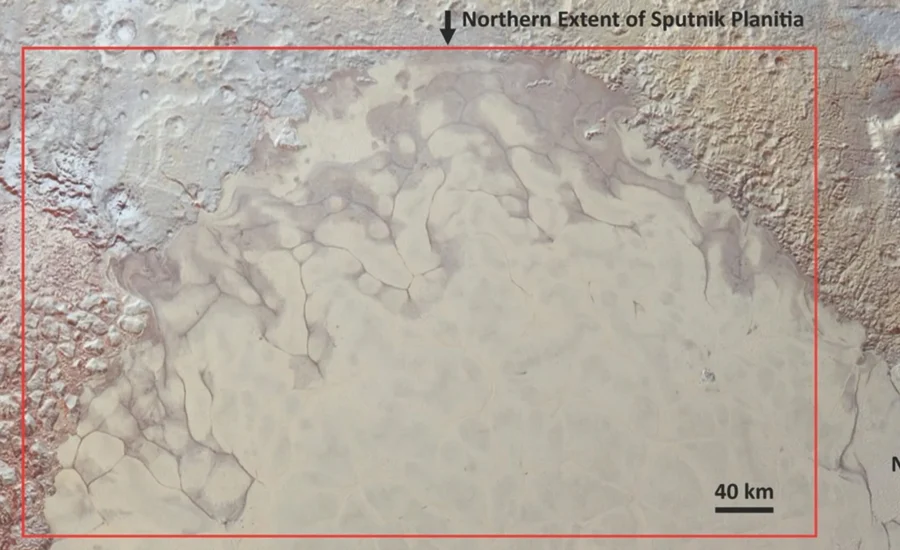
One of Pluto’s most striking landmarks is Sputnik Planitia, a massive glacier filled with frozen nitrogen ice. It covers more than a million square kilometers, about the size of Texas, and forms part of the planet’s famous “heart-shaped” feature seen in New Horizons images.
Scientists studying the northern part of Sputnik Planitia have found patterns that suggest the ice sheet isn’t just sitting still. A new analysis of images from NASA’s New Horizons flyby of Pluto in 2015 shows evidence that liquid nitrogen may be rising to the surface through cracks at the northern edge of Sputnik Planitia. This is the first sign of recently flowing liquid on Pluto. The study suggests that dark streaks and diffuse features may occasionally be wetted by liquid nitrogen.
“Pluto never stops surprising us,” said Alan Stern, principal investigator of New Horizons and lead study author from the Southwest Research Institute in Boulder, Colorado. “In addition to suggesting that liquids have recently expressed themselves on Pluto’s surface, this result also suggests a new kind of time-variable feature on Pluto.”
On Pluto’s northern Sputnik Planitia, surface patterns look like Earth’s glaciers after being wetted by rain or rising subsurface liquid. Since Pluto’s conditions rule out liquid nitrogen rain, scientists think nitrogen is flowing up from beneath the glacier.
The absence of impact craters means the surface is continuously being resurfaced, and polygon-like patterns suggest very slow currents. Areas where liquid nitrogen climbed, spread and refroze might be denoted by sharp edges or diffuse zones. To achieve this, the glacier’s base has to melt beneath due to pressure before being pushed upwards in liquid form and freezing up again.
Liquid nitrogen has to form under pressure, so the base of that ice sheet would need to melt before anything could exist on Pluto. That liquid would then be able to percolate through glacial ice and warm up, only to freeze again. If it ran long enough, it would dam up in insulation spaces to depart the dulled fronts scientists see today.
If Pluto’s “heart” hides flowing nitrogen, it means the planet is geologically active, a surprising trait for a world at the edge of the solar system. Understanding this could also shed light on other icy worlds like Triton or Europa.
Journal Reference:
- S. A. Stern, Orkan Umurhan, Gary D. Clow, Robert S. Anderson, Alan Howard and Kelsi N. Singer. Evidence for Possible N2 Basal Flow beneath Pluto’s Northern Sputnik Planitia. The Planetary Science Journal. DOI 10.3847/PSJ/ae7e85