Data captured during inclement conditions for typical observation was instead used to study white dwarfs and the rocky debris drawn in to them.
Based in the Arizona desert, the Dark Energy Spectroscopic Instrument (DESI) was designed to observe distant galaxies during its primary five-year survey, but conditions did not always allow for perfect observations.
But researchers were still determined to use observation time effectively, so these periods of non-optimal conditions were instead focused on 12 highly metal-enriched white dwarfs and their spectra.
“We are lucky enough to get a lot of white dwarfs observed as a side project,” explains the study’s lead author, Paula Izquierdo of the University of Warwick. “Among those, we found these ones which are super metal-enriched.”
White dwarfs are a stage in the latter days of a star’s life cycle
When stars similar in size and density to our Sun see a reduction in hydrogen fusion to the point of no longer being in hydrostatic equilibrium, they increase in density and temperature, expanding outwards to become a red giant. After this stage, the star sheds its outer layers and becomes a dense type of cooling star, also known as a white dwarf.
Estimates vary for how long it will take for our own Sun to reach this stage, but many astronomers believe it will take place roughly 5 billion years in the future. The nearest identified white dwarf to Earth is Sirius B, part of the constellation Canis Major.
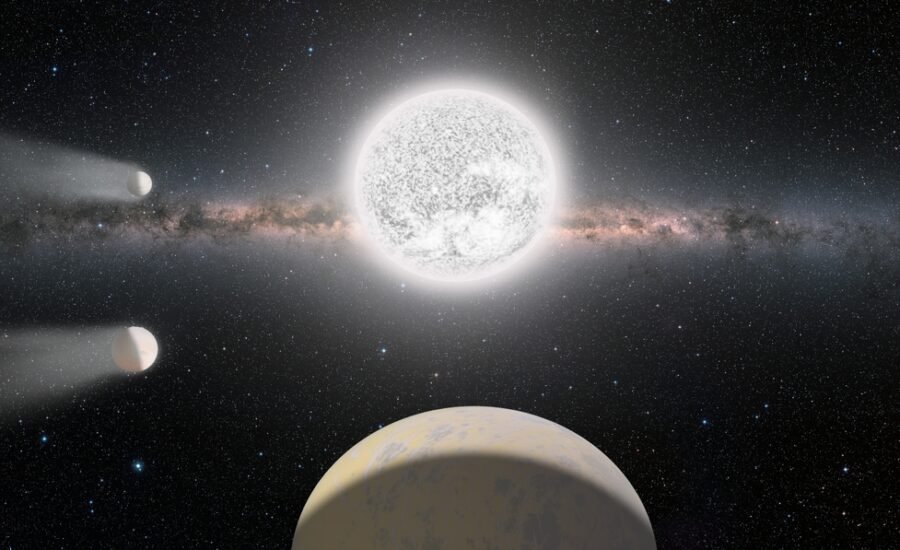
As part of this lifecycle, rocky exoplanets that once orbited at a safe distance to stars can be pulled in closer, where gravity and tidal forces eventually tear them to pieces. This debris will eventually be pulled into the white dwarf’s surface, where elements heavier than helium(referred to as ‘metals’ in astrophysics) can be detected in the atmosphere.
These trace elements on stars can be used to hypothesise about the compositions of the exoplanets that once were in orbit, with an estimated 20%-50% of the white dwarfs observed by astronomers showing evidence of metals in stellar spectra.
Of this group, around 1,750 are known to be actively accreting planetary debris, with only a small proportion of these few showing observable differences in their spectra.
To date, between 20% and 50% of the hundreds of thousands of white dwarfs observed by astronomers carry signatures of metals in their stellar spectra, offering a unique glimpse of the compositions of the exoplanets that once orbited them. Of these, just over 1,750 are known to be actively accreting planetary debris—and of those, only a few dozen have spectra altered enough to yield reliable data on their metal compositions, making them especially valuable targets.
Data was compared with solar system planets
“In order to understand if our solar system is common or special in terms of its composition, we need a sizable number of exoplanets whose chemical composition is derived,” Izquierdo continues. “Currently, this can only be done by analysing this type of white dwarf.”
The data suggests that the debris gathering around white dwarfs is of a familiar composition to planetary astronomers. “Most of the accreted bodies by white dwarfs show the major rock-forming elements that we see in our solar system, resembling the composition seen in primitive meteorites,” Izquierdo says.
The team identified between three and 10 different heavy elements, including oxygen, magnesium, silicon, calcium and iron- all of which are crucial rock-forming elements found on planets like Earth and Mars.
Six of the studied spectra were detailed enough to support more thorough analysis, with four showing dry, rock-forming compositions and signs of oxide compounds in the other two.
Although not DESI’s intended purpose, the research shows that the device could continue to give insights into planet formation across different star systems, as well as revealing more about already discovered rocky exoplanets.