

A controlled experiment suggests that stress-related cortisol can disrupt the physiological warning signals behind risky decisions, but the effect appears to be specific to men.

Stress-induced cortisol clouds the gut feeling in decision-making: a randomized controlled study. Image Credit: Golden Dayz / Shutterstock
In a recent study accepted for publication in the journal Scientific Reports, researchers found that cortisol reactivity to acute psychosocial stress may alter the bodily signals that help guide risky decisions, particularly in men.
Crucial decisions are often taken under stress, and evidence suggests that stress skews decision-making toward immediate reward-seeking and increased risk-taking. Cortisol is frequently proposed as a mechanism linking stress to decision-making. Higher cortisol reactivity has been associated with greater risk-taking when it is disadvantageous, although some studies suggest the opposite effect.
Although meta-analyses have not established cortisol as a consistent moderator of stress-related decision-making, they suggest that stress has stronger effects when decisions are made under ambiguity. Skin conductance responses (SCRs), a physiological surrogate of somatic markers, have been associated with advantageous choices in healthy individuals.
While most studies have averaged SCRs across trials for simplified analyses, assessing intra-individual variability in SCRs has been recommended for establishing proper temporal precedence.
About the study
In the present study, researchers investigated whether cortisol reactivity moderates the contribution of intra-individual variability in somatic markers to decision-making.
Participants were recruited via online advertisements, and eligibility was evaluated through a phone screening. Participants were randomly assigned, using sex-stratified allocation, to a psychosocial stressor or a non-stressful condition (control). The psychosocial stressor was a modified version of the Trier Social Stress Test (TSST).
The TSST involved an anticipation phase and a test phase, each lasting 10 minutes. The test phase comprised a mock job interview, followed by a surprise mental arithmetic task. In the control condition, participants read magazines for a duration equivalent to the TSST condition. Saliva samples were collected at seven time points; the first was discarded for acclimatization, and cortisol reactivity was quantified from the remaining six samples. Participants also rated their subjective stress levels at these time points.
Next, participants completed the Iowa Gambling Task (IGT), in which they were asked to maximize profits from a fictitious loan by drawing cards from four decks. Two decks yielded high gains and larger losses and were therefore disadvantageous or risky, while the other decks were advantageous with smaller gains and losses. Anticipatory SCRs were recorded before each decision during the IGT. Multilevel logistic regression was used to assess IGT performance. The trial was retrospectively registered in July 2026.
Findings
In total, 109 young adults, including 54 women, comprised the final sample. Participants were randomized to the TSST (n = 54) or the control condition (n = 55). Women in the TSST condition showed significantly higher cortisol levels at the third and fourth samples (i.e., 20 and 50 minutes after TSST onset) than in the control condition. Likewise, men had significantly elevated cortisol levels in the third, fourth, and fifth samples (i.e., 20, 50, and 60 minutes post-TSST onset) relative to the control condition.
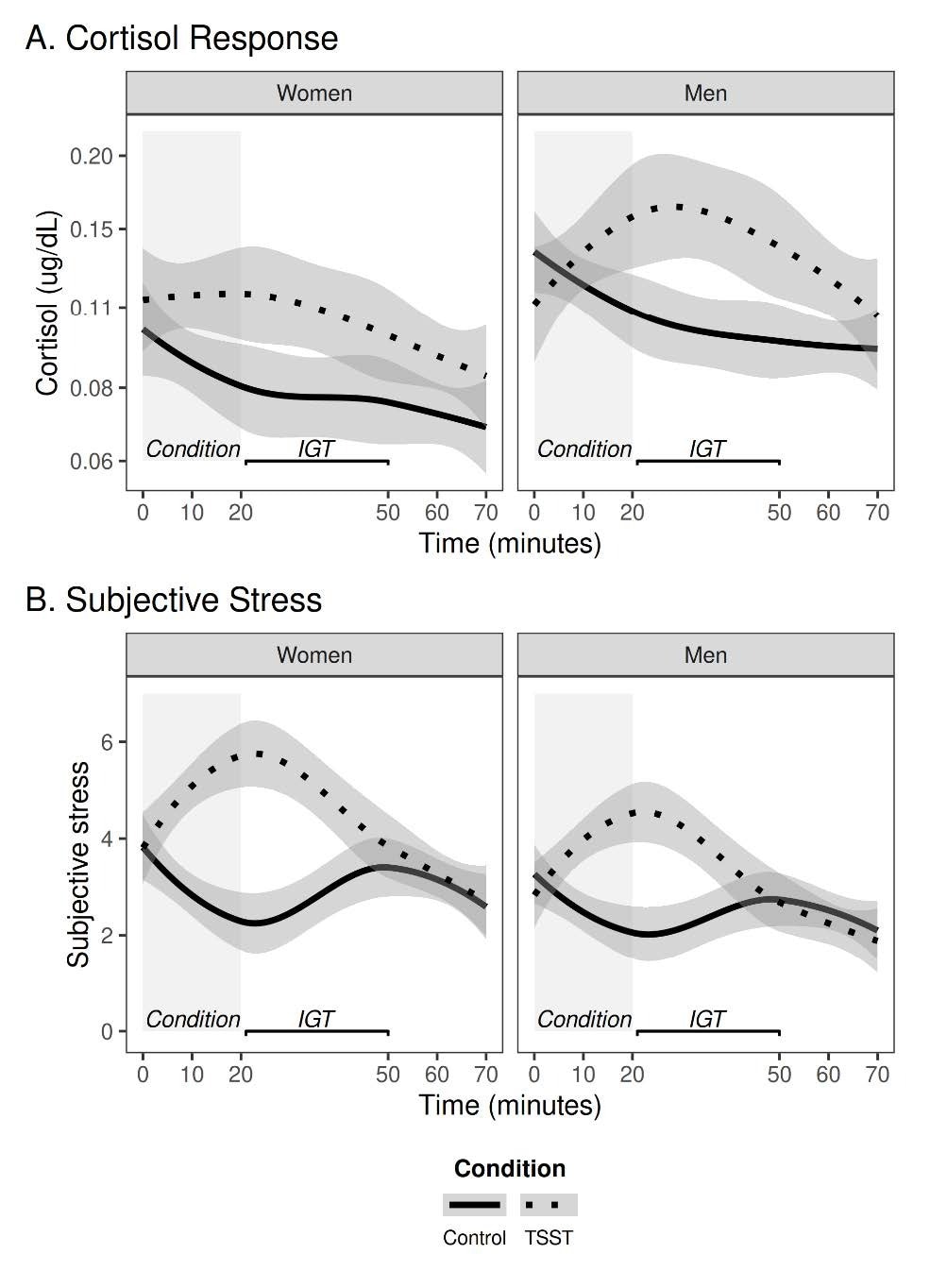
Cortisol reactivity (A) and subjective stress (B) response to the experimental conditions stratified by sex. Cortisol values are in ug/dL and the cortisol y-axis is in the log scale. Subjective stress was reported on a scale from 1 (no stress) to 10 (extreme stress). The shaded ribbons represent 95% CI for the estimated mean trend based on the raw values. The tick marks on the x-axis represent the six timepoints when saliva samples and subjective stress were recorded. Time 0 was the time point immediately before beginning the TSST (i.e., before the anticipation phase). TSST = Trier Social Stress Task. IGT = Iowa Gambling Task.
Subjective stress levels were higher in both sexes 10 and 20 minutes after TSST onset compared to controls. The TSST group showed greater cortisol reactivity than controls, with men exhibiting stronger responses than women. However, assignment to the TSST did not significantly alter overall IGT performance. Notably, women drew more cards from risky decks than men in the final two task blocks. Men took fewer risks as the task progressed in both conditions, while women did not exhibit reduced risk-taking in either condition.
Women in the control condition showed a non-significant tendency toward greater anticipatory intra-individual SCR before drawing cards from risky decks than from safe decks in the second block, whereas men showed significantly greater responses before risky choices in the third and fourth blocks.
In the TSST condition, there were no differences in intra-individual SCR in relation to deck selection, except for women near the end of the task, when it was higher before picking cards from risky decks than from safe decks.
The relationship between cortisol, physiological signals, and changing risk-taking patterns appeared to differ between men and women, although the statistical evidence for this sex difference was borderline.
In women, intra-individual SCR and cortisol reactivity showed no interactions. Women with higher cortisol reactivity drew fewer cards from risky decks in the first block than women with lower reactivity, and did not change their risk-taking levels over the course of the task.
Meanwhile, women with lower cortisol reactivity made fewer risky choices as the task progressed. Conversely, there were interactions between intra-individual SCR and cortisol reactivity in men, which changed as the task progressed.
At both high and low cortisol reactivity levels, men reduced their risky choices as the task progressed. A one-standard-deviation (SD) increase in intra-individual SCR before a given draw was associated with higher risk-taking early in the task for men with low cortisol reactivity; this relationship tended to reverse by the end of the task. For men with high levels of cortisol reactivity, a one SD increase in intra-individual SCR was associated with lower risk-taking early in the task.
Conclusions
In summary, cortisol reactivity to a psychosocial stressor moderated the association between anticipatory somatic markers and decision-making in a sex-specific manner, with the significant SCR-related pattern observed only in men. Acute stress may alter risk-taking processes through cortisol’s disruptive action on affective somatic markers, primarily in men. IGT performance of women may reflect distinct moderating factors.
The findings should be interpreted in light of the study’s sample of 109 healthy young adults, the potential confounding effect of hormonal contraceptive use, changes in physiological stress responses during the 25-minute IGT, and SCRs measuring arousal rather than emotional valence.
Overall, these results suggest that cortisol may distort how anticipatory bodily signals influence risky decisions in men, rather than showing that stress universally increases risk-taking.
Journal reference:
- Duplessis-Marcotte, F., Magnon, V., & Marin, M. F. (2026). Stress-induced cortisol clouds the gut feeling in decision-making: A randomized controlled study. Scientific Reports. DOI: 10.1038/s41598-026-65255-4, https://www.nature.com/articles/s41598-026-65255-4