West Virginia University investigates how the solar wind and space weather interact with planets, using space plasma physics to uncover new insights into the Zwan-Wolf effect at Mars.
All of the stars in our Universe emit continuous streams of energetic particles outward into their host stellar systems. These streams are known as stellar winds, and the particles they are comprised from are special: they are charged particles. Charged particles, known as ‘ions’, are atoms and molecules that have had one or more of their electrons stripped away, leaving them a net positive charge. These ions, and the stripped away electrons, can be emitted at high speed from their stars, making them a form of radiation that can be dangerous to robotic and human explorers.
The stellar wind from our Sun is called the solar wind: it’s comprised of about 95% protons, 5% doubly charged helium, and trace amounts of what are known as heavier elements, which includes carbon, oxygen and iron ions. These ions are emitted at an average speed of about 400 km/s (1 million miles per hour!). The exact properties of each stellar wind are unique to each star.
As the solar wind flows outward into our solar system, it will encounter various objects in its path that it will have to flow around, including planets, comets and moons (collectively known as ‘solar system bodies’). An analogy is a rock in a stream of flowing water on Earth: the water represents the flowing solar wind, and the rock represents one of the planets in our solar system.
Because the water is relatively dense, physical collisions between water molecules and the rock control how the water flows about that rock. In essence, the water molecules continuously bump into each other and the rock, and that bumping determines how the molecules flow around the rock.
In space, things are different: space is tenuous (not very dense), and this means that the charged particles in our solar wind do not physically collide with each other very often, just a handful of times in their journey from the Sun to the Earth. If physical collisions don’t control how the solar wind moves around solar system bodies, what does?
This is where the study of ‘plasma physics’ comes in. Because physical collisions between particles are so rare in space, electromagnetic fields and their interactions with the charged particles of the solar wind control the motion of these particles. Instead of bumping around into each other, the particles are instead pushed and pulled by electric and magnetic fields. The study of plasma physics in space is called (perhaps unsurprisingly) ‘space plasma physics.’
In our Earth analogy, the water flows around the rock and continues on its way, but things can get a bit more complicated in space. Many factors, including the size of the body, whether it possesses a strong magnetic field and/or an atmosphere, can all impact how the solar wind flows around that body. In some cases, the solar wind can even be channelled into a planet’s atmosphere – this is how the aurora are produced on Earth – but that’s another story for another time. Plasma physics is crucial to understanding all of these phenomena.
What is space weather and why is it important?
On Earth, the flow of water in a stream is not exactly the same on any given day: the water may flow faster on some days compared to others, and the total amount of water flowing at any given time (known as the discharge, or flow rate) can also change. Sudden changes in the flow rate are typically tied to changes in the weather: a torrential downpour may lead to much more water flowing much faster downstream. The same idea is true for our Sun and the solar wind: while the average speed is around 400 km/s, that can vary considerably and can reach over 1000 km/s in extreme cases. These changes are driven by processes within the Sun itself. Of importance here is that, just with water in a stream on Earth, sudden surges in the solar wind flow can be dangerous: in this case for humans and our space infrastructure. Astronauts can be exposed to life-threatening levels of radiation in short periods of time; satellites can be damaged or even permanently disabled; communication infrastructure, such as Global Positioning Systems (GPS), can become subject to significant errors; power grids can be disrupted or damaged, causing power blackouts. In analogy to Earth, these extreme solar events have been termed ‘space weather’ events.
The topic of space weather, then, can be viewed as one big puzzle that is comprised of many parts. Solar physicists study how the extreme events manifest in the Sun (similar to how a tropical storm may form over the ocean). Space physicists attempt to understand how such events travel through the solar system (similar to how the tropical storm might travel across the ocean and make land fall). Space physicists and planetary scientists aim to understand the impact of these space weather events on the planets and other bodes in our solar system (similar to determining how much rain may fall once the tropical storm makes landfall). Understanding space weather is thus a complex task that requires many scientific fields of study to collaborate and contribute their ‘piece of the puzzle’ to the overall jigsaw.
Space weather at Mars
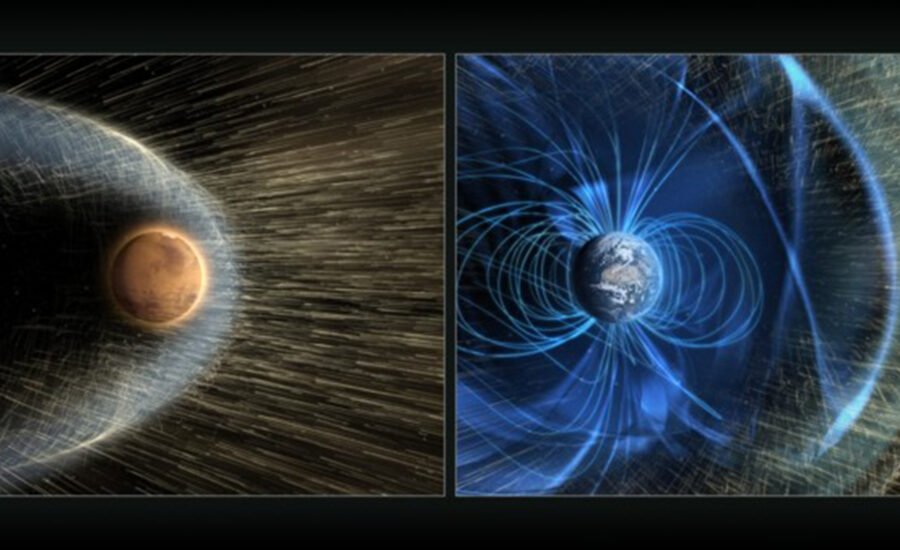
In December 2023, a large space weather event, known as a coronal mass ejection, erupted from the Sun and a few days later collided with the planet Mars. This collision resulted in a process known as the ‘Zwan-Wolf effect’ occurring in Mars’ atmosphere, which was observed by NASA’s Mars Atmosphere and Volatile EvolutioN (MAVEN) spacecraft. The Zwan-Wolf effect occurs when magnetic field lines are compressed and charged particles are squeezed along them, similar to squeezing toothpaste out of a tube. To understand the novelty of this at Mars, we have to take a brief detour to talk about ‘planetary magnetospheres.’ Planetary magnetospheres are the regions of space around planets where the influence of that planet is felt. At Earth, this region is controlled by what is known as the ‘planetary dipole magnetic field.’ This dipole field exerts an influence spanning tens of thousands of kilometres around the Earth and is the reason a compass points northward. When the flowing solar wind encounters this dipole field, it pushes against it. The Zwan-Wolf effect is one of several processes that act to move the solar wind plasma around and past the edges of the magnetosphere – effectively squeezing the flowing water of the stream around our rock.
Mars is, however, different to Earth: it does not possess a dipole magnetic field (a compass held on Mars would not point northward!) and the solar wind can push right up against the planet’s atmosphere. During the December 2023 space weather event, this pushing was able to squeeze charged particles within the atmosphere itself – something that had not been observed before and is likely unique to planets like Mars that do not possess their own dipole magnetic fields.
How is this Zwan-Wolf effect at Mars connected to space weather? The space weather event made this observable at Mars: the Zwan-Wolf effect is actually probably always occurring in Mars’ atmosphere, but at such small levels that past and current scientific instruments are not sensitive enough to detect it. The impact of the space weather event amplified the effect, making it observable by the MAVEN spacecraft.
Similar to tropical storms here on Earth, space weather events are a rare occurrence. However, when they do occur, they can have large impacts on our solar system and the bodies within it. Understanding how these events impact Mars is just one piece of the space weather jigsaw puzzle.
Please Note: This is a Commercial Profile