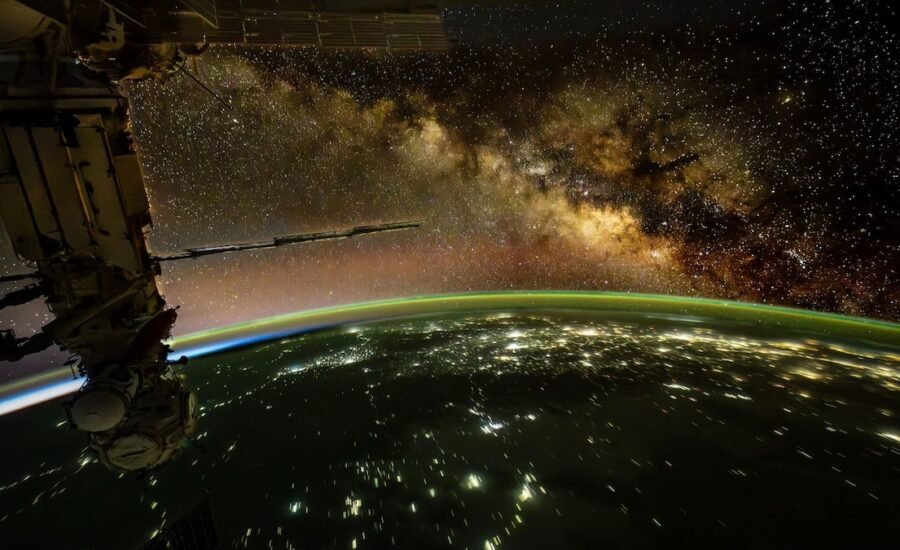
The image, taken using a custom-built camera system and advanced star-tracking technology, has quickly gone viral on social media.
Milky Way captured from the ISS
Pettit shared the photograph on X, revealing that it was one of 1.2 million RAW image files from his latest mission aboard the ISS. The image was taken from the Cupola, the space station’s observation module with seven panoramic windows overlooking Earth and space.
How the image was captured
To photograph the Milky Way, Pettit used a Nikon Z9 camera fitted with a 15 mm Arri Zeiss lens at a T1.8 aperture, allowing more light to reach the camera’s sensor.
The setup included a custom sidereal drive that cancelled out the ISS’s orbital motion, allowing distant stars to be captured as fixed points.
Sharing the image, Pettit wrote, “I finally have all 1.2 million raw image files from my latest mission to ISS! Here is a sample of one of my favorite Milky Way photos.”
Many have asked how this photo was made. This is my explanation.
The ISS rotates about its pitch axis as it orbits Earth at 17,000mph to keep its nadir view constant. Because of this long exposure photography turns stars into arced lines.
Sidereal clock drives on Earth match… https://t.co/SWMWmoD94r pic.twitter.com/9DhcPuBbao
— Don Pettit (@astro_Pettit) August 1, 2026
How the custom tracker worked
After many asked how the photograph was taken, Pettit explained that the ISS travels around Earth at nearly 17,000 mph while constantly rotating to keep its view pointed toward Earth. According to Pettit, the ISS’s orbital motion causes long-exposure images to capture stars as arced lines.
To overcome this, a custom camera mount was built at the Rochester Institute of Technology (RIT). The mount rotated once every 90 minutes, cancelling out the ISS’s orbital motion and allowing distant stars to be captured as fixed points.
ALSO READ | Watch: ESA astronaut captures spectacular green aurora from the International Space Station
Pettit said it was a rotational coil spring-powered analogue star tracker, machined from aluminium and built entirely without electronics to meet NASA’s cargo requirements. “After Expedition 72 it was safely returned to Earth and is to be displayed at RIT. Photography is an important part of sharing the journey to new frontiers for all people of Earth!” he added.
Internet reacts
The photograph has since attracted more than seven million views on X, with users praising both its beauty and the engineering behind it.
One user called it “one of the most historic photographs ever taken by a human,” while another described it as “stunning”.
A third user said, “Woah … how does it feel to witness something like that in real time? I can’t even imagine. Thank you for thoroughly documenting the experience for all of us to enjoy. That is incredible.” “This is the most beautiful space photo I’ve seen in a long time. Thank you,” another added.