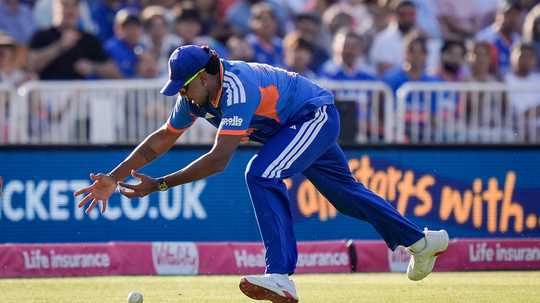
In T Dilip and Ryan ten Doeschate, India had no shortage of fielding expertise in their coaching setup, yet fielding has become the team’s Achilles Heel in recent times. Their catching efficiency dipped abysmally: so much so, that even Zimbabwe – ranked 12th in T20Is – outperformed Gautam Gambhir’s side on that measure. Poor catching wasn’t necessarily the sole reason for India’s disappointing tour of the UK recently, but there is little doubt that the team has slipped from its once-enviablestatus as one of the top three fielding sides in the world.
R Sridhar, former India fielding coach, under whom the team developed into one of the world’s finest outfits, says: “Fielding is part of a team’s culture; it cannot be developed overnight. The most important ingredient is the players’ desire to become good fielders. For a fielding coach to build a top-class fielding unit, they needs time to work with the players. If you only have two or three days to prepare before a series, it becomes extremely difficult”.
Sridhar adds, “While it is the coach’s responsibility to prepare and plan, the ownership ultimately rests with the players.”
That, in turn, raises an obvious question: how many of the current new-generation cricketers are genuinely committed to improving their fielding? There has been some chatter that during the recent four-team multi-day emerging sides tournament involving 64 players at the BCCI’s Centre of Excellence (CoE), several players frequently sought reasons to leave the field.

Former India fielding coach R Sridhar feels frequent change in personnel can be a challenge ©Getty
Beyond the question of intent, the numbers also paint a worrying picture. Since June, India have dropped 28 catches across their men’s international fixtures: four in the Test against Afghanistan, one in the ODI series against Afghanistan, six in the two T20Is in Ireland, five in the five-match T20I series against England, two in the ODIs against England and 10 in the three T20Is against Zimbabwe. The overall catching efficiency during this period stood at a modest 76.8 per cent.
The Zimbabwe series, in particular, exposed India’s fielding frailties. The visitors managed a catching efficiency of just 64.2 per cent, taking 18 catches while spilling 10. Zimbabwe, in contrast, recorded an impressive 92.3 per cent, taking 12 catches and dropping only one. It was not just catching; there were instances of runs not being stopped and throws going awry.
Sridhar also underscored another factor affecting fielding standards. “Frequent changes in personnel are another challenge. It is difficult to devise player-specific and position-specific fielding plans or assign specialised roles when the playing XI keeps changing. Ultimately, though, it all comes down to fitness. The fitter the player, the better the fielder,” he said.
The frequent change of personnel lends credence to Sridhar’s point. Since the end of IPL 2026, India have used 35 players across 17 internationals in all three formats. The breakdown comprises 20 players in 10 T20Is, 18 in six ODIs, besides the XI that featured in the one-off Test against Afghanistan.The constant changes have also seen eight players make their international debuts during this period.
Fielding, of course, will be an important factor in Sri Lanka where India play two Tests. With spin expected to be the dominating factor, close-in fielding and slip catching will be crucial, making it a challenging first assignment for new fielding coach Subhadeep Ghosh.
Circling back to ten Doeschate and Dilip: one has already joined an IPL franchise, while the other is expected to sign with one soon. While ten Doeschate has been appointed Head of Strategy at Kolkata Knight Riders, he is also expected to oversee the franchise’s fielding programme in the IPL. He may not necessarily be part of the dugout during matches, but is likely to fill the void left by Dishant Yagnik, who has moved to the BCCI’s Centre of Excellence (CoE).
As for Dilip, whose contract was not renewed by the BCCI, he is unlikely to remain out of work for long. Having received unequivocal backing from Rohit Sharma, the former India fielding coach is expected to land an IPL role soon. It is learnt that he is in talks with a few franchises that have multiple teams across leagues, which means he is likely to remain just as busy as he was with the Indian team.
‘Indian players don’t spend as much time on fielding as their primary skills’
Former Irish player John Mooney, fielding coach of Delhi Capitals and currently coaching the Southern Brave side in the Hundred, has also overseen international teams including Afghanistan and West Indies. He weighs in on the subject and reflects on what makes an excellent fielder, builds a good fielding side and what ails Indian fielding.
What does it take to be a good fielding side?
It’s an interesting question because humans are humans and they are always vulnerable to mistakes. A good fielding side can still have bad days. But ultimately, I think a good fielding side is made up of 11 players who are willing to fight for each other and do whatever it takes to be competitive and save every single run.
I always talk about the value of one run. If every fielder who goes out on the field says, ‘I’m going to save one run today,’ I think that’s a really powerful message. It’s not always possible, but if everybody goes out with that mindset — ‘I’m going to do something today in the field that will save one run. I’m going to be disciplined, do what I have to do and stay focused’ — then, if all 11 players are in that frame of mind, that is what produces a good fielding side.
As a fielding coach, what do you tell the players?
A lot of it is done one-on-one, if I’m being honest. It’s about getting into the players’ minds and understanding how they deal with pressure. Even if you’re playing cricket in a park or just for the love of the game, you have much more time to think about taking a catch than you do to hit a bowler for four or six, or to bowl a ball. Those things happen in a split second, but with catching you often have two, three or even four seconds to think as the ball comes towards you. Sometimes it’s instinctive, but other times it’s a high catch.
The key is understanding a player’s mindset and what goes through his mind in that situation. What I tell each player is specific to him, because some are naturally good fielders while others aren’t. Some are naturally nervous, while others are very confident. So the message is different for every player.
Technique is the most important thing. If a player has good technique, he generally has all the basics in place to do what he has to do. But if a player has poor technique and lacks confidence, you have to spend more time with him. You have to give him mental cues — what should be going through his mind and how he should deal with that pressure. It’s a very individual process. Generally, you’re telling players to believe in themselves, be as confident as they can and trust their technique.
How much is fitness an aspect in fielding?
Fitness is certainly an aspect, but in my opinion the most important thing is mental discipline — your mindset. Take a fast bowler, for example. He might have just finished an over and moved to a 45-degree position because he may not be the strongest fielder. That’s often a position where the ball comes very quickly.
In those situations, fitness isn’t really the issue. The question is whether the player is still thinking about the over he has just bowled or whether he has put it behind him and is ready for the next ball. The most important thing is to be ready for the next ball.
Fitness matters because you want to be as quick and as strong as possible, so you can get to the ball quickly and throw it hard. But my philosophy is that cricket is a beautiful game because not everybody is at the same level of fitness. In a 50-over game, players obviously need to be fit, but ultimately you have to be mentally strong enough to do the right thing. You have to be in the right frame of mind, expecting the ball to come to you every time. That’s a mental thing, not a fitness thing. It’s all about the mental side of the game.
What are the key problems with the Indian team?
Look, there are some really good coaches in India and with the Indian team, and I don’t want to get into nitpicking. But from my experience, I believe Indian players spend a great deal of time honing their primary skills — batting and bowling. They devote a lot of time to those areas.
What I don’t believe — and this is just my opinion — is that they give fielding the attention it deserves. A top-order batter might spend an hour in the nets, sometimes even two hours if there are enough bowlers, and then spend only five minutes on fielding.
I think the disparity between working on their core skills and working on their fielding is simply too great. I would love to see players commit more time to their fielding because it is an area where you can get exposed. When you’re playing for your country, the team has to come first, not the individual.
Players naturally focus on improving their batting or bowling, but in the process they can sometimes neglect their fielding. That’s just my opinion. I believe training should be more proportionate. If a player spends an hour or an hour and 20 minutes in the nets during a two-hour session, then he should also devote another 10 to 20 per cent of that time to fielding to ensure he is properly prepared. I feel some players are simply not willing to do that.

Mooney: ‘Disparity between working on core skills and fielding is simply too great’ ©IPL
Is it a technique, skill or mental issue?
It’s all combined and interconnected. Obviously, you need the skill because catching a cricket ball isn’t easy. Even something as simple as picking up a ball rolling towards you can become difficult if you’re playing in a packed stadium, in a big match, with a lot on the line.
So you need the skill and you need the technique. Then you need the mental awareness to understand what you’re doing and be comfortable doing it. Younger players often struggle because they haven’t experienced big stadiums, big crowds or high-pressure games. But the more you play, whether it’s tournaments or international cricket, the more comfortable you become and the stronger your mental state gets.
Fundamentally, though, if you don’t have the technique and you don’t have confidence in yourself, you’re going to come unstuck. It starts with skill, then technique, and finally the mental side of the game. The question is whether you’re mentally strong enough to take that catch, effect that run-out or simply do the right thing.
How different are skillsets for catching, fielding and throwing?
They’re all very individual and they’re all different. My simple philosophy on catching is that, whenever possible, you want to get yourself into a still position. You want to be waiting for the ball rather than moving while you’re catching it. If you’re fielding in the covers and the ball is hit hard at you, you want both feet on the ground, a strong base and to be in a position to receive the ball cleanly.
If it’s a high catch, you want to make up the ground quickly, get into position early and be waiting for the ball. That’s my philosophy on catching. It’s not always possible because cricket is a beautiful game and it throws up surprises all the time. But that’s what you’re striving for. My philosophy is to make things as easy as possible for yourself because, if you do that, the results will usually follow.
When it comes to ground fielding, footwork is absolutely everything. The players with the quickest and best footwork, who get themselves into the right positions, will almost always produce the best results.
Throwing is another area that’s a bit of a bugbear for me, especially in Ireland. I can’t speak specifically about India, but I don’t think we spend enough time teaching youngsters how to throw the ball properly. Take baseball, for example. In my opinion, fielding in baseball is more limited than in cricket. Cricket fielders have far more to think about and far more to do. But one thing they do exceptionally well in America is teach children how to throw from a very young age. As a result, they all develop really strong throwing arms.
I just feel we neglect that aspect a little in our training and even in our warm-ups. Throwing should be a fundamental part of a youngster’s development. By the time a player is 17 or 18 and perhaps makes a state or international team, that work should already have been done by junior coaches. He should be capable of producing a really powerful throw by then. That foundation should be laid early in a player’s development, but I don’t see that happening consistently around the world.
Is poor fielding a new-generation thing?
I don’t want to label any particular generation. But I do feel social media and similar distractions have affected the attention spans of many young people. Cricket is a game of concentration. It’s a game of skill. It’s a game of wits. There is so much involved in playing the game. In my opinion, social media has definitely had an impact on the attention span of this generation. I’m sure there’s scientific research on it, although I can’t say that for a fact. That’s simply my opinion.
When I was playing, we didn’t have those distractions. We spent time together as a group, even on the team bus. If you get on a team bus now, there’s very little conversation or sharing of ideas. Everybody is in their own bubble, looking at their phones with earphones on.
People will say that 30 years ago we didn’t do that. We were more alert and more engaged with the game. As for the younger generation, it’s not their fault. It’s simply the world they have grown up in.
It is said that fielding is a cultural thing…
I would 100 per cent agree with that thought. Our team culture in Ireland was built around the belief that we were never going to out-skill Australia or India at cricket. But what we could do was outfield them, or at least match them in the field. That was a fundamental part of our culture.
It’s certainly a culture in New Zealand cricket, and it’s a culture in Australian cricket. South African cricket has always been renowned for it as well. When South Africa returned to international cricket, they were just amazing on the field. I was a teenager then, and I still remember watching them. The energy they brought to the field was what made them different.
It is 100 per cent a matter of culture. And that goes back to my earlier point. I’m not just talking about Indian players; I’d extend it to much of Asian cricket. Players spend a great deal of time working on their individual skills and, potentially, not enough time on their fielding.
Why are Indian fast bowlers not generally great athletes?
My opinion is this, and I’ll use Mitchell Starc as an example. I worked with Mitchell at Delhi in the IPL. Believe it or not, he was a wicketkeeper when he was a kid before growing into one of the world’s premier fast bowlers. But he’s also an unbelievably skilled fielder. His catching technique is outstanding and, above all, he has a real desire to win.
That goes back to his childhood. As a youngster, Mitchell always wanted to be involved in the game. He wanted to field and do everything. More broadly, if you take a typical Australian cricketer, he has probably also played rugby, hockey, soccer or Australian Rules football while growing up.
Playing a variety of sports during your formative years teaches you a lot. It improves your peripheral vision, your speed and your ability to move in different directions — sideways, backwards and forwards. Cricket, by comparison, is a very linear game.
I feel many South Asian players grow up playing only cricket and not enough other sports. In my opinion, that can hold back their development as fielders. It’s not their fault; it’s simply the culture they grow up in. South Asian players are exceptionally skilled cricketers, but if I asked Mitchell Starc to kick or catch an Australian Rules football, I know he’d be able to do it because he grew up playing a variety of sports. That broad sporting background helped make him the outstanding fielder he became. I have to say, I was genuinely surprised by just how good he was in the field.
Take someone like Mohammed Siraj. I don’t know his background, so I can’t say this for certain, but I doubt he grew up playing four or five different sports at school. He probably focused mainly on cricket. I don’t know that for a fact, but that’s my impression.