Title: Reionization driven by the few: the ionizing budget of galaxies at z=5-10 from JWST/NIRSpec
Authors: Emma Giovinazzo, Pascal A. Oesch, Anne Verhamme, Romain A. Meyer, Callum Witten, John Chisholm, Rui Marques-Chaves, Charlotte Simmonds
First Author’s Institution: Department of Astronomy, University of Geneva
Status: Submitted to Astronomy & Astrophysics [open access]
Intro to Reionization
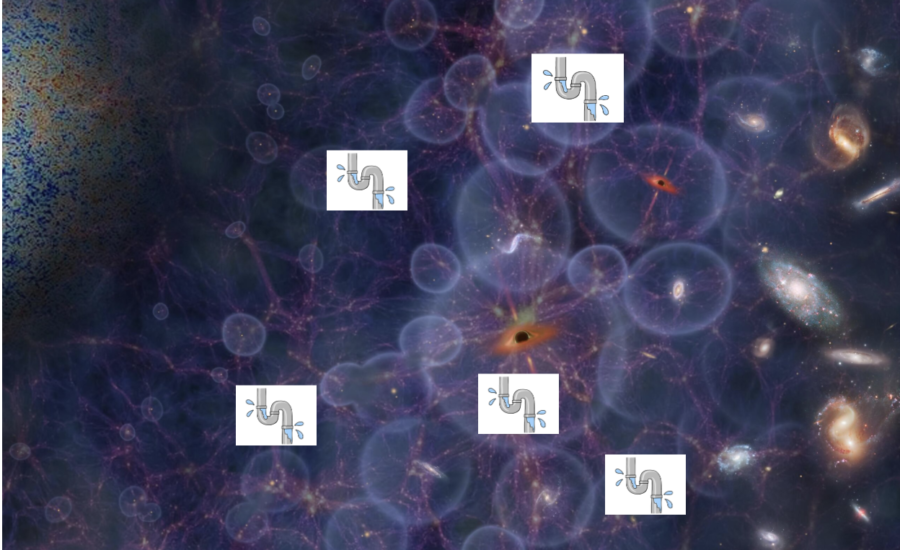
Sometime during the Universe’s first billion years, hydrogen gradually went from being completely neutral to completely ionized (losing an electron). This transition is known as the epoch of reionization, beginning with the formation of the first stars and galaxies. Reionization is likely driven by star-forming galaxies and is expected to be “patchy”: bubbles of ionized gas form and grow around objects that leak the most photons.
The exact details of how reionization occurred are largely unknown. In the simplest patchy model, we can think of three dependencies that would affect how fast reionization happened:
- 1. The number of galaxies with the ability to produce high-energy ionizing photons (ρUV)
- 2. How efficiently galaxies can produce those photons (ξion)
- 3. How many of those photons actually escape the galaxy and affect the intergalactic medium (fesc)

Weak vs Strong Leakers
JWST has measured Quantity #1 and #2 decently well, but Quantity #3, called the escape fraction, is the wild card. It is impossible to measure directly since these photons are absorbed by neutral hydrogen and never reach us. Fortunately, all is not lost; when photons are absorbed, they create an emission line. This appears to us as galaxies with high escape fractions having weaker nebular emission lines than expected given the stars they contain. The authors of today’s paper examine 1428 sources observed with the James Webb Space Telescope (JWST) using the NIRSpec/PRISM instruments and place new constraints on the timeline of reionization.
Unsurprisingly, brighter galaxies tend to emit more ionizing photons overall since they contain more stars. The authors find a more interesting result at fixed brightness—galaxies with high escape fractions deliver ~30 times more ionizing photons into the intergalactic medium than galaxies with low escape fractions. The authors call these two groups strong leakers (fesc > 10%) and weak leakers (fesc < 10%), making up about 20% and 80% of the sample, respectively.

Who Won?
A natural question with the discovery of these two groups is which group actually reionized the universe … a small population of strong leakers or a large population of weak leakers? The authors resolve this by mapping the 1428 galaxies onto a complete population of early galaxies from other surveys. Then, they determine the neutral hydrogen fraction as a function of time and find that reionization ends at about z = 5.7 (~12.5 billion years ago). This result is consistent with measurements with Planck, which observed the Cosmic Microwave Background.
Giovinazzo et al. repeat this process, but instead test the strong and weak leakers separately. Ultimately, they find that strong leakers alone reproduce nearly the full reionization history, while weak leakers have barely any effect!

So reionization wasn’t a group effort. A small minority of galaxies (about 20%) supplied nearly 90% of the photons that reionized the Universe. This result could have impacts on how we observe reionization: perhaps we should look for rare leaky galaxies, not the many ordinary ones. To understand the drivers of reionization, we will have to measure fesc with faint galaxies beyond current spectroscopic limits, eventually with the Extremely Large Telescope.
Astrobite edited by Munira Hoosain
Featured image credit: Jingchuan Yu, Beijing Planetarium