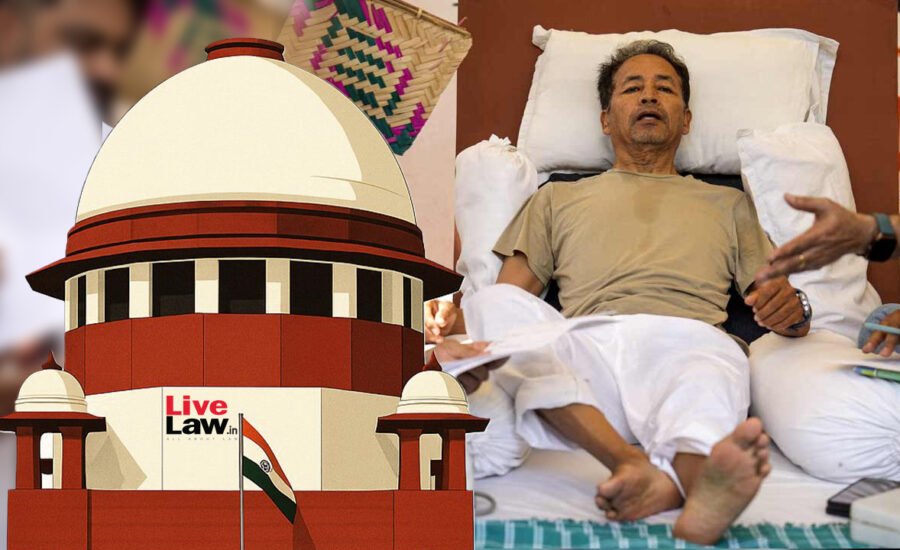
The Supreme Court on Wednesday refused to entertain a writ petition challenging a resolution passed by the Executive Committee of the Supreme Court Bar Association expressing solidarity with the hunger strike held by Sonam Wangchuk in support of the student protests over the exam paper leak issue.
The Court disposed of the petition, giving liberty to the petitioner to pursue “democratic processes” available as per the SCBA Rules. When the petitioner pointed out that the Executive Committee was no longer in existence, the Court clarified that the Election Committee can be approached.
The bench comprising Chief Justice of India Surya Kant, Justice Joymalya Bagchi, and Justice V Mohana observed that it will be a dangerous precedent if the Court interferes with the views expressed by the Bar Association. Members having a contrary opinion can call for another general body meeting to express their views, the bench suggested, expressing reluctance to interfere in the issue.


The petitioner Ashish Gopal Garg submitted that the Executive Committee passed a resolution in a politically contentious matter, giving an impression that it was the view of the entire Association. The petitioner also argued that the Executive Committee had no authority to pass such a resolution, since it has become “Functus Officio” after the declaration of the next elections.
“They should not pass such a resolution; they have become functus officio. Personal ideology is being passed as an SCBA resolution,” the petitioner’s counsel submitted.
Justice Bagchi, expressing that it was an “internal affair” of the Association, said, “There is a distinction between an undemocratic decision and an illegal decision. If this is an undemocratic decision, your remedy is to go to the floor and ask for a General Body Meeting. If you don’t hold a GBM, come to us, then that is illegal.”
The petitioner said that since the elections are due, a contrary resolution can be passed only by another EC. “This has to be withdrawn by this EC,” the counsel submitted. The petitioner argued that the resolution was passed hastily in a matter of 1-2 hours.
Referring to an annexure of the petition, the CJI said that 37 persons have already come forward saying that this resolution should not have been passed. “Then you go for the requisite strength[for a general body]. It is a democratic process. You should call a general body, that is the appropriate recourse. Resolve among yourselves,” the Chief Justice of India said.
When the petitioner argued that the present EC should be restrained from passing such resolutions, Justice Bagchi warned that it can set a dangerous precedent. “Sir, please understand. One stance taken by us, because you did not like a resolution, will actually set a wrong precedent with regard to the democratic character of your Bar. It is the freedom of the bar; we will not interfere,” the Judge said.
The petitioner contended that the resolution gave an impression that the opinion of a few was the opinion of the entire bar. “Individual opinion cannot be thrust on the entire bar. If they are going to praise Sonam Wangchuk, we are not going to accept that,” he said. Justice Bagchi then said, “Please do not use the word ‘we’. Because you also do not represent the entire bar.”
“It will be a dangerous precedent if we interfere in the democratic process of a bar association, having a view and a counter-view, and having the dialectics which democracy will always encourage,” Justice Bagchi said.
The petitioner objected to the resolution’s language that “institutional conscience has not responded with the urgency and sensitivity” to Wangchuk’s strike, and urged the bench to direct the calling of a General Body Meeting. The bench flatly said that it will not pass such a direction.
When the petitioner urged the bench to restrain the EC from passing such a resolution, the CJI said that the Court cannot speculate what type of resolutions they will pass in the future. “You decide in the bar association hall. Get the requisite signatures and move for a meeting,” the CJI said. When the petitioner said that the EC was no longer in existence, the CJI said that the Election Committee can be approached.
The bench reiterated the suggestion that the petitioner explore the convening of a GBM to discuss the matter.
The bench ultimately disposed of the writ petition with the following observation :
“While we are not inclined to entertain the petition, liberty is granted to the petitioner to explore the democratic processes as prescribed under the SCBA Rules, including the Election Committee.”
Case : ASHISH GOPAL GARG Vs SUPREME COURT BAR ASSOCIATION | W.P.(C) No. 948/2026