NASA Marshall Space Flight Center has awarded Phase3D a role in a new program aimed at proving that metal additively manufactured parts can be qualified for spaceflight during production.
The program will generate more than 50,000 individually inspected build layers on a production-scale EOS M300-4 quad-laser system, creating one of the largest in-situ inspection datasets ever assembled for metal additive manufacturing qualification research.
The scale of the dataset matters because the problem it addresses is not inspection. It is time. NASA estimates that qualifying a single flight-critical additively manufactured component currently takes more than 18 months.
The program NASA has structured around this problem pairs Phase3D with a confidential U.S. aerospace prime and space propulsion manufacturer. Its focus is topology-optimized Invar 36 brackets representative of the structural components that fly on spacecraft. Phase3D will deploy Fringe Inspection and Fringe Qualification on the EOS system.
Fringe Inspection uses structured green light projection to capture calibrated 3D height measurements after every powder layer and laser exposure, while Fringe Qualification aggregates that data across machines, facilities, and production programs into unified qualification workflows.

Testing Born Qualified Manufacturing
What those two systems produce together is a continuous measurement record of the entire build. The central question the program is trying to answer is whether that record, assembled from thousands of layer-by-layer measurements taken during production, can be reliably correlated with the results of post-build CT scanning.
If the correlation holds at scale, manufacturers could define quantitative go/no-go thresholds that support qualification decisions in real time. That is the core of what NASA calls “born qualified” manufacturing.
The specific process disturbances Fringe Inspection is designed to catch are the kinds that currently remain invisible until post-build testing. The system measures powder spreading irregularities, recoater blade interactions, layer shifts, melt pool abnormalities, spatter accumulation, delamination, and unexpected surface height variation.
Because those measurements are captured at every layer, engineers can see when and where a deviation occurred, not just that one exists somewhere in the finished part.
None of this is starting from scratch. Previous collaborative research between Phase3D and NASA Marshall demonstrated correlation between Fringe Inspection measurements and CT-detected porosity. Separate studies conducted with the US Air Force Research Laboratory (AFRL) showed close agreement between layer-wise anomalies flagged during production and defects identified in post-build analysis. The current program is intended to validate those earlier findings at production scale, on a multi-laser machine that reflects the equipment manufacturers are actually deploying.
That is where the choice of the EOS M300-4 becomes relevant. The system combines a large build volume with four independent lasers, and it is increasingly the platform aerospace and defense contractors are installing for production work. Proving that real-time qualification functions reliably on a machine of this class is a different proposition from demonstrating it on a single-laser research system with a small build chamber.
The work is structured around NASA Civil Space Shortfalls 1490 through 1494, a set of identified capability gaps covering in-situ monitoring, process qualification, and qualification of complex additive manufactured geometries.
It also aligns with established aerospace qualification standards including NASA-STD-6030, NASA-STD-6033, and SAE AMS7032, which define requirements for qualifying metal AM components and processes for flight applications.
Building on Earlier Validation
The current program builds on a specific evidence trail. In 2024, Phase3D validated its Fringe Research software on Ti64 for the US Air Force, 3D printed on an EOS M 290, and on GRCop-42 for NASA, printed on a Colibrium Additive M2. The Air Force tests showed 81% of in-situ anomalies correlating to CT-detected defects, with depressions larger than 47 µm.
The NASA tests showed 83% correlation, with 100% for depressions larger than 42 µm. That work was funded through an AFRL Phase I STTR contract. Later that year, Phase3D introduced Fringe Qualification at Formnext 2024, extending its inspection capability from individual machines to a centralized platform for managing in-situ quality across production fleets.
Those results explain both why this program exists and what it still needs to prove. The 100% correlation observed above specific µm thresholds provided the technical basis for NASA to test whether born qualified manufacturing can be demonstrated at production scale. But those results were generated with test geometries, not on a quad-laser production system 3D printing flight-representative brackets.
The 50,000-layer dataset is designed to answer whether those correlations hold at production scale, and if they do, to define the go/no-go criteria that would let manufacturers qualify parts during the build.
3D Printing Industry is inviting speakers for its 2026 Additive Manufacturing Applications (AMA) series, covering Energy, Healthcare, Automotive and Mobility, Aerospace, Space and Defense, and Software. Each online event focuses on real production deployments, qualification, and supply chain integration. Practitioners interested in contributing can complete the call for speakers form here.
To stay up to date with the latest 3D printing news, don’t forget to subscribe to the 3D Printing Industry newsletter or follow us on LinkedIn.
Explore the full Future of 3D Printing and Executive Survey series from 3D Printing Industry, featuring perspectives from CEOs, engineers, and industry leaders on the industrialization of additive manufacturing, 3D printing industry trends 2026, qualification, supply chains, and additive manufacturing industry analysis.
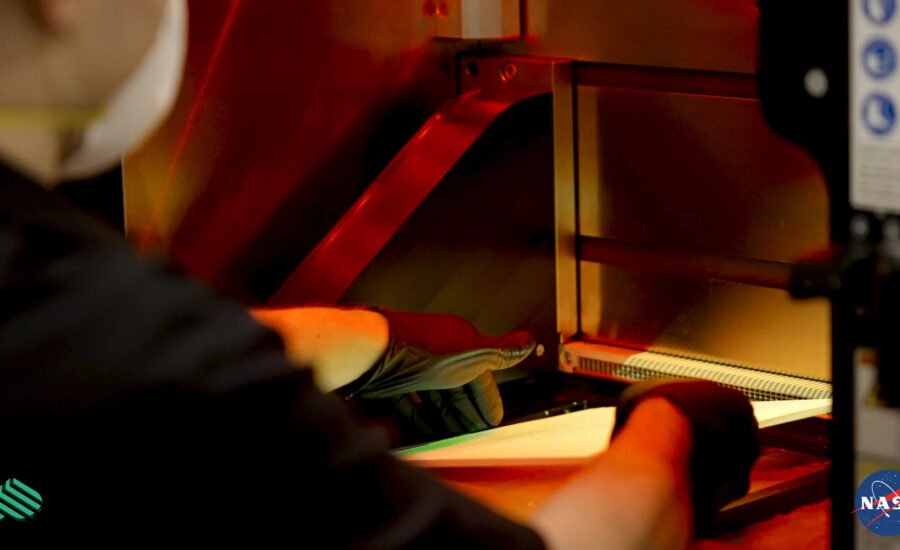
Featured image shows an engineer handling a build plate inside a 3D printer. Photo via Phase3D.