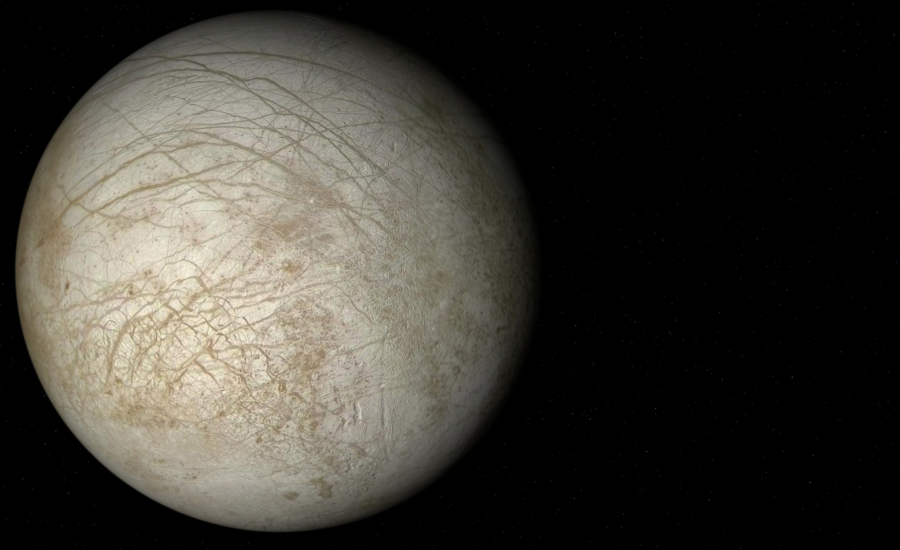
Most of the excitement about life on Europa rests on one comparison: if Earth’s deep ocean floor can host thriving colonies of life around hydrothermal vents, with no sunlight anywhere nearby, then Europa’s ocean, sealed under kilometres of ice but kept liquid by Jupiter’s gravity, might do the same. A study published this January complicates that comparison considerably, and a second paper from the same month offers Europa a different way to stay habitable that does not depend on it.
A seafloor that may simply be quiet
The first study, led by Paul Byrne at Washington University in St Louis and published in Nature Communications, modelled how much heat Europa’s interior actually generates. Jupiter’s gravity flexes the moon as it orbits, a process called tidal heating, and on Io, another Jupiter moon, that flexing is violent enough to drive constant volcanic eruptions. Byrne’s team calculated how much of that same tidal energy would reach Europa’s seafloor, using the moon’s size, internal structure and orbital mechanics as inputs, and compared the result with Earth, the Moon and other bodies.
Their answer was unglamorous. Byrne summed it up plainly: “Everything would be quiet.” The tidal forces acting on Europa’s rocky interior do not appear to be strong enough to sustain the kind of hydrothermal venting or tectonic activity that provides the chemical energy Earth’s deep sea vent ecosystems run on. That matters because those vents are the closest working example anyone has of an ecosystem with no sunlight at all, the exact scenario Europa would need. On Earth, the chemistry at a vent, hydrogen sulphide and minerals dissolved out of hot rock, gives microbes an energy source to build on instead of sunlight, and everything else in that ecosystem eventually depends on them. Byrne’s calculations do not rule out any activity at all on Europa’s seafloor, but they suggest it would be far more subdued than the vent fields that support life on Earth’s ocean floor, and possibly too weak to matter. I wrote recently about how the 1977 discovery of vent life on Earth rewrote what biologists thought life required. Byrne’s modelling suggests Europa may not have the geological engine to run the same experiment.
A different way for nutrients to get in
A second paper, by Austin Green, now a postdoctoral researcher at Virginia Tech, and Catherine Cooper of Washington State University, published in The Planetary Science Journal, approaches the habitability question from the opposite direction. Rather than asking whether the seafloor is active, it asks whether Europa’s ocean could receive what it needs from above.
Europa’s surface ice is bombarded by radiation from Jupiter’s punishing magnetic environment, which alters the chemistry of the ice and concentrates salts and other compounds near the surface. Green and Cooper modelled a process similar to crustal delamination on Earth, where dense material breaks away from a surrounding layer and sinks. Their simulations found that sufficiently salty, radiation-altered ice can become dense enough to detach from the surrounding shell and sink down through it towards the ocean below, carrying whatever chemistry it picked up on the surface with it. The process, in their models, could happen relatively quickly on geological timescales and repeat over and over, working across a wide range of salt concentrations as long as the ice has been weakened somewhat by impurities first.
Two papers, one shifted question
Put together, the two studies do not agree on much except the framing of the problem. Byrne’s work suggests the classic energy source for alien seafloor life, hydrothermal venting, may simply not exist on Europa in any meaningful way. Green and Cooper’s work suggests that even if it doesn’t, there may be another route for the raw materials of life to reach the ocean, delivered from above rather than generated below. Neither paper claims to have settled anything. Both are models built on the physical properties scientists currently believe Europa has, not direct measurements of what is actually happening under the ice, and the authors of each describe their results as one contribution to an open question rather than a final answer.
That question will not stay theoretical for much longer. NASA’s Europa Clipper spacecraft, launched in October 2024, is due to fly past Earth in December 2026 to pick up a gravity-assisted speed boost on its way to Jupiter, where it is scheduled to arrive in April 2030. Its instruments are built to measure the composition and structure of Europa’s ice shell and surface material directly, which is exactly the kind of data that would tell scientists whether Green and Cooper’s sinking brine pockets are a real mechanism or just a plausible one, and whether Byrne’s quiet seafloor is the accurate picture or an underestimate. For now, the honest state of the science is that Europa’s case for habitability rests on a genuinely open contest between two different theories, not a settled hope.
Standards
Space Daily articles are edited and fact-checked before publication. We use AI tools in the newsroom. See our editorial standards and masthead.