
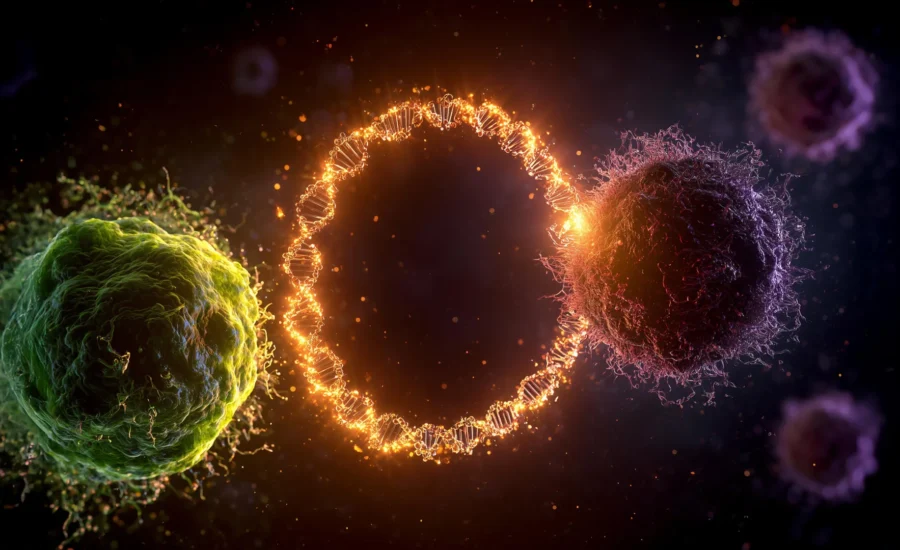
Jumping genes are genetic parasites found in bacteria, plants, animals, and humans. They can be released inside cells as small RNA molecules from ribonucleic acid (RNA), then use specialized mechanisms to insert themselves into new locations within the genetic material. These movements can give cells new traits, making jumping genes an important force in evolutionary change.
Some jumping genes can also remove themselves from RNA with the help of an RNA enzyme. These elements, known as ribozymes or self-splicing introns, represent a distinctive group of mobile genes.
Moving within a single cell is one thing. Crossing into another cell or even another species is far more difficult. Genetic family tree studies show that such transfers have occurred, but scientists have generally assumed that jumping genes traveled as passengers inside plasmids or viruses.
Jens Harder and his colleagues have now observed something unexpected that points to another possible route.
A Methane-Producing Microbial Community
The researchers studied a slowly growing enrichment of bacteria and archaea that produces methane (biogas). The community contained an unusual dominant organism, a very small predatory bacterium.
Candidatus Velamenicoccus archaeovorus feeds on microorganisms that convert limonene, the compound responsible for the scent of oranges, into methane and carbon dioxide. Within filaments of Methanothrix soehngenii, the most important methane producer on Earth, the researchers noticed that individual cells were dead.
They suspected that Ca. Velamenicoccus archaeovorus might be responsible. To test that possibility, they needed to find molecules from the predator inside the dead cells.
Searching for a Mobile Intron
While examining the genome of Ca. Velamenicoccus archaeovorus, Jens Harder identified an intron that functions as a jumping gene. Intron RNA had never been detected outside a cell, which made the researchers especially interested in looking for it inside the bacterium’s prey.
Scientists at the Max Planck Institute for Marine Microbiology had developed methods sensitive enough to detect very small amounts of RNA in bacterial cells. Using specially designed nucleic acid probes, the team produced microscopic images showing intron RNA in living cells of Ca. Velamenicoccus archaeovorus and in dead cells of Methanothrix soehngenii.
The researchers had effectively caught the intron while it was trying to replicate. However, Ca. Velamenicoccus archaeovorus had already killed the new host. The gene’s attempted transfer therefore ended as a jump into an empty cell.
Why the RNA Survived
Ribonucleic acids act as messengers in living cells. These long-chain molecules carry instructions from the genetic material to the cell’s protein factories. They are normally broken down quickly, beginning at their exposed ends.
For that reason, dead cells usually do not contain ribonucleic acids.
The intron RNA survived because it forms a circular molecule with no open ends. This ring-shaped structure protects it from enzymes that would otherwise break it apart.
“The stability of intron RNA in its ring form is a distinctive feature. In humans, circular RNA molecules influence many metabolic processes, and their role in tumor development is currently the subject of intensive research. Applications in RNA vaccines, for example against the Covid virus and certain forms of cancer, are also in the pipeline. Our study has shown that in microorganisms jumping genes can be transferred to other species via their circular RNA,” says Jens Harder.