
Maintaining a long-distance relationship may be difficult for humans, but it’s even more difficult for entangled states.
The longer the fiber, the harder it becomes to keep the two quantum memories linked.
Overcoming this tyranny of distance has been one of the major challenges of quantum communication.
But perhaps not an insurmountable one.
A team of physicists led by Xi-Yu Luo, Chao-Yang Wang, and Ming-Yang Zheng at the University of Science and Technology of China has breached a milestone – with the longest fiber-based matter-to-matter entanglement yet.
Across an optical fiber measuring 420 kilometers (261 miles), the researchers successfully entangled quantum memories – more than four times farther than previous demonstrations, and beyond the point where direct transmission runs into its fundamental limits.
“Our experiment provides a test bed of studying quantum network applications beyond metropolitan scale,” they write in a paper published in Physical Review Letters.
 frameborder=”0″ allow=”accelerometer; autoplay; clipboard-write; encrypted-media; gyroscope; picture-in-picture; web-share” referrerpolicy=”strict-origin-when-cross-origin” allowfullscreen>
Quantum entanglement is something of an established art by now, but it will probably never stop being kind of a wonder.
You take two or more particles and correlate them in such a way that their properties become intertwined. Measure one, and you immediately know the corresponding properties of the other, even when they’re separated by vast distances.
Physicists describe it as the particles sharing a quantum state.
Many entanglement experiments involve particles of light, or photons.
A future quantum internet, however, will need something more robust than fleeting photons. It will need quantum memories: devices capable of storing quantum information. In the new work, those memories consisted of laser-cooled clouds of rubidium atoms.
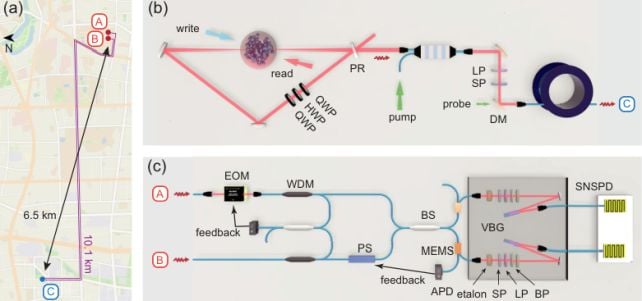
The system consisted of two memory units containing such clouds, nicknamed Alice and Bob, separated by the 420-kilometer optical fiber cable.
In the middle, a node named Charlie receives photons emitted by Alice and Bob.
If Charlie detects the correct interference pattern from these photons, that means entanglement has successfully been achieved between Alice and Bob – even though the two never actually meet.
The strategy worked. The team successfully demonstrated matter-to-matter entanglement over the full 420-kilometer fiber.
The achievement rested on three key techniques. None was entirely new on its own, but the researchers combined and improved them in ways that allowed the whole system to operate over unprecedented distances.
The first challenge was, of course, the distance.
Quantum memories naturally emit photons at wavelengths that optical fibers absorb relatively quickly. To stop the signal from fading away, the team converted those photons into wavelengths used by the telecommunications industry, which allowed them to travel through fiber with far lower transmission losses.
The second challenge was the vulnerability of quantum signals to outside interference. Even minuscule temperature changes and vibrations can scramble the quantum interference needed for entanglement.
So the researchers developed a sophisticated stabilization system that continuously corrected those fluctuations, keeping the quantum states synchronized over the entire link.
Finally, they used a single-photon entanglement scheme that requires only one photon to survive the journey, rather than two.
“A more efficient quantum frequency conversion protocol helps us to reduce the fiber loss and extend the transmission distance,” the researchers explain in their paper.
“Additionally, we employ a novel phase stabilization scheme to ensure the implementation of the experiment based on single-photon interference, which can be conveniently applied to other platforms.”
There was another milestone hidden in the result, too.
According to a 2017 paper that has become a benchmark for quantum communication, there’s a limit to how much quantum information can be transmitted through a lossy channel without the use of repeaters or memories.
Known as the PLOB bound, it is a bit like trying to throw paper airplanes across a windy field: the farther they have to travel, the fewer make it to their destination.
In their work, Luo and colleagues showed that, beyond a distance of 320 kilometers, their system achieved successful entanglement at a rate higher than would be possible by directly transmitting entanglement through the same optical fiber, according to the PLOB bound.

It’s not a defiance of the PLOB bound, but a demonstration that adding memory-based quantum networks really can outperform the best possible direct optical fiber link.
Related: Physicists Have Found a Radical New Way to Entangle Light And Sound
We’re still a long way from a practical quantum internet, of course.
But long-distance entanglement between quantum memories is widely regarded as one of the essential building blocks. This work shows that this building block can function over hundreds of kilometers of optical fiber.
“Furthermore, our experiment also demonstrates the capability of high-rate entanglement generation at shorter distances (∼100 kilometers), which is of significant interest for the construction of quantum repeaters,” the researchers write.
“Combining this feature with subsecond lifetime storage based on an optical lattice, entanglement swapping can be employed to enable the connection of many such remote entanglement segments.”
The findings will appear in Physical Review Letters.
This article was fact-checked by Michael Irving and edited by Michael Irving. While we pride ourselves on our process, we are only human. If you spot a mistake, please let us know.