NASA has committed to something that still sounds like science fiction when you say it plainly. It is going to fly a drone around another world. Not drive a rover, not drop a lander and hope it survives, but fly, hopping from place to place across the surface of a moon nearly a billion and a half kilometres away.
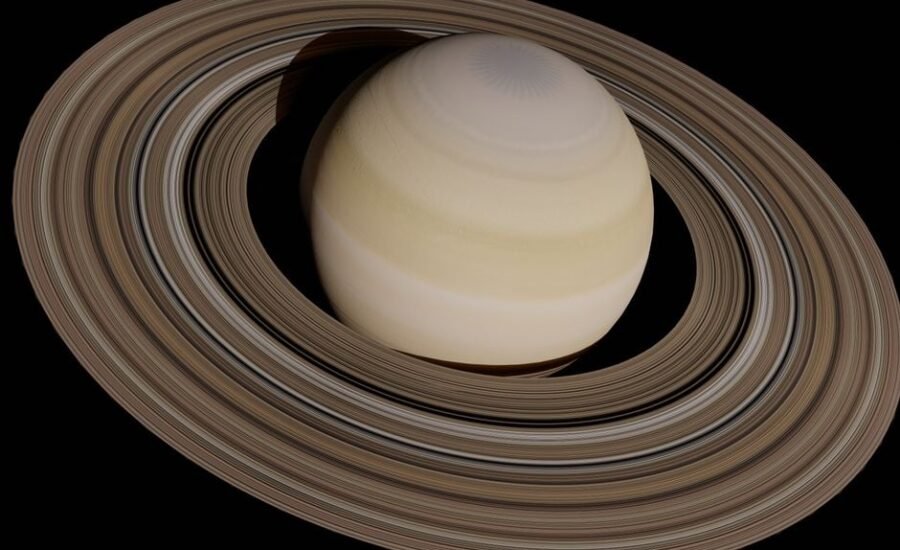
The world is Titan, the largest of Saturn’s moons, and the machine is called Dragonfly. Of all the places we might have chosen to attempt powered flight, Titan is arguably the best in the solar system.
I am a writer with a long interest in this beat, not a planetary scientist, so treat this as a careful tour of what the mission is rather than expert testimony.
Why flying makes sense there
On most worlds, flying would be a foolish way to explore. Titan is the exception, because the physics happens to line up perfectly. Its atmosphere is denser than Earth’s own at the surface, so there is plenty of air to push against, and its gravity is only about a seventh of ours, so there is far less weight to lift. The old line among scientists is that a person there could strap on wings and flap their way into the air.
A wheeled rover has to grind across whatever terrain it meets. A flyer can simply leap over it. That is why Dragonfly is built to cover ground no rover could, moving tens of kilometres in a single hop to sample a fresh site each time.
What Dragonfly actually is
Picture a car-sized craft with eight rotors, closer to a large drone than to anything we have landed on another planet. It cannot run on sunlight, because Titan sits so far out that daylight there is a tiny fraction of ours, so it carries a nuclear power source instead, the same kind of long-lived generator that kept the Voyagers and other deep-space craft alive for decades.
NASA’s confirmed plan has Dragonfly launching in 2028 and arriving at Titan in 2034. It is worth being honest that dates like these have moved before and could move again, and that even on schedule it means waiting until the mid-2030s for the science to begin. Once there, it is designed to spend around three years making a flight roughly once per Titan day, which lasts about sixteen Earth days, studying the ground between hops.
The world it is going to
Titan is genuinely strange. Its surface sits at about minus 179 degrees, its thick air is mostly nitrogen like ours, and it is the only place beyond Earth known to have standing liquid on its surface, complete with rain, rivers and seas. The catch is that the liquid is not water but methane and ethane, and the largest sea, Kraken Mare, is comparable in size to all five of North America’s Great Lakes combined. The bedrock, meanwhile, is water ice frozen hard as stone. I have written more about that peculiar environment in an earlier piece on Titan.
Almost everything we know about it came from the Cassini orbiter and the Huygens probe, which parachuted to Titan’s surface in 2005 in the first landing ever made in the outer solar system. Dragonfly is the long-awaited follow-up.
What it is really looking for
This is the part worth being careful about. Dragonfly is not going to Titan to look for aliens. It is going to study chemistry.
Titan behaves like a vast natural laboratory. Sunlight and energy break apart the nitrogen and methane in its atmosphere, and the fragments recombine into a haze of complex carbon-based molecules that drift down and coat the surface. That is exactly the kind of chemistry thought to have preceded life on the early Earth, running here on a planetary scale and locked in a deep freeze. Dragonfly will land at different sites and sample that material to see how far the chemistry has progressed, and whether the steps that lead towards biology can happen in conditions this alien.
There is a further intriguing possibility beneath the surface. Titan is thought to hold a layer of liquid water buried deep under its icy crust, which in principle could be a home for chemistry of its own. I would flag that this idea is unsettled. A recent study led by NASA’s Jet Propulsion Laboratory has argued that any such ocean may be less global and less accessible than earlier models assumed. It remains an open question rather than a settled fact.
Why it is worth the wait
Dragonfly is a patient bet. It will not send back a word of data until the middle of the next decade, its schedule may still shift, and the honest expectation is that it finds interesting chemistry rather than anything alive. None of that makes it small.
If it works, it will be the first time humanity has flown a craft under its own power across the surface of another world, and it will do it on the one moon whose rain, rivers and seas make it feel eerily like a frozen, chemical mirror of the early Earth. That seems like exactly the right place to go looking for how the story of life begins.
Standards
Space Daily articles are edited and fact-checked before publication. We use AI tools in the newsroom. See our editorial standards and masthead.