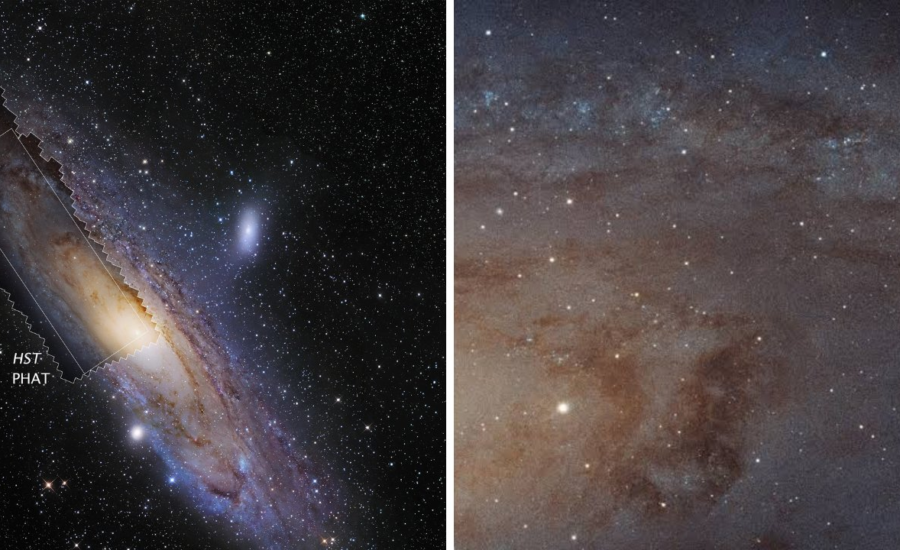
The Hubble Telescope has apparently captured one of the most detailed views ever of the Andromeda Galaxy, revealing an amazing field of stars, dust lanes and stellar structures. The image gives scientists and the public a closer look at the closest big galaxy to the Milky Way.
The reported Hubble Andromeda Galaxy image may be a combination of thousands of observations taken over a long period of time. To obtain sufficient detail for scientific analysis of a galaxy as huge as Andromeda, large astronomical mosaics usually require many individual exposures.
Andromeda in remarkable detail
Also known as Messier 31, Andromeda is 2.5 million light-years away from Earth.
In fact , there are hundreds of billions of stars in the galaxy . If you were in a dark place at night , you would see what looks like a faint blur . The sharp resolution of Hubble allows astronomers to pick out many individual stars that would otherwise be smudged together in images taken from farther away.
It means the results can show crowded star fields, dark clouds of dust and bright regions of new stars being born.
The mosaic could be thousands of images.
One Hubble exposure is typically not enough to get a complete portrait of Andromeda.
Astronomers photograph the galaxy in sections because it covers a large area of the sky. These observations are then calibrated and combined into a fine mosaic.
The technique gives a much wider view, but retains Hubble’s ability to pick out fine structure across the galaxy.
Scientists look billions of years back in time
Scientists can learn about the evolution of large spiral galaxies by studying Andromeda in detail.
Different regions have stars of different ages, temperatures and chemical composition. Scientists can reconstruct parts of the history of the galaxy and find evidence for earlier mergers with smaller galaxies by studying their distribution.
The findings might also offer clues about the evolution of the Milky Way.
Hidden structures in dust lanes
The Andromeda also has what appear to be dark bands running across it . These are clouds of dust which are hiding some of the light from the stars behind them .
These regions are important since they often contain the gas that is required for future star formation. Some of this dust can be seen through in infrared images, while visible light images show how much it affects the appearance of the galaxy.
Combining observations from different telescopes gives astronomers a better picture of these regions.
Hubble Resolves Individual Stars
The most amazing thing about this image is that Hubble can see individual stars in another large galaxy.
This enables scientists to measure brightness, colour and location across a huge population. Then they can compare young blue stars, older red stars and dense stellar groupings in different parts of Andromeda.
The data can be used to test models of galaxy growth and evolution.
Andromeda and Milky Way Moving Towards Each Other
Andromeda is heading towards the Milky Way and astronomers expect the two galaxies to interact in the distant future.
Current estimates put their major encounter billions of years in the future. The event would change both galaxies but individual stars probably will never collide because of the huge spaces between them.
If we look at Andromeda now we can model what that future interaction could look like.”
Sources
- NASA – Official Hubble mission updates and image releases.
- European Space Agency – Hubble science info and observation details
- Space Telescope Science Institute – Hubble Data Processing and Research.
- NASA Goddard Space Flight Centre – Astronomy Coverage, Telescope Operations.
- The Astronomical Journal – Peer-reviewed research on galaxies
- Sky & Telescope – Astronomy news and observing information.