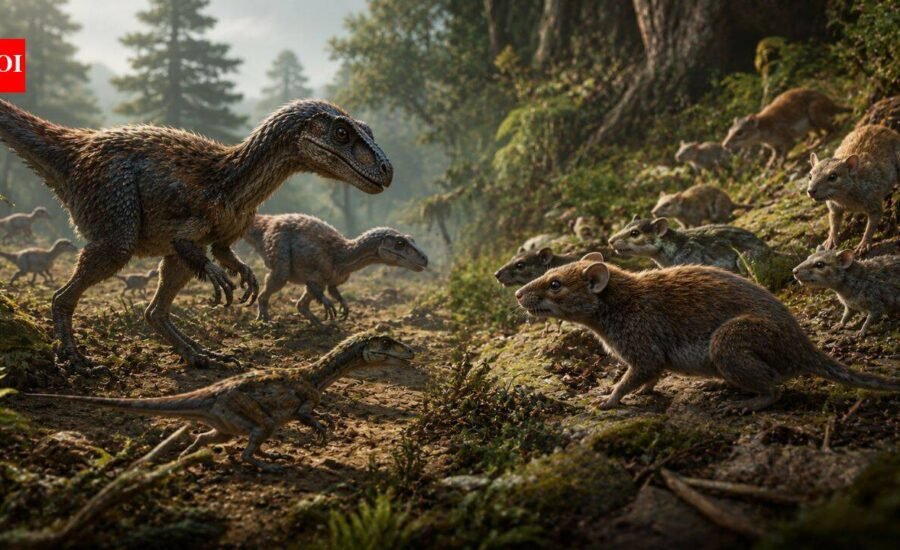
Dinosaurs ruled the Earth for roughly 180 million years, filling nearly every ecological role available to them. Yet one gap in their story has puzzled scientists for decades: there were no small ones. The smallest adult non-avian dinosaurs weighed around 400g, hundreds of times heavier than the tiniest living birds, mammals or reptiles. This absence is strange because, across the animal kingdom, small-bodied species are usually the most common, not the rarest. A new study has tested whether this gap can be explained by biology alone, using a model that links body size to how efficiently animals turn food into offspring. The results suggest something else was holding dinosaurs back from going small, and the answer may be connected to the very origin of birds.
Why the new evolution study predicted tiny dinosaurs should have existed
According to the new study published in the journal Evolution, titled ‘The explanatory power of energetic fitness models across living amniotes and extinct non-avian dinosaurs’, animal body sizes can be predicted using an energetic fitness model. This approach, first proposed by ecologist James Brown and colleagues in 1993, works on a simple trade-off. Small animals are efficient at gathering energy relative to their size, but poor at converting that energy into offspring. Large animals are the opposite: efficient at reproduction, but relatively inefficient at gathering enough resources to fuel it. Somewhere between these two extremes sits an optimal body size, the point at which an animal converts the most energy into the most offspring.The researchers tested this model against real body size data from six major groups of living animals: mammals, birds, lizards, snakes, turtles and crocodylians. For mammals and birds, the model performed well, correctly predicting that most species should cluster around a small, energetically efficient size. Mammals matched an expected optimum of around 100g, while birds matched a predicted 33g, both close to the actual most common body sizes seen in those groups today. Turtles also fitted the model closely. However, lizards, snakes and crocodylians did not follow the pattern at all, which told the researchers that biology alone could not be the full explanation for body size across every group.
Why mammals may have prevented tiny dinosaurs from evolving
Their theory centres on competition, most plausibly with the small mammals that lived alongside dinosaurs throughout the Mesozoic era. Both groups likely competed for similar niches involving fast metabolisms and small body sizes, and the researchers suggest mammals may have effectively locked dinosaurs out of that space, much as dinosaurs are widely thought to have prevented mammals from evolving to large sizes during the same period.This idea was tested indirectly using living animals: lizards and flightless birds on islands, where competition and predation pressure are typically lower than on continents, showed body size distributions that fitted the energetic model noticeably better than their mainland relatives did. According to the researchers, this pattern offers a clue to one of palaeontology’s more curious footnotes: how birds managed to shrink so dramatically after breaking away from other dinosaurs. Birds today have a typical body size of around 33g, with the smallest species weighing under 2g, a scale never achieved by their non-avian relatives despite 180 million years of evolutionary opportunity. The evolution of flight in early birds coincided with an abrupt release from the ecological pressures that had kept other dinosaurs large, allowing miniaturisation to happen quickly once it became possible. In this view, the missing small dinosaurs were not a failure of biology, but a consequence of ecological competition that only ended when flight gave one dinosaur lineage an escape route into a size range the rest of their relatives were never permitted to reach.
Why scientists found no tiny dinosaurs in the fossil record
When the same model was applied to non-avian dinosaurs, it failed badly. The researchers tested every plausible combination of energy-related values drawn from living animals, searching for any biological explanation that could push the predicted optimal dinosaur size up towards several hundred kilograms. Even the most extreme combination only produced a predicted size of around 3kg, nowhere near the 400g minimum actually observed in the dinosaur fossil record, and nowhere close to explaining why the model kept predicting dinosaurs should exist in the 100 to 300g range, when none ever did. According to the study, this gap cannot be dismissed as a quirk of incomplete fossil sampling, because small-bodied contemporaries such as mammals, lizards and amphibians are regularly found in the same rock layers where equivalent small dinosaurs are missing entirely. The researchers paid particular attention to two exceptionally well-preserved fossil sites, the Jehol Group in China and the Djadokhta Formation in Mongolia, both known for capturing small animals unusually well.Even in these deposits, dinosaurs below 300g were completely absent, despite tiny mammals and reptiles being preserved alongside them. This ruled out preservation bias as the sole explanation and pointed towards something actively excluding dinosaurs from small body sizes, rather than simply a failure to find them.