The US Navy is planning a new fleet of nuclear-powered battleships that could fundamentally change the cost and scale of modern naval warfare. According to a report by the Congressional Budget Office, building 15 of these Trump-class warships will cost an estimated $275 billion.
The lead warship alone will cost around $23 billion to build. Once full production begins, later ships in the series will average about $18 billion each over their operational lifetime. The report was requested by Senator Jeff Merkley to evaluate how the new platform affects long-term military spending.
If these plans move forward, the Navy’s yearly budget for surface warships will more than double. Annual spending will jump from $6.9 billion to $15.2 billion. Between 2027 and 2056, defense planners intend to buy 72 major warships. This total includes the 15 new battleships alongside 57 Arleigh Burke-class destroyers.
A massive hull
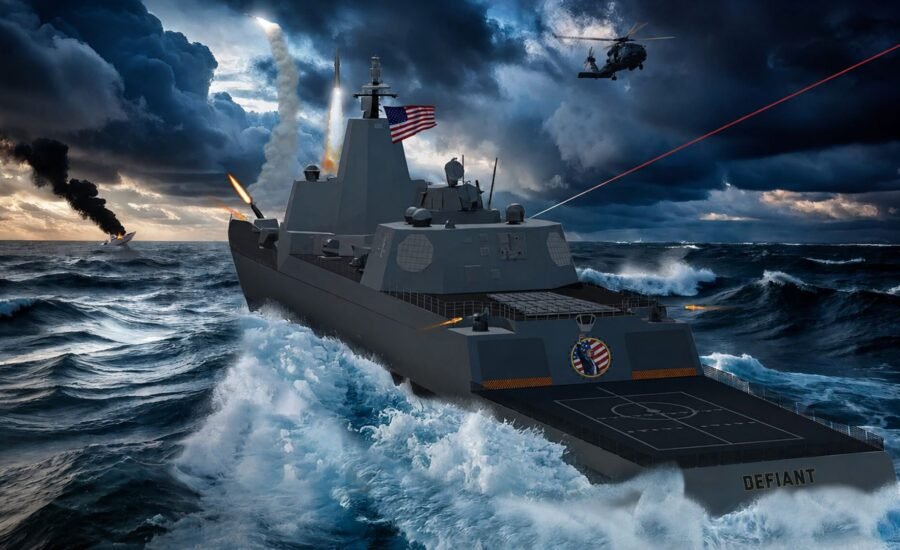
The proposed warship, designated BBGN, can reportedly weigh 35,000-41,000 tons when fully loaded. That makes it the largest surface combatant designed for the Navy since World War II.
To put that size in perspective, the new ship has more than double the mass of a Zumwalt-class destroyer. It is also 3.5 times larger than the Navy’s current workhorse, the Arleigh Burke-class destroyer.
Naval engineers need a hull of this size to supply raw power. Modern radar, lasers, and computing networks require immense electricity. A massive hull provides the physical space needed for nuclear reactors, heavy cooling units, and high-voltage power networks.
Capable of carrying heavy weapons
The design focuses heavily on long-range strike capability and energy-based defense systems. For standard missile operations, the warship features 128 Mark 41 vertical launch cells capable of firing anti-air and land-attack munitions. These are supplemented by four large-diameter launch tubes dedicated to Conventional Prompt Strike hypersonic missiles.
“The Navy has stated that the ship would be equipped to carry the nuclear-armed sea-launched cruise missile, or SLCM-N,” said the report. This armament gives the warship more firepower than any American vessel outside of Ohio-class ballistic missile submarines.
“Other elements would include large lasers, a rail gun, and a variety of defensive systems such as guns, smaller missiles, decoys, and optical dazzlers intended to counter and disrupt unmanned aerial systems,” added the report.
Reducing long-term operational costs
The choice of propulsion is central to the design. A conventional gas-turbine engine would lower initial construction costs by about 13 percent. However, a nuclear reactor dramatically reduces long-term operational costs.
Nuclear propulsion allows the ship to run indefinitely without refueling, while generating the constant electricity required by futuristic radar and laser weapons.
Manufacturing will rely on a shared industrial network. Different shipyards across the country will fabricate individual sections of the hull. Workers will then transport these sections to HII Newport News Shipbuilding, where final assembly will take place in Drydock 12, the same drydock used to build Ford-class aircraft carriers.
The Pentagon is requesting $1 billion in early funding for 2027, aiming to place the official order for the first battleship in 2028.