Next-Generation Technologies & Secure Development
Next Generation Cryptography Showcased Over Leased Albuquerque Fiber
This webpage was transmitted on a network through ones and zeros – a sequence of classical bits that are either on or off, streamed in flashes of light and electricity. Quantum communication, which depends on the more ambiguous properties of particles operating at an atomic scale, is still a far-off proposition.
See Also: Why Healthcare Leaders Are Rethinking Their Data Strategy Before Scaling AI
But perhaps not too far off, judging by the raft of startups and proliferation of testbeds – now including what backers of New Mexico’s recently opened ABQ-Net say is the first open-access, quantum entanglement-based network in the United States.
“It’s 100% open to universities and national labs and researchers,” said Mehdi Namazi, chief science officer of Qunnect, which provides ABQ-Net’s infrastructure. “It’s quite free.”
The network proving ground just announced that four quantum companies will test next-generation technologies on its facilities. One of them is Massachusetts-based Aliro, which is running what company CTO Michael Cubeddu calls a production-ready, entanglement-based quantum key distribution, or QKD, which many experts say is quantum communication’s most practical application.
Quantum networking depends on two phenomena, entanglement and superposition. The first is a quantum property in which the state of a particle, such as a photon, is linked to the state of another. Albert Einstein famously described it as “spooky action at a distance.” The second describes how particles exist in multiple states at once, increasing the amount of data that can be transmitted per quantum bit, or qubit, when compared to classical bits that oscillate between zero and one.
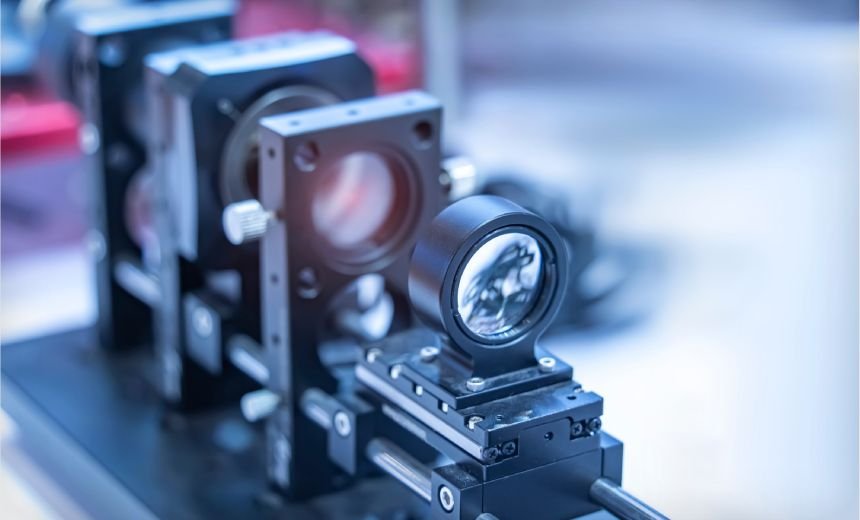
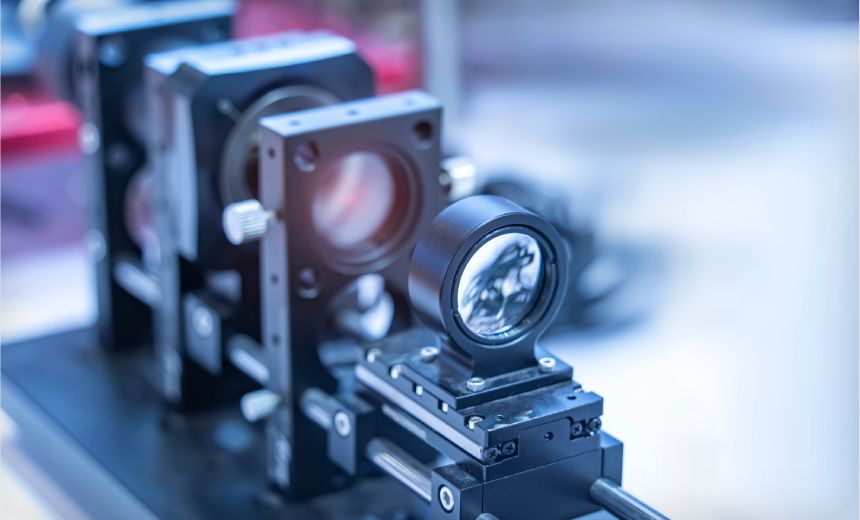
Quantum key distribution using entanglement takes advantage of two connected photons to generate a shared encryption key. Quantum key distribution – as well as quantum communication networks – doesn’t need a quantum computer. The “quantum” comes from how QKD exploits the properties of atomic-level particles, which in ABQ-Net’s case are pairs of photons coaxed by precision lasers trained on a tiny vaporized chunk of the rare-earth element rubidium.
Each party that wants to communicate measures one of the entangled photons to generate an encryption key used to secure messages sent over classical networks, like the one used to transmit this article.
“A router can say, ‘Hey, I need a quantum key,’ and then it requests our stack,” Cubeddu said. Aliro uses BBM92, a protocol developed in 1992. “And then we go and request the Qunnect hardware to make sure that happens,” he said. Qunnect provides ABQ-Net’s custom-built lasers and rubidium vapor at two locations. The facilities fling photons across the ABQ-Net network, which consists of leased internet service provider fiber cable looped to travel 50 kilometers.
“This is not a fiber spool in a lab,” Cubeddu said. “A lot of our fiber is aerial fiber, between telephone poles. It’s subject to all sorts of environmental stresses.”
An advantage of QKD is that – despite its being a symmetric key – eavesdroppers can’t intercept the key without changing it. That’s due to the “observer effect,” a property of quantum physics in which observation collapses superposition into a single, definite state.
“No man in the middle, no adversary can learn the key without being detected,” Cubeddu said.
Cubeddu also touted QKD’s dependency on hardware rather than math, pointing to Anthropic’s discovery of a weakness in a proposed post-quantum-safe signature scheme. “These math-based security algorithms are not guaranteed,” he said (see: Claude Mythos Finds New Cryptographic Algorithm Attacks).
Existing asymmetric encryption algorithms of sufficient length continue to offer unbreakable encryption for the moment, but a force driving post-quantum cryptography and the nascent commercialization of QKD is worry over the “harvest now, decrypt later” problem. “It totally makes sense for the industry or government who already invest in the technology that we can prove are going to be broken by quantum computers, or classical computers, or AI, to pump quantum cryptography into the picture,” said Alireza Shabani, founder of Cisco Quantum Lab and advisor for the Center for Quantum Networking.
Of course, QKD faces its own set of challenges. Most immediately is the problem that photons don’t travel forever. After a certain distance – roughly 150 kilometers using existing technology – they degrade.
“You can do quantum key distribution between a bank in New York City and some branch in New Jersey; you can’t do quantum key distribution over much longer distances because we don’t have quantum repeaters,” said Celia Merzbacher, executive director of the Quantum Economic Development Consortium, which promotes the quantum industry.
The lack of quantum repeaters – hardware that extends entanglement over longer distances – points to another problem QKD will have to mitigate, and that’s how it moves cybersecurity risk from software to hardware. Rather than waiting for repeaters, QKD instances could use relay nodes, but that model would require users to explicitly trust the nodes.
Researchers have additionally already identified potential hardware attacks against QKD including a quantum version of a Trojan horse involving injecting photons into optical modules of a QKD system. They also worry about the potential of a photon-number-splitting attack in which an eavesdropper could succeed in making a measurement that doesn’t collapse the superposition.
One advantage of rubidium as a photon source, said Qunnect’s Namazi, is that the timing of photon creation is random, making it harder for a would-be attacker to predict when the rare earth metal will eject an entangled pair.
He predicted that a quantum repeater operating at room temperature is achievable roughly five years from now. Once that system is in place, QKD will be able to stretch over “meaningful distances” such as Boston to Washington, D.C., he predicted.
For now, the discussion centers around which portion of an organization’s network is suitable for QKD, Cubeddu said.
“That’s probably the data center-to-data center communications, or it’s for critical infrastructure like financial networks and utility grids, where you have a very high concentration of very sensitive data, and we roll it out where it makes sense,” he said. “We’re targeting right now to telcos, to banks, to utilities, to governments that are the first adopters of this kind of physics-based security.”