
The United States (US) Bureau of Labor Statistics (BLS) is set to release the Nonfarm Payrolls (NFP) data for July on Friday at 12:30 GMT.
With investors scaling back bets for a Federal Reserve (Fed) interest rate hike in September on easing inflation fears, the underlying details of the employment report could influence how markets assess the US central bank’s policy outlook and drive the US Dollar’s (USD) valuation.

What to expect from the Nonfarm Payrolls report?
Investors expect NFP to rise by 80K following June’s disappointing print of 57K. The Unemployment Rate is seen holding steady at 4.2%, while the annual wage inflation, as measured by the change in the Average Hourly Earnings (AHE), is projected to remain unchanged at 3.5%.
Economists at Deutsche Bank expect a slightly firmer US labour market print on Friday, projecting that the July payrolls report will show employment growth of “+65k, modestly above June’s +57k reading,” with “private payrolls also expected to rise by +65k after +49k previously.” They forecast the unemployment rate to remain at 4.2%, “although risks are skewed towards a rounding up to 4.3% if labour force participation rebounds after last month’s sharp decline.” On pay and hours, Deutsche Bank looks for “average hourly earnings to increase by +0.3% month-on-month, unchanged from June, while average hours worked are forecast to hold at 34.3 hours.”
Meanwhile, strategists at BNY Mellon flag this week’s July Nonfarm Payrolls report as a key data point for the Fed, noting that “market expectations currently see around 80,000 new jobs.” They note that they don’t think the payrolls “breakeven rate” needed to keep the unemployment rate from rising “is much above 50,000 per month,” given that “it currently doesn’t require large monthly employment gains to keep the unemployment rate steady, thanks to a much slower labor force growth than before the pandemic.”
Economic Indicator
Unemployment Rate
The Unemployment Rate, released by the US Bureau of Labor Statistics (BLS), is the percentage of the total civilian labor force that is not in paid employment but is actively seeking employment. The rate is usually higher in recessionary economies compared to economies that are growing. Generally, a decrease in the Unemployment Rate is seen as bullish for the US Dollar (USD), while an increase is seen as bearish. That said, the number by itself usually can’t determine the direction of the next market move, as this will also depend on the headline Nonfarm Payroll reading, and the other data in the BLS report.
How will the US July Nonfarm Payrolls affect EUR/USD?
Fed policymakers remain focused on taming inflation as the labor market shows no signs of a cooldown despite the disappointing June NFP print. Earlier in the week, Philadelphia Fed President Anna Paulson told CNBC that the Fed will need to act if they fail to make progress on inflation and noted that the job market is stable. Similarly, Kansas City Fed President Jeff Schmid defined the labor market as “roughly balanced” and said that inflation is “too high” and “worrisome.”
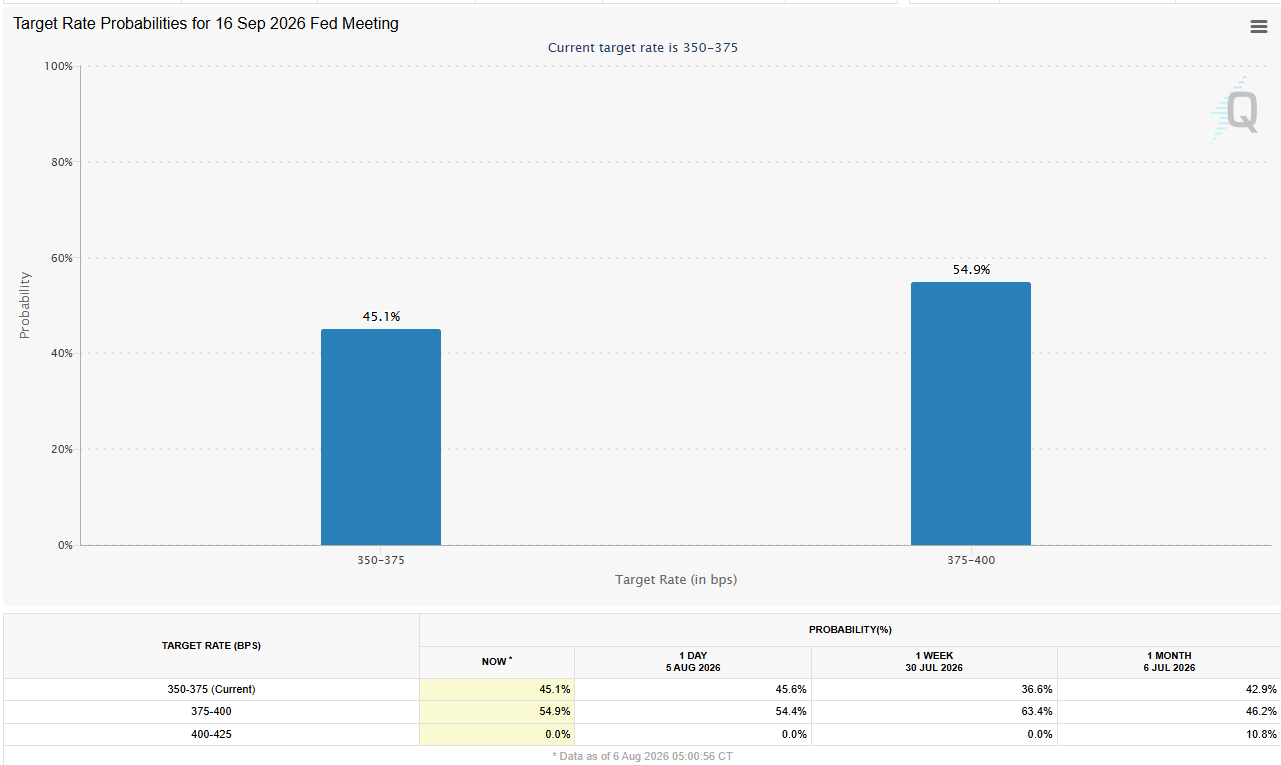
After rising more than 20% in July, crude Oil prices turned south in August as investors grew optimistic about the re-opening of the Strait of Hormuz. In turn, the CME Group FedWatch Tool’s probability of a 25 basis points (bps) Fed interest rate hike in September declined to 55% from about 70% at the end of July. A significant downside surprise in the NFP, with a print below 40K, could suggest that the Fed could take its time to ensure that the labor market is not in a downturn before tightening the monetary policy. In this scenario, the USD could come under pressure and allow EUR/USD to gain traction.
Conversely, an NFP increase of more than 100K could hint that policymakers are likely to continue to prioritize price stability without worrying about a negative impact on employment. In this case, the USD is likely to stay resilient against its rivals and weigh on EUR/USD. However, the pair’s downside could remain limited regardless of the NFP figure if Oil prices continue to decline in the near term.
TD Securities analysts argue that the recent bout of post-Fed Dollar softness does not mark a regime change for the currency. The bank “view[s] the latest USD move more as a temporary retracement rather than the formation of a new USD downtrend,” explaining that “hawkish speeches from the Fed dissenters should offset some of the post-FOMC USD weakness.” In their view, “in the absence of material US data weakness to remove the near-term Fed rate hike pricing, the broad USD Q3 2026 uptrends remain intact.”
Eren Sengezer, European Session Lead Analyst at FXStreet, offers a brief technical outlook for EUR/USD:
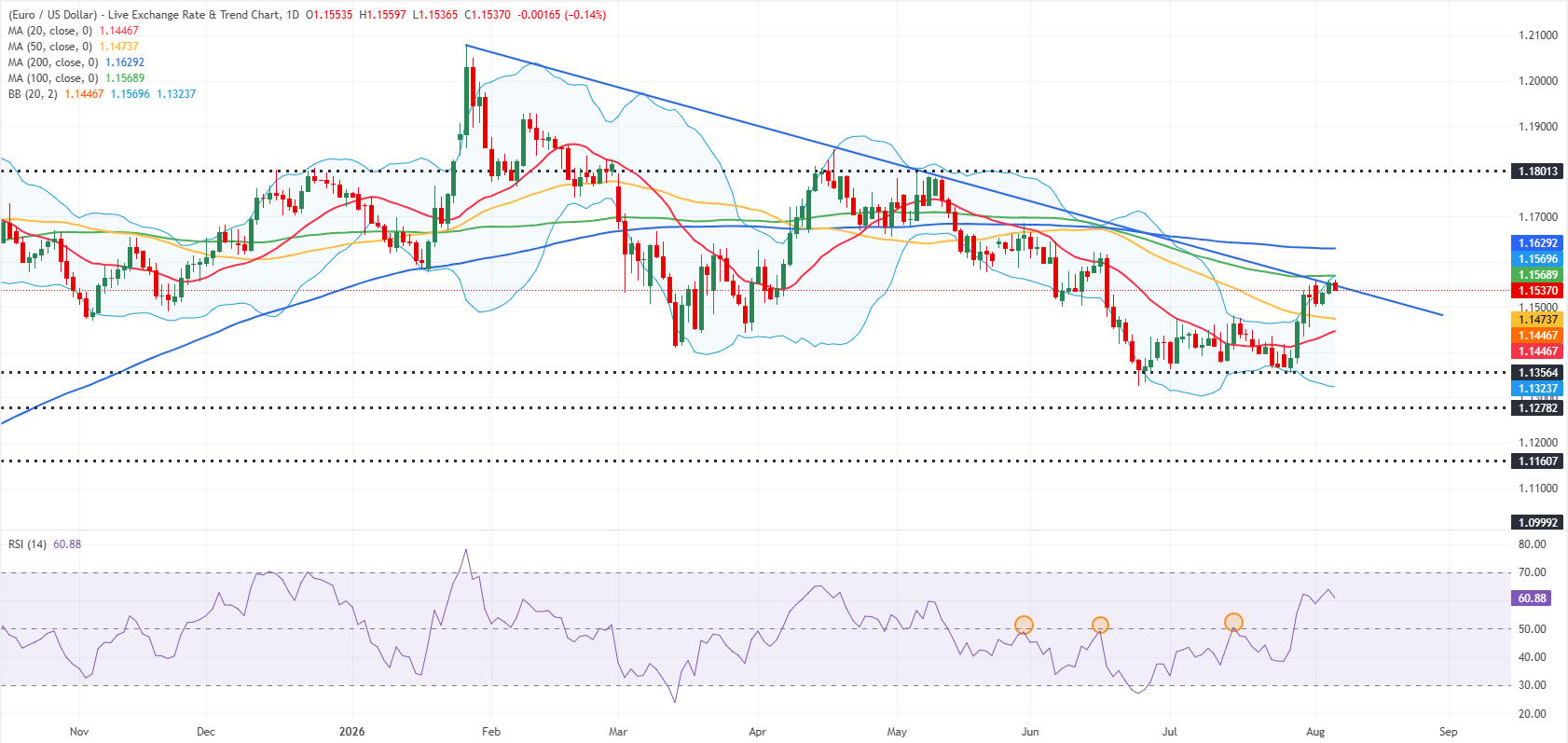
“EUR/USD’s near-term technical outlook suggests that the pair is closing in on key technical levels that could confirm or deny a bullish reversal. The Relative Strength Index (RSI) indicator on the daily chart rose above 60 after failing to clear the neutral 50 level multiple times since early June. While this points to a buildup in bullish momentum, technical buyers could refrain from committing to a steady uptrend until the pair clears 1.1570 and 1.1630 levels, where the 100-day Simple Moving Average (SMA) and the 200-day SMA are located, respectively. If EUR/USD manages to stabilize above the latter level and confirms it as support, 1.1800 could be seen as the next significant resistance level.”
“On the downside, the first support area could be spotted at 1.1475-1.1440 (50-day SMA, 20-day SMA) ahead of 1.1360 (static level) and 1.1280 (static level).”
Employment FAQs
Labor market conditions are a key element to assess the health of an economy and thus a key driver for currency valuation. High employment, or low unemployment, has positive implications for consumer spending and thus economic growth, boosting the value of the local currency. Moreover, a very tight labor market – a situation in which there is a shortage of workers to fill open positions – can also have implications on inflation levels and thus monetary policy as low labor supply and high demand leads to higher wages.
The pace at which salaries are growing in an economy is key for policymakers. High wage growth means that households have more money to spend, usually leading to price increases in consumer goods. In contrast to more volatile sources of inflation such as energy prices, wage growth is seen as a key component of underlying and persisting inflation as salary increases are unlikely to be undone. Central banks around the world pay close attention to wage growth data when deciding on monetary policy.
The weight that each central bank assigns to labor market conditions depends on its objectives. Some central banks explicitly have mandates related to the labor market beyond controlling inflation levels. The US Federal Reserve (Fed), for example, has the dual mandate of promoting maximum employment and stable prices. Meanwhile, the European Central Bank’s (ECB) sole mandate is to keep inflation under control. Still, and despite whatever mandates they have, labor market conditions are an important factor for policymakers given its significance as a gauge of the health of the economy and their direct relationship to inflation.