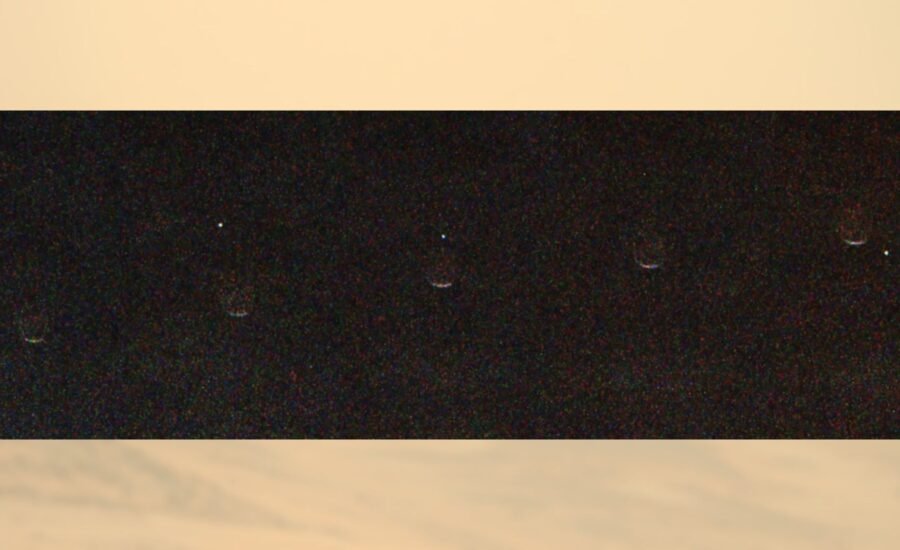

NASA’s Perseverance rover witnessed a rare event recently, when Earth briefly disappeared behind Mars’ moon Phobos in the Red Planet sky.
What is it?
These new composite images were released by NASA’s Jet Propulsion Laboratory (JPL) and taken on July 2, 2026, the 1,907th Martian day of Perseverance’s mission. They consist of nine different images taken by the rover’s Mastcam-Z instrument as it pointed up into the hazy Martian sky, watching our planet, seen here as a pale dot, cross behind the Mars moon Phobos.
This type of event is known as an occultation, from the Latin word occultare, meaning “to hide.” On Earth, the most common type of occultation occurs when our moon passes in front of background stars or when planets pass behind the moon.
Mars has two moons, Phobos and Deimos. Phobos is the larger and innermost moon. Both are lumpy and irregularly shaped, and astronomers aren’t sure whether they came from the asteroid belt or were formed from an ancient impact near or on the Red Planet.

Why is it incredible?
The image took careful preparation and required Perseverance to be in the right place at the right time.
“Phobos crosses the Martian sky three times a day, and Earth is visible for months at a stretch, but catching one directly behind the other takes planning and a little luck,” said Mark Lemmon, a Mastcam-Z co-investigator at the Space Science Institute.
Aside from catching Earth passing behind Phobos, Perseverance has also witnessed Phobos passing in front of the sun, in what JPL calls a “Martian solar eclipse.”