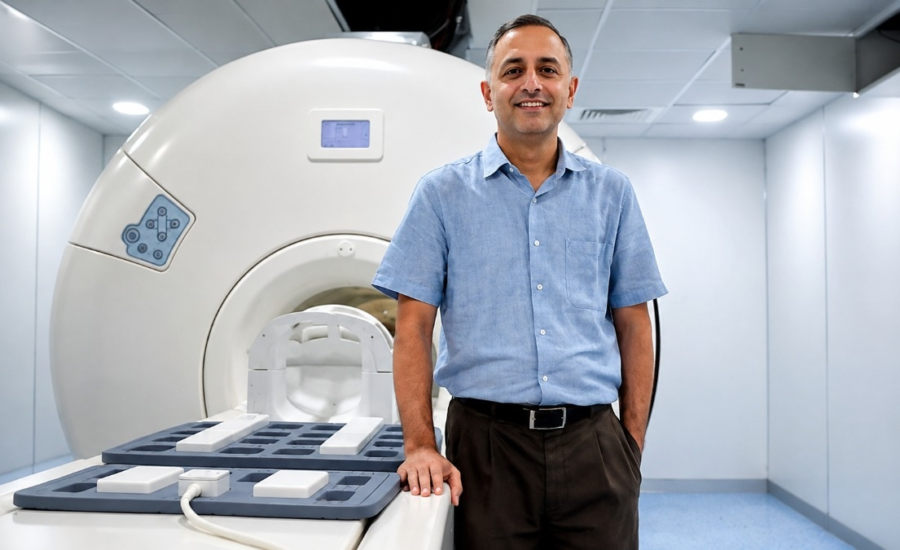
The world’s Magnetic Resonance Imaging (MRI) industry is dominated by a handful of global giants. Some of those giants are sharks as well. They are always on the hunt to gobble up smaller manufacturers that bring innovative technologies and retain their dominance. That’s what India’s first MRI maker, the Bengaluru-based Voxelgrids faced. However, funding support from Tata Trusts and Sridhar Vembu’s Zoho helped Arjun Arunachalam continue on the path of his dream to build an affordable MRI machine and provide it to every corner of India.
For decades, countries like the US, Germany, Japan, China, Italy and the Netherlands have built MRI machines that hospitals across the world use, and India is one of their biggest customers.
Voxelgrids founder and CEO, Arjun Arunachalam, was running out of money while building one of the world’s most complex medical devices, and competing against corporations worth billions of dollars. So when a multinational giant approached Voxelgrids with an offer during the Covid-19 pandemic, Arunachalam could have taken the easy way out.
Instead, Arunachalam walked away. He viewed that partnering with a multinational would come at the cost of the very innovation he was trying to build. It is common knowledge that most MNC giants offer to be partners and then gobble up their partners.
What made the 47-year-old electronic engineer Arunachalam’s resolve stronger was a financial lifeline from Tata Trusts, then led by Ratan Tata, and later Vembu. The funding allowed the startup to survive long enough to develop what could become India’s first indigenous MRI scanner — a machine that Arunachalam says could eventually reduce the cost of an MRI scan by around 70% and make advanced diagnostics accessible in every corner of the country.
“We thought partnering with the company would risk our innovation,” Arunachalam told India Today Digital.
What Voxelgrids has manufactured is almost a miracle in the field of medical devices. Its MRI machines will be 40% cheaper and 50% lighter, which will further reduce the installation costs. This will be a mini-revolution in a country that imports Rs 3,500 crore worth of MRI-related products annually.
HOW ARUNACHALAM DECIDED TO BUILD INDIA’S FIRST MRI MACHINE
Arunachalam, speaking to India Today Digital, said that building an MRI scanner is often compared to building a jet engine or a rocket.
MRI machines are among the most expensive and technologically demanding medical devices ever created, requiring years of research, enormous capital and expertise across physics, electronics, software and precision engineering.
Arunachalam knew exactly what he was taking on.
An electrical engineer specialising in MRI physics, he studied at the University of Wisconsin-Madison in the US before spending nearly three years at GE HealthCare’s research centre in America around 2008-09.
“I was very fortunate enough to work at GE’s research centre. That experience is coming of help in the building of MRI machines in India,” he said.
After his stint at GE, Arunachalam moved to Singapore, and having briefly taught at IIT Bombay, he realised what was frustrating him.
“I wanted to do research on MRIs and build something innovative, but we had to beg to use somebody else’s machine. Companies that built MRIs had no interest in working with Indian institutes because they didn’t consider us a serious country,” Arunachalam told India Today Digital while remembering his days at IIT Bombay as a professor.
That frustration gradually evolved into a mission.
“I also wanted to do something meaningful in India and stay here,” Arunachalam said, adding, “My father was an Indian Air Force officer.”
Patriotism must have been an everyday lesson for Arunachalam at home.
WHY DIDN’T INDIA BUILD AN MRI MACHINE? NO, IT’S NOT ABOUT THE COST
For Arunachalam, the problem extends beyond imports. “The harsh truth of us as a country is that we don’t build anything,” he said.
India imports every MRI scanner installed in its hospitals. “Last year alone, MRI imports were valued at roughly Rs 3,500 crore,” Arunachalam told India Today Digital.
Those imports eventually translate into higher costs for patients.
An average MRI scan in India costs nearly Rs 10,000, making it unaffordable for many families in the country.
“The demand is huge. Anybody who buys a CT scanner wants an MRI,” Arunachalam said.
Yet MRI adoption continues to lag behind CT scanners.
According to him, India has nearly three times more CT scanners than MRI machines, largely because imported MRI systems remain expensive to purchase, install and maintain.
“There is a global product-fit issue with MRI machines,” Arunachalam said.
HOW A SMALL BENGALURU-BASED PLAYER BUILT MRI MACHINES
Instead of trying to imitate established manufacturers, Arunachalam’s Voxelgrids started with a blank sheet of paper.
“The bigger giants have restrictions. They can’t innovate and pivot quickly because of regulatory structures. That’s an advantage for smaller players like us,” he said.
According to Arunachalam, initially, his company wanted to develop only MRI imaging software and intellectual property.
But existing manufacturers would not allow outsiders to innovate in their systems.
“They would attach monetary value to our IP,” he said.
That forced a far bigger decision, and Arunchalam decided to build his own MRI machine.
Everything, from software to electronics, was designed in-house by a team that has grown from just four engineers to 33 now.
“Our image quality is equal to any MRI. Our design is different,” Arunachalam told India Today Digital.
HOW MACHINE BUILT BY VOXELGIRDS WILL CUT MRI COSTS
The biggest promise of Voxelgrids’ MRI isn’t simply that it is made in India. It is that it has been designed differently from the ground up.
Its internal magnet architecture is different. It uses around one-third the number of cables found in conventional MRI systems, according to Arunachalam.
The electronic packaging consumes significantly less power. The MRI machine is lighter.
Most importantly, it has an option of using nitrogen instead of helium, one of the world’s most expensive non-renewable gases that India imports for MRI systems.
“Every software is in-house, and that is the most expensive thing anyone can achieve,” Arunachalam said.
All these changes dramatically reduce manufacturing and operating costs.
The savings, he says, will eventually reach patients. “MRI scanning will become affordable,” he said.
Arunachalam estimates that scan prices could fall by around 70%, with costs eventually dropping to nearly 40% of current prices as indigenous manufacturing scales up.
“Our goal is simple. The Indian-made MRI should reach every corner of the country,” he told India Today Digital.
RATAN TATA’S SUPPORT FOR MADE-IN-INDIA MRI MACHINE
The vision of Arunachalam nearly ended before it began. Funding remained the biggest challenge.
“Tata Trusts was the first organisation that believed in us,” Arunachalam recalled while speaking to India Today Digital.
He first approached the Trust in 2015, when Ratan Tata was still actively involved.
The then Managing Trustee, R Venkataramanan, invited Arunachalam to Mumbai after seeing potential in the technology he was building.
“The Tatas showed genuine interest,” Arunachalam said, revealing that he met Ratan Tata, then Chairman of Tata Trusts, twice.
“Ratan Tata wanted to see technologies that helped the country grow,” he added.
The relationship became even more critical during Covid-19, when Voxelgrids was struggling to survive.
Arunachalam revealed that he continuously wrote to Tata Trusts updating them about the progress of the machine.
Eventually, Ratan Tata’s then personal secretary, Delnaz Gilder, helped arrange another meeting.
Tata Trusts agreed to financially support the company by placing what Arunachalam describes as an “order for the machine”.
“We didn’t have a product, and Ratan Tata had provided us with orders. That’s how great and humble he was. I’m so grateful,” Arunachalam said.
WHEN SRIDHAR VEMBU’S ZOHO BACKED INDIA’S MRI MACHINE
Even after Tata’s support, the journey remained uncertain. Following Ratan Tata’s passing, Arunachalam says the startup’s relationship with Tata Trusts naturally evolved, and new sources of support became crucial.
Government funding through the National Biopharma Mission helped keep development alive.
But another breakthrough came through an introduction to Zoho founder Sridhar Vembu. One of Arunachalam’s acquaintances connected him to Vembu in 2021.
Being an electrical engineer himself, Vembu immediately understood both the technological challenge and the long-term national importance of the project.
“He said, I know this is a big challenge. I’ll still give the money. Let us see if you develop a good product,” Arunachalam told India Today Digital.
That investment allowed Voxelgrids to continue independently instead of compromising its technology through a partnership with a multinational.
WHY ARUNACHALAM REJECTED OFFER FROM MNC MRI GIANT
According to Arunachalam, multinational manufacturers understand just how difficult it is for startups to survive in MRI manufacturing.
“They know small firms cannot survive because building an MRI machine needs a lot of money,” he told India Today Digital.
Many expect startups to eventually run out of cash. That’s precisely why Voxelgrids refused to surrender control.
“We had no interest in partnering with a bigger firm,” he said.
Instead, the startup chose the harder route of building patiently, spending cautiously and making fewer expensive mistakes than global corporations could afford.
“People ask why it is taking longer,” Arunachalam said. “That is exactly how we are building a cheaper machine,” he added.
For a company competing against some of the biggest names in medical technology, survival itself has been a victory. If Voxelgrids succeeds in bringing its indigenous MRI to hospitals across India, Arunachalam believes the impact will go far beyond one machine.
It could mean that a technology once reserved for major cities and expensive hospitals finally becomes affordable enough to reach distant hospitals, smaller diagnostic centres and millions of patients who currently cannot afford it.
– Ends