In August, we will have two vastly different eclipses: one solar and one lunar. One total and the other partial. One visible from the United States and another visible only in a few places thousands of miles away. Throw in a solid annual meteor shower and this month is going to downright astronomical.
Here’s a look at what’s coming up in the skies, and where you need to be to see the full glory.
Total solar eclipse – Aug. 12
Did you see the total solar eclipse in 2024? Want to experience that again? Well, you’re going to have to travel for the next one.
The moon will completely cover the sun on Aug. 12 creating another total solar eclipse. But only the far northeastern part of the United States will see a tiny sliver of a partial solar eclipse. To experience totality and see the sun disappear, you’ll have to travel to Iceland, Spain, or somewhere in between.
During totality, the moon’s shadow touches a small section of the Earth and races at hundreds to thousands of miles per hour. If you want to catch the beginning of the total solar eclipse, you can watch it from northern Russia for a few moments or for about two minutes over eastern Greenland.
Then the shadow touches land again for viewers in western Iceland before crossing the North Atlantic Ocean and darts diagonally across the country of Spain.
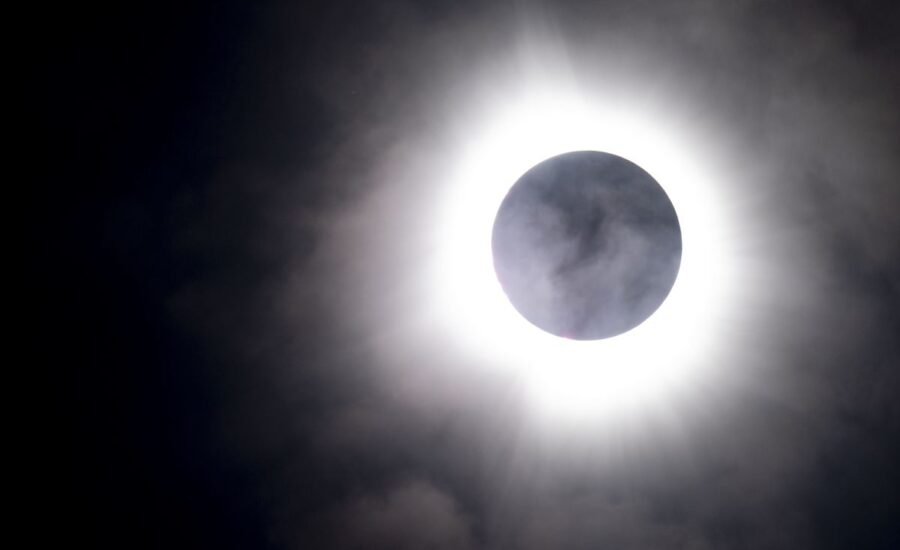
A view of the total solar eclipse at Miami Whitewater Forest in Miami Township on Monday, April 8, 2024.
Unlike the total solar eclipse in 2024, which lasted four minutes in some places, viewers in Reykjavik, Iceland, will see totality for about one minute, and cities and towns in Spain along the path of totality will experience it for less than two minutes.
The next total solar eclipse will occur on Aug. 2, 2027, and only be visible across portions of North Africa and the Arabian Peninsula. This will be one of the longest total solar eclipses this century when it will last up to 6 minutes, 23 seconds. Start planning now!
Perseid Meteor Shower – Also Aug. 12
In case you can’t travel to Greenland, Iceland or Spain this month, there will be another astronomical event happening on Aug. 12 visible from the United States: The Perseid Meteor Shower.
Each year, the Earth plows into a stream of small particles left over from comet Swift-Tuttle. When they enter the atmosphere, the comet pieces create meteors or shooting stars. The best times to look are between 2-5 a.m. on Aug. 12 and 13. But you may see stray meteors earlier in the night. While some websites claim you can see between 50-100 meteors per hour, a more realistic estimate is 10-20. Still a good show and a great excuse to stargaze if you can’t make it to the total solar eclipse.
A total lunar eclipse on March 14, 2025.
Partial lunar eclipse – Aug. 27
About 15 days after the solar eclipse, the moon will have orbited to the other side of the Earth and will enter the shadow of our planet. A lunar eclipse will occur on the evening of Thursday, Aug. 27, and will be visible across the United States.
Only one small problem: the moon will not go completely into the darkest shadow of the Earth and so will not be a total lunar eclipse.
However, 96% of the moon’s surface will be shrouded by the Earth. So, it is almost a total eclipse and should showcase cool astronomical effects.
During a total lunar eclipse, the moon turns eerie shades of orange, pink and red, often giving it the nickname of a Blood Moon. The color and deepness of the Earth’s shadow on the moon varies from eclipse to eclipse, and it is possible to still see rosy coloration on the lunar surface during the maximum portion of this lunar eclipse.
Timing for the almost-total lunar eclipse on Aug. 27-28 (Eastern Daylight Time)
-
10:33 p.m.: Partial lunar eclipse begins (you can start to see the shadow of the Earth growing on the lower-left portion of the moon.
-
12:12 a.m. (Aug. 28): Maximum lunar eclipse when 96% of the moon is covered. Look to the lower left side of the moon again for the darkest colors.
-
1:52 a.m.: Partial lunar eclipse ends. The moon will now look like a normal full moon.
The next total lunar eclipse won’t happen until Dec. 31, 2028. So, get out there to see the moon turn dark on the night of Aug. 27.
Dean Regas is an astronomy educator and author of seven books including “1000 Facts About Space” and “How to Teach Grown-Ups About Pluto.” He hopes to see the total solar eclipse from Spain on Aug. 12 and can be reached at www.astrodean.com.
This article originally appeared on Cincinnati Enquirer: Solar eclipse, meteor shower converge to create rare magical night. But …