
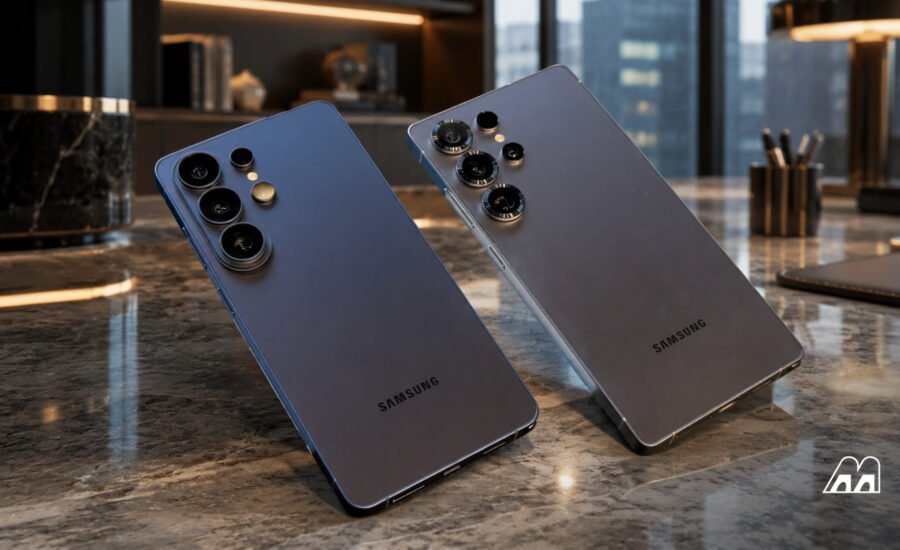
Samsung is printing ink inside its camera lenses — and that might be the most important Galaxy S27 Ultra upgrade you’ll never see. According to a report shared by leaker Ice Universe, Samsung will expand inkjet lens printing to all three rear cameras on the S27 Ultra, up from limited use on the current S26 Ultra. Here’s why a manufacturing detail buried inside a lens stack matters more than any megapixel number.
What Inkjet Lens Printing Actually Does
Every smartphone camera lens is a stack of six to eight tiny glass elements. Between those elements, manufacturers place thin black films to absorb stray light — the kind that causes ghosting and flare when you shoot toward a bright source.
Those films work fine, but they take up space. Inside a module only a few millimeters thick, even a few dozen micrometers of film and adhesive add up.

Samsung’s fix: instead of stacking films, use inkjet equipment to print matte black light-absorbing material directly onto each lens element’s outer rib. Same light-blocking job, far less thickness.
The S26 Ultra introduced this on one lens layer in one module. The S27 Ultra reportedly extends it to the L3 Tele, L3 Wide, and L6 Wide — one layer per module across all three rear cameras. The rest still use conventional film. Samsung is being selective, balancing better optics against manufacturing yields and reliability.
Why Micrometers Matter in 2027
Saving a few dozen micrometers doesn’t sound dramatic. But in smartphone optics, space is everything — it’s what decides whether Samsung can fit bigger sensors, stronger stabilization, or more ambitious zoom optics without growing the camera bump.
That trade-off is about to get much more important. Multiple leaks point to the Galaxy S27 Ultra shipping with a mechanical variable aperture on its 200MP main sensor — a feature Samsung last used on the Galaxy S9 in 2018. Variable aperture means a physical iris mechanism: tiny blades that open and close to control how much light hits the sensor. That mechanism needs room. The inkjet process helps create it.
If Samsung’s Galaxy S27 camera overhaul leaks pan out, the 2027 Ultra would be the first Samsung phone in nearly a decade with real optical aperture control. That’s not a spec bump — it’s a fundamental change in how the camera captures light.
Three Cameras, Not Four — and That’s the Point
The S27 Ultra is also reportedly dropping from four rear cameras to three: a 200MP main, a 50MP ultrawide, and a single 50MP 5x periscope telephoto. The 3x lens that’s been an Ultra staple for six years? Gone.

Samsung’s reasoning: the 200MP sensor can achieve 3x “lossless” zoom through in-sensor cropping, no dedicated lens needed. The freed-up space could go toward Qi2 charging magnets, a larger battery, or the variable aperture hardware.
It’s a calculated trade. Losing a dedicated 3x lens is a real compromise for some shooters. But Samsung is betting that deeper optical engineering — inkjet printing, variable aperture, a potentially larger ultrawide sensor — outweighs one zoom option. The Galaxy S27 Pro is shaping up as the alternative for anyone who still wants that mid-range telephoto.
The Real Race: Samsung vs. Apple in Optics
Here’s the bigger picture most coverage of this story misses.
Apple’s iPhone 18 Pro launches this September with its own mechanical variable aperture — the first in iPhone history, replacing the fixed f/1.78 lens used on Pro models since 2022. Analyst Ming-Chi Kuo flagged the feature in late 2024, and supplier production reportedly began in April 2026.
Samsung and Apple are converging on the same upgrade through very different paths. Apple is investing in a complex iris blade assembly. Samsung is attacking it from the manufacturing side — shaving space inside the module so the mechanism fits without growing the camera bump.
The smartphone camera race is shifting from sensor specs to manufacturing technique. Megapixel counts stopped mattering years ago. Computational photography closed most gaps between flagships. What separates the next generation won’t be on a spec sheet — it’ll be decided by who builds more precise optics in tighter spaces.
What This Means for You
If you’re on a Galaxy S25 or S26, nothing here changes urgently — the S27 Ultra is still months away, expected at Galaxy Unpacked in January or February 2027.
But if you care about phone photography, these manufacturing shifts are worth tracking. Inkjet printing alone won’t transform your photos. Combined with variable aperture, a new sensor, and a streamlined triple-camera layout, it’s part of a package that could genuinely change how the Galaxy Ultra shoots.
Samsung isn’t marketing ink inside its lenses. That’s exactly why it matters.
FAQs
What is Samsung’s Privacy Display on the Galaxy S27?
Privacy Display uses Flex Magic Pixel technology to darken the screen from side angles, keeping your content hidden from people nearby. Samsung debuted it on the S26 Ultra and is reportedly expanding it to the full S27 lineup, including the new Pro model — making it a standard feature rather than an Ultra exclusive.
How does the Galaxy Z Fold 8 Ultra camera compare to slab flagships?
The Fold 8 Ultra packs a 200MP main sensor and triple rear cameras — on par with the Galaxy S26 Ultra. But folding designs limit sensor size and OIS hardware. Our Galaxy Z Fold 8 vs Fold 8 Ultra comparison breaks down where the cameras genuinely differ and where they converge.
When is the Samsung Galaxy S27 Ultra release date?
Samsung hasn’t confirmed a date, but the S27 Ultra is widely expected to debut at Galaxy Unpacked in January or February 2027. The S26 launched on February 25, 2026, and Samsung typically targets that early-year window for its flagship S-series.
Will the iPhone 18 Pro also get variable aperture?
Yes. Apple’s iPhone 18 Pro and Pro Max are expected to launch in September 2026 with a mechanical variable aperture camera — Apple’s first. The system reportedly adjusts between f/1.4 and f/2.8, giving photographers real control over depth of field and low-light capture.
What chipset will the Galaxy S27 Ultra use?
Leaks point to the Qualcomm Snapdragon 8 Elite Gen 6 Pro, built exclusively for Samsung’s Ultra model. The standard S27 and S27+ are expected to run Samsung’s own Exynos 2700 chip, continuing the brand’s region-based chip split.