This article has been revised to reflect NASA’s updated plan for PROMISE to be a hybrid of both the Perseverance and Curiosity engineering testbeds, rather than the Perseverance testbed alone. The cost estimate is unchanged.
In a surprise announcement on June 30, 2026, NASA Administrator Jared Isaacman stated that the agency may send an engineering duplicate of a Mars rover to the Moon.
“We’ve got this hardware that the taxpayers invested a lot in,” said Isaacman. “So the question was posed, what if we sent it to the Moon?”
NASA did not clarify which scientific priorities this project would address or how it would be funded given the 46% cuts currently proposed to the agency’s Science Mission Directorate.
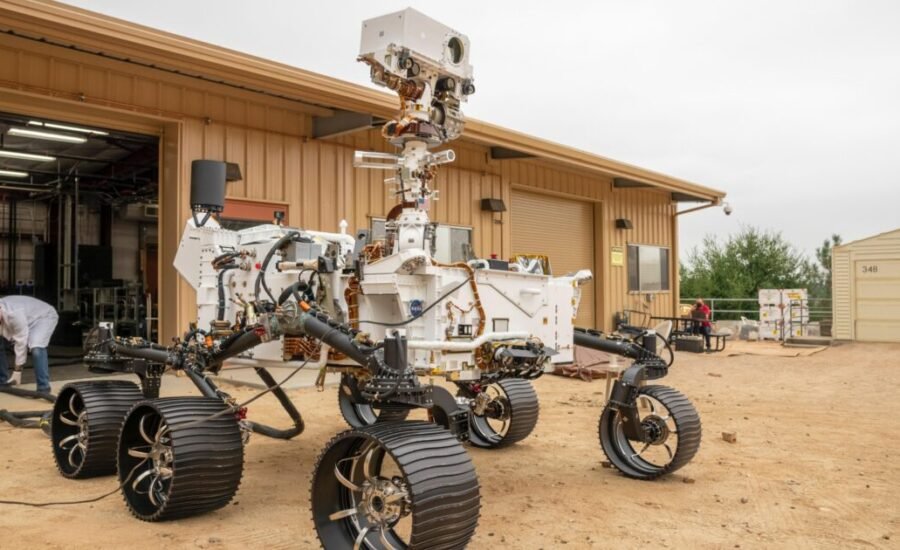
NASA’s Jet Propulsion Laboratory (JPL) maintains two engineering duplicates of the Mars rovers Curiosity and Perseverance on its campus in southern California.
The concept, called PROMISE (Polar Rover for Observation, Mapping, and In-Situ Exploration), would assemble a rover from the body and parts of these engineering test articles for use at the Moon.
PROMISE is presented as a sensible, cost-saving effort to repurpose existing hardware for lunar exploration. It’s a worthy experiment, certainly, but the outcome is far from certain. Qualifying a testbed rover for the rigors of spaceflight will take considerable time and money, particularly since NASA describes PROMISE as using components that could be upwards of 17 years old. Given these complexities, if NASA decides to pursue this project, PROMISE would likely cost the agency between $700 million and $1.3 billion and not launch until sometime in the early 2030s.
To reach this conclusion, I analyzed historical spending on prior missions, NASA procedural requirements, and detailed cost estimates for nuclear-powered lunar rovers done for the most recent planetary science decadal survey.
This is, emphatically, not a replacement for a detailed engineering cost assessment. That effort is currently underway at NASA’s Jet Propulsion Laboratory. Instead, this estimate attempts to define a reasonable cost range based on known requirements: launch costs, spacecraft processing and assembly, mission operations, nuclear power compliance, and science payload development. These quickly add up to hundreds of millions before any hardware upgrades are considered. If nothing else, PROMISE represents a significant opportunity cost that should to be weighed against the declines in overall science funding and the drawdown of investment at Mars and beyond.
Regardless of whether one agrees with every estimate below, one thing is clear: PROMISE is far from a “freebie.” It will consume significant resources that might otherwise be available to pursue established scientific priorities in NASA’s scientific portfolio.