
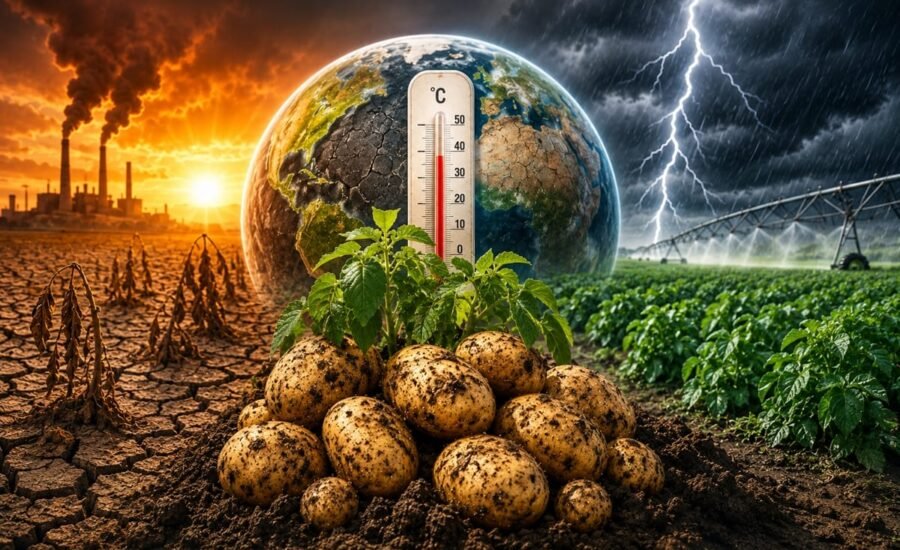
Global warming is no longer just increasing it is speeding up. A new climate study suggests the Earth’s temperature has been rising faster since around 2015, raising fresh concerns for agriculture, including potato production, processing, and global supply chains.
Researchers at the Potsdam Institute for Climate Impact Research (PIK), whose findings were published in Geophysical Research Letters, analyzed global temperature records after removing the effects of natural climate influences such as El Niño, volcanic eruptions, and changes in solar activity. They found that the Earth’s long-term warming rate has increased to around 0.35°C per decade over the past ten years, compared with just under 0.2°C per decade between 1970 and 2015. The trend was consistent across five independent global temperature datasets, with more than 98% statistical confidence, providing the strongest evidence to date that global warming itself is accelerating.
The study did not examine potatoes directly, but its findings reinforce decades of agricultural research showing that higher temperatures and more frequent extreme weather events are likely to create new challenges for potato growers around the world.
Potatoes Prefer Cooler Growing Conditions
Potatoes are grown in more than 150 countries and are one of the world’s most important food crops, with annual production exceeding 380 million tonnes. Unlike many cereal crops, potatoes thrive in relatively cool conditions. When temperatures rise during tuber initiation and bulking, plants produce fewer tubers, the growing season becomes shorter, dry matter accumulation declines, and both yield and quality can suffer.
Scientists have long projected that suitable potato-growing regions will gradually move toward higher latitudes and elevations as the climate warms. At the same time, many traditional potato- producing areas are expected to experience more frequent heat stress, forcing growers to adapt their production practices.
Hotter Weather Could Reduce Processing Quality
Climate change presents challenges that go beyond lower yields.
Heat and drought stress can change how potato tubers develop and store carbohydrates. Under stressful growing conditions, some potato varieties accumulate higher levels of reducing sugars, which can produce darker fries and potato chips during frying through the Maillard reaction.
Higher temperatures can also trigger physiological disorders such as secondary growth, growth cracks, hollow heart, and irregular tuber sizing. These defects reduce the proportion of potatoes that meet the quality standards required by fresh markets and food processors.
With global demand continuing to grow for French fries, potato chips, dehydrated potato products, and other processed potato foods, maintaining consistent raw material quality is becoming increasingly important.
Water Management Will Become Even More Important
As temperatures rise, crops lose more water through evapotranspiration. Because potatoes have a relatively shallow root system and are highly sensitive to water stress during tuber initiation and bulking, irrigation demand is expected to increase across many growing regions.
Rainfall patterns are also becoming less predictable. Longer dry spells, more frequent droughts, and heavier rainfall events are making irrigation scheduling increasingly difficult. As a result, technologies such as precision irrigation, soil moisture monitoring, and practices that improve soil water-holding capacity will play a larger role in sustaining potato production.
Pests and Diseases Are Likely to Shift
Warmer conditions are also expected to change the distribution and activity of important potato pests and diseases.
Insect vectors such as aphids and potato psyllids may survive across larger geographic areas and remain active for longer periods, increasing the risk of virus transmission in some regions. Changes in temperature and moisture may also affect diseases such as late blight, bacterial wilt, and blackleg, although the impact will vary depending on local climate conditions.
Researchers say integrated pest management strategies will need to continue evolving as weather patterns change.
Storage and Supply Chains Face New Challenges
Climate change affects much more than crop production.
Higher temperatures are expected to increase cooling requirements during potato storage, raising energy costs for growers and processors. Without effective temperature control, potatoes respire faster, sprout earlier, and have a shorter storage life, leading to greater postharvest losses.
Extreme weather events—including heatwaves, floods, droughts, and storms—can also disrupt harvesting, transportation, and processing, making potato supply chains more vulnerable and increasing market volatility.
Building a More Climate-Resilient Potato Industry
Although the latest climate study focused on measuring the acceleration of global warming rather than agricultural impacts, its findings highlight the growing need to strengthen climate resilience throughout the potato industry.
Researchers, breeders, growers, and processors are already investing in solutions. These include developing heat- and drought-tolerant potato varieties, improving irrigation efficiency, adopting regenerative farming practices that build healthier soils, using digital crop monitoring systems for early stress detection, investing in advanced storage technologies, and adjusting planting dates where necessary.
Organizations such as the International Potato Center (CIP) are accelerating breeding programs to develop potato varieties that can maintain productivity under higher temperatures, increasing water scarcity, and greater pest and disease pressure. At the same time, advances in precision agriculture, artificial intelligence, and remote sensing are giving growers better tools to monitor crops and respond quickly to changing conditions.
The Road Ahead for Global Potato Production
The latest research sends a clear message: climate change is accelerating, and agriculture will need to adapt just as quickly.
For the global potato industry, the challenge extends far beyond the farm. Rising temperatures are expected to influence irrigation needs, storage conditions, processing quality, pest and disease pressure, and the resilience of supply chains.
The industry has already begun investing in climate-smart technologies and more resilient production systems. However, if global warming continues to accelerate, those efforts will need to move even faster.
Continued collaboration between researchers, breeders, growers, processors, technology companies, and policymakers will be essential to protect potato yields, maintain tuber quality, strengthen food security, and ensure that one of the world’s most important food crops remains productive in a changing climate.