
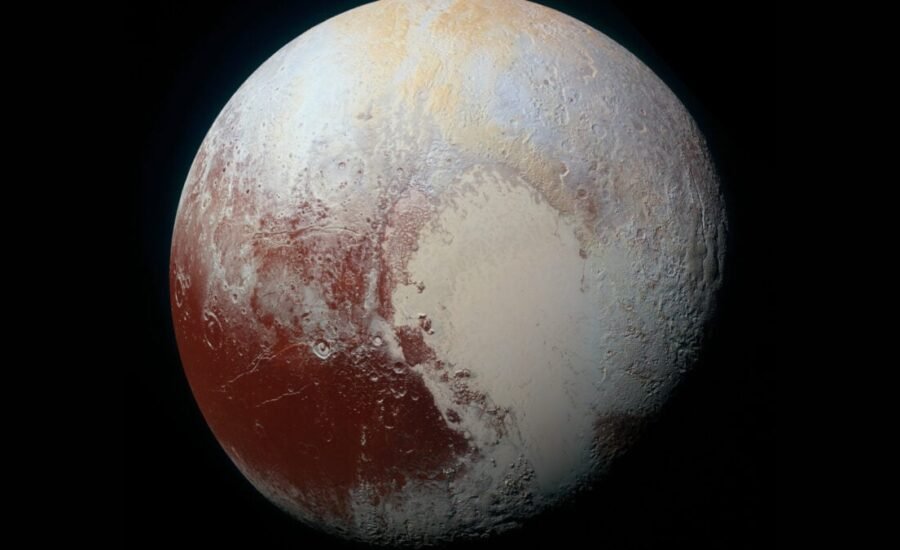
Odd surface patterns on Pluto hinted to astronomers that, sometime in the past—quite possibly not that long ago—liquid existed on its surface. A team of planetary scientists believe they’ve found it.
A new analysis of New Horizon images of the Sputnik Planitia, a section of Pluto’s massive, heart-shaped glacier, suggests that liquid nitrogen once existed on the dwarf planet’s surface. The study, published late last month in The Planetary Science Journal, presents the first evidence of recent liquid flow on Pluto. That is, recent on astronomical scales; Sputnik Planitia is presumably less than one million years old, so if the findings are true, it would mean that liquid nitrogen was present sometime in that period.
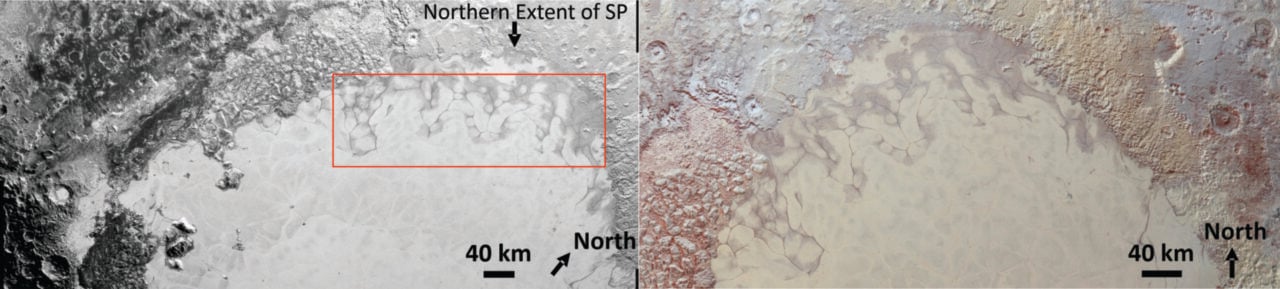
“Pluto never stops surprising us, and this new result certainly does that,” Alan Stern, the study’s lead author and New Horizons’s principal investigator, said in a statement. “In addition to suggesting that liquids have recently expressed themselves on Pluto’s surface, it also suggests a new kind of time-variable feature on Pluto.”
The right spot
According to the paper, the area that came to be called the Sputnik Planitia caught astronomers’ interest even before New Horizons. Hubble’s observations and other data indicated that one specific section of Pluto had an unusually bright terrain. This was one important reason that, when New Horizons made its Pluto flyby in 2015, Sputnik Planitia was deemed a primary target for high-resolution observations.
Astronomers’ assumptions were on the mark. New Horizons’s images of the region showed unique patterns of dark linear patterns, whose albedo, or fraction of diffusely reflected sunlight, was “remarkably close to that of the Earth’s polar ice sheets,” the researchers explained in the paper. However, Pluto’s thin atmosphere, as we observe it today, makes liquid nitrogen rain physically impossible, the researchers explained in the statement.
Inklings of nitrogen
As a result, prior analysis on Sputnik Planitia, including those Stern was involved in, assumed that there were some ancient liquid flows. The latest paper, on the other hand, evaluates the hypothesis that there is currently or recently liquid nitrogen below the glacier. For the study, the team ran computer simulations to confirm it was feasible for liquid nitrogen to push upward from beneath the glacier and form the distinctive patterns we see on Pluto’s surface today.
The researchers found that it was possible for liquid nitrogen to travel up small conduits, like lava or geyser tubes, and remain liquid long enough to create dark patterns on the nitrogen glacier. That said, Pluto, due to its sheer distance, remains an enigma to astronomers, and future observations may or may not further this hypothesis.
“Pluto has many unique terrains seen nowhere else in the solar system, and this area of Sputnik Planitia is one of them,” added Kelsi Singer, a study co-author and a research scientist at the Southwest Research Institute. “Its surface provides a different set of conditions compared to what we are used to on Earth, and exploring that allows us to better understand how materials behave in environments that are difficult to produce on Earth.”
Related article: Pluto’s Atmosphere May Finally Be Starting to Collapse