
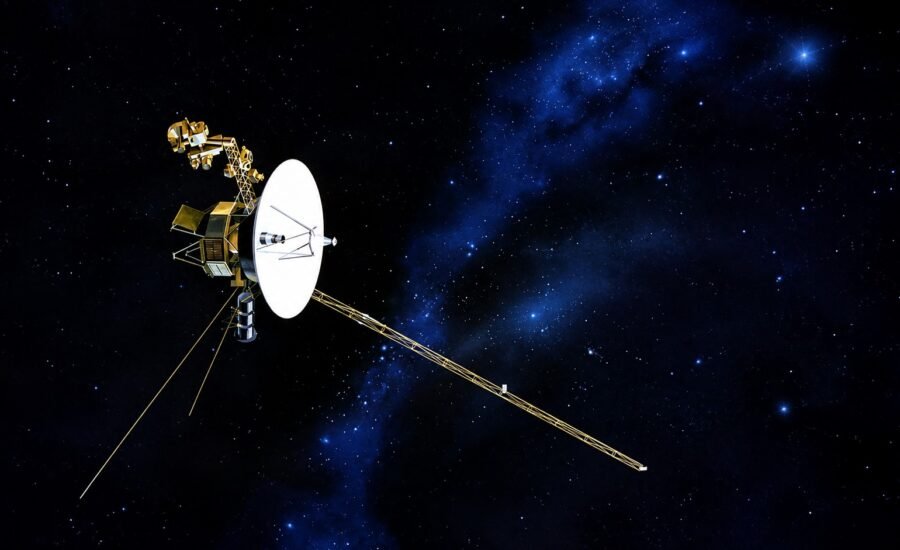
A 49-year-old spacecraft, 12 billion miles from Earth, was about to lose one of its last three scientific instruments. Its plutonium power supply bleeds roughly 4 watts per year — down to about 57% of its 1977 output. On August 4, 2026, JPL engineers sent a precisely choreographed command sequence they nicknamed “Big Bang” across 17 hours of empty space. Two heaters and a device kept running solely for its residual warmth were swapped simultaneously for lower-power alternatives. Everything had to change at once, because near absolute zero, you don’t get to toggle things off one by one and hope for the best.
One Swap, No Take-Backs
The Big Bang traded heating sources in a single irreversible sequence to keep Voyager 2’s fuel lines from freezing.
The name fits. Interstellar space sits near −459°F. Every configuration — old and new — had to satisfy thermal minimums from the very first moment of the swap. Think of it like defusing a bomb by replacing three wires simultaneously, except the bomb is older than the iPhone by three decades, and your wire cutters are a radio signal that takes 17 hours to arrive.
- Three instruments preserved: the Triaxial Fluxgate Magnetometer (MAG), Plasma Wave Subsystem (PWS), and Cosmic Ray Subsystem (CRS)
- CRS had been scheduled for shutdown before the end of 2026 — now postponed by at least a year
- Data still trickling home at 160 bits per second from interstellar space
- Engineers waited nearly two days for confirmation the spacecraft survived the swap
As NASA and JPL reporting has emphasized, every watt saved on Voyager is a permanent decision, according to The Register and JPL mission coverage. No do-overs. None.
This wasn’t JPL’s first hack. In 2023–2024, engineers raided backup power originally reserved for voltage regulation — a calculated bet that a spacecraft with nearly five decades of stable operation probably wouldn’t see a voltage spike. The Big Bang stacks on top of that earlier gamble. These aren’t improvisations; they are the logical final moves in a decades-long chess match of load reduction and load substitution.
Voyager 1 Is Next – and the Clock Is Already Running
NASA plans a similar reconfiguration on Voyager 1 after an unexpected power drop cost it an instrument in April 2026.
Voyager 1 is already down to two instruments. An unexpected power loss during a February 27 roll maneuver forced the Low Energy Charged Particles (LECP) experiment offline on April 17. NASA reportedly plans a similar Big Bang swap in the coming months, with hopes of actually restoring LECP after the reconfiguration succeeds. This is spacecraft surgery performed via telegraph.
Original mission scientist Garry Hunt has noted that engineers “brimmed the spacecraft’s tanks” and designed explicitly for possible extensions, according to The Register — foresight from the Carter administration still paying dividends nearly 50 years later.
If both probes survive their respective procedures, Voyager could reach its 50th anniversary in 2027 still returning multi-instrument interstellar data, with at least one instrument projected to operate into the 2030s. The engineering lessons here — end-of-life load substitution, safety-reserve repurposing, thermal choreography — will shape how future RTG-powered deep-space missions are designed and managed. Sometimes the most radical thing you can do is refuse to let something old die.