

This article explains how this helps REIT and InvIT investors.
If a REIT, InvIT opts for the new tax regime then what does this amendment mean for its unitholders?
The REIT, InvIT holders used to pay no tax on dividends recieved if the trust had opted for old tax regime, but if it opted for new tax regime, unitholders got not such tax exemption. So this amendment changes this and extends the tax exemption on dividends received by REIT, InvIT unitholders even if the REIT, InvIT has opted for the new tax regime.
The Bill amends the taxation framework applicable to Business Trusts by extending dividend tax exemption to unit holders while correspondingly increasing the surcharge on Special Purpose Vehicles (SPVs). Clause (b) of the Schedule V [Table: Sl. No. 5.D] is proposed to be omitted to provide tax exemption on dividend received by a unit holder, even where SPV has exercised the option under section 200 of the Income-tax Act, 2025 to move to new tax regime.
Before you continue reading
How financially free are you?
Most people overestimate their financial freedom. Discover your Financial Freedom score through a quick survey

Chartered Accountant Suresh Surana explains that this says that if a Real Estate Investment Trust (REIT) / Infrastructure Investment Trust (InvIT) [through its underlying Special Purpose Vehicle (SPV)] opts for the concessional (new) tax regime, this amendment is favourable for its unitholders.
Surana says: “The amendment provides the exemption of dividend income in the hands of REIT/InvIT unitholders in respect of dividends distributed by an SPV that has opted for the concessional tax regime.”
According to Surana, prior to this amendment, where an SPV opted for the concessional tax regime under Section 200 or 201 of the Income Tax Act, 2025 (corresponding to section 115BAA or 115BAB of the Income Tax Act, 1961), the dividend distributed by such SPV and passed through the REIT/InvIT lost its tax-exempt character and became taxable in the hands of the unitholders.
Neeraj Toshniwal, CFO, Knowledge Realty Trust REIT, says that in the last budget, however, it was clarified that SPVs under the old regime could not carry forward MAT credit, but dividend will be exempt in the hands of unit holders. However, dividend exemption was not permitted under the new tax regime. This issue is now fixed via this amendment in the tax framework.
Toshniwal said to ET Wealth Online: With this amendment in the tax framework, SPVs can now transition to the new tax regime and avail MAT credit set-off of up to 25% of their annual tax liability. Importantly, dividend income distributed by REITs — irrespective of whether they opt for the old or new regime — will now be exempt in the hands of unit holders.”
Also read: Nexus Select Trust posts 11% increase in net operating income to Rs 510 crore
What is the catch?
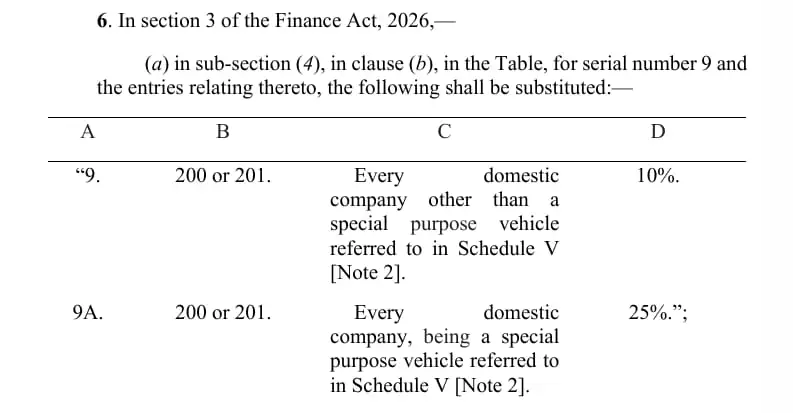
SPV of a REIT or InvIT can opt for the new tax regime but this means they need to pay a 25% surcharge, whereas the surcharge rate is 10% under the old tax regime. However, the amendment says that if the SPV opts for the new tax regime, then also its dividend is tax exempt for unitholders. So this decision is not so easy to take and will need careful evaluation by the respective REIT and InvIT.
Surana says: “While the recent amendment enhances the attractiveness of the concessional regime (new tax regime) by exempting dividends in the hands of unit holders, the corresponding increase in surcharge at the SPV level means that the optimal choice will depend on the facts and financial profile of each structure rather than a uniform rule.
The surcharge rates:
Source: CA Suresh Surana
Some FAQs from the Income Tax Department
What are the present provisions of exemption in respect of dividends receivedorreceivable by a unit holder of a business trust from an SPV of such business trust?
Ans: Business trusts are pass-through vehicles. They collect funds of unit holders andinvestin real estate or infrastructure through a company (special purpose vehicle – SPV). TheSPVpays tax on its profits and thereafter passes dividends to business trusts which is passedontothe unit holders.
At present, in the case of a business trust, dividend is exempt in the hands of a recipient unitholder only if SPV is taxable under the old tax regime. If the SPV is in the newtaxregime, the exemption of dividends is not available to the unit holders.
Who shall be eligible for exemption under the proposed provision?
A unit holder shall be eligible for exemption on the dividend received fromtheSPVopting for new tax regime.
Embassy Park REIT investors can also benefit
Amit Shetty, CEO, Embassy REIT says that by enabling REIT SPVs to opt for the Concessional Tax Regime (CTR) and utilise accumulated MAT credits, while preserving the tax-exempt treatment of dividends distributed to unitholders, the Bill upholds the principle of tax neutrality that is fundamental to the REIT model.
Shetty says: “REIT SPVs opting for this regime will also benefit from a lower tax rate and will not be required to pay Minimum Alternate Tax (MAT) going forward.”
Shetty says: “For Embassy REIT, subject to the final enacted provisions, this will restore the economic value of approximately Rs 592 crore of accumulated MAT credits that had previously been written off in books of accounts.”
According to Shetty, the benefit can accrue progressively through lower cash taxes, strengthening distributable cash flows and creating additional value for their unitholders.
Should REIT and InvIT trusts choose the old tax regime or the new tax regime?
Surana says that the decision on whether the SPV of a REIT or InvIT should opt for the old tax regime or the concessional (new) tax regime cannot be made in isolation and must be evaluated on a case-by-case basis. Accordingly, the appropriate tax regime should be determined after assessing the overall tax efficiency of the entire structure rather than focusing solely on the tax liability at the SPV level.
Surana says that where the SPV opts for the concessional tax regime (new tax regime) under Section 200 or 201 of the Income Tax Act, 2025, dividends distributed by such SPV to the REIT or InvIT are exempt in the hands of the unit holders.
Surana says: “However, this benefit is accompanied by a higher surcharge rate of 25% applicable to the SPV.”
Alternatively, where the SPV continues under the old tax regime, the surcharge burden may be lower, although the overall corporate tax outflow may be higher depending on the deductions, incentives and tax attributes available to the SPV.
Surana says: “The Surcharge rate is 10% under the old tax regime.”
Surana explains that the decision should be based on a comprehensive assessment of the overall tax cost rather than the tax position of the SPV or the unit holders in isolation. Key factors that should be evaluated include:
The effective tax liability of the SPV under the old and concessional tax regimes, including the impact of the higher surcharge.
The quantum of dividends expected to be distributed through the REIT/InvIT and the tax benefit arising from the exemption available to unit holders under the concessional regime.
The availability and value of deductions, incentives or tax attributes that may not be available under the concessional regime.
The commercial objectives of the REIT/InvIT, including cash flow requirements, distribution policy and long-term investment strategy.
Therefore, the choice between the two tax regimes should be made only after carrying out a holistic cost-benefit analysis of the entire REIT/InvIT structure.
What amendments were made
Surana said to ET Wealth Online that theThe Taxation and Other Laws (Amendment) Bill, 2026 marks the first significant set of amendments to the Income-tax Act, 2025 since its implementation.
- The proposed amendments include rationalisation of the safe-harbour framework for offshore investment funds, extension of tax incentives for the electronics manufacturing sector, relaxation of conditions for data-centre operations, introduction of new exemptions for foreign investors in Government securities and rough diamond trading, and a new exemption for foreign companies storing electronic components in customs-bonded warehouses.
- The Bill also revises the taxation framework applicable to Business Trusts by extending dividend exemption to unit holders while correspondingly increasing the surcharge on Special Purpose Vehicles (SPVs).
- In addition, consequential amendments have been proposed to the Payment and Settlement Systems Act, 2007 to establish an independent framework for notifying electronic payment modes.
Can the REIT and InvIT trust change tax regimes?
Surana says that the recent amendment does not modify the statutory framework governing the exercise or withdrawal of the option to choose between the old and the new (concessional) tax regimes.
Instead, the amendment is confined to altering the tax consequences where the underlying SPV opts for the concessional tax regime by exempting dividends received by REIT/InvIT unit holders while subjecting such SPVs to a higher surcharge.
It is also pertinent to note that the Income Tax Act, 2025 the process for opting for tax regimes has been simplified.
Surana says that under the erstwhile Income Tax Act, 1961, taxpayers were generally required to exercise or withdraw such an option for changing tax regimes by filing the prescribed forms, subject to the applicable provisions.
However, Sections 200 and 201 of the Income Tax Act, 2025, read with Rule 136 of the Income Tax Rules 2026, now provide that wherever an option to opt into or withdraw from a concessional tax regime is available under the specified provisions, such option shall be exercised or withdrawn through the income tax return (ITR) furnished under Section 263(1) for the relevant tax year.
Surana says: “Accordingly, an eligible REIT or InvIT is no longer required to file a separate prescribed form, and the election for tax regime change can now be made directly in the ITR for the relevant tax year.”