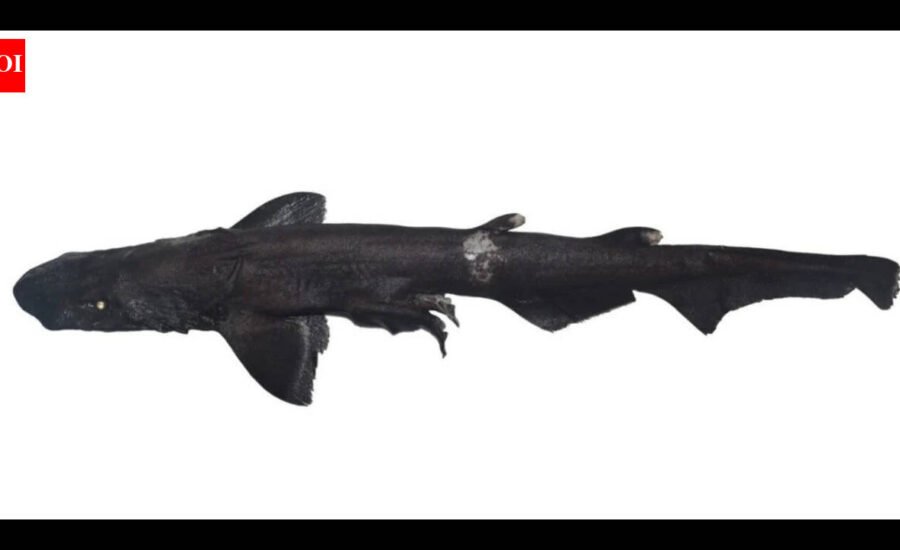
The deep sea is often called the last unmapped frontier on Earth, and India’s coastline has also proven that true in surprising ways.While a new discovery is expected to happen through a designated research expedition, one was made by fishermen catching their shrimp.Off the coast of Kerala, in deep and dark waters, scientists found a brand-new predator previously unknown to science that most of us only fear. This predator, a dark-bodied catshark with strange, pale white eyes, had never been spotted before and has been quietly living hundreds of metres below the surface.
A deep-sea shark that was discovered by fishermen
In 2022, scientists sorting through the catch of deep-sea shrimp trawlers came across an unusual fish, one that looked black, slender-bodied, with a sharply pointed snout and gleamy white eyes. It had been pulled up from depths of 400 to 650 metres at the Kollam slope, a continental shelf edge in the southeastern Arabian Sea that has been designated an Important Shark and Ray Area. Researchers quickly identified it as belonging to Apristurus and took it for further study.
The species now has a name
Two years later, in 2024, the same team collected three more specimens at the Sakthikulangara Fisheries Harbour in Kollam during routine monitoring surveys. Combining morphological study with molecular analysis of all four specimens, the researchers concluded that this catshark was different from every other known species in its genus.They described it as ‘Apristurus drona’, publishing their findings in the journal Zootaxa earlier this year. The study was carried out under the Ministry of Earth Sciences’ Deep Ocean Mission.
Another similar discovery was also made
In 2024, some of the same Kerala-based researchers described an entirely different new species, a deep-water dogfish shark named Squalus hima, based on 13 specimens collected from the same general region.“The new species, Squalus hima, was discovered from samples we collected from a fishing harbour in Kerala close to the Arabian Sea,” team leader and ZSI scientist Bineesh KK of the Marine Biology Regional Centre said, according to a PTI report. He noted that taxonomic reassessment of the genus Squalus across the Indo-Pacific has revealed many species that were historically lumped together under one name.