California recognised Diwali as a holiday in October 2025. Now, a court has struck down key provisions of AB 268, the law recognising the Hindu festival as an official state holiday, ruling it violates constitutional protections against government endorsement of religion
A July legal ruling last month in California has placed the official state recognition of Diwali at the centre of a constitutional debate.
United States Superior Court Judge Stephen Acquisto struck down key provisions of Assembly Bill 268 (AB 268) — the legislation that designated Diwali as an official state holiday — ruling that the law violates the Establishment Clause provisions of both the US Federal and California State Constitutions.
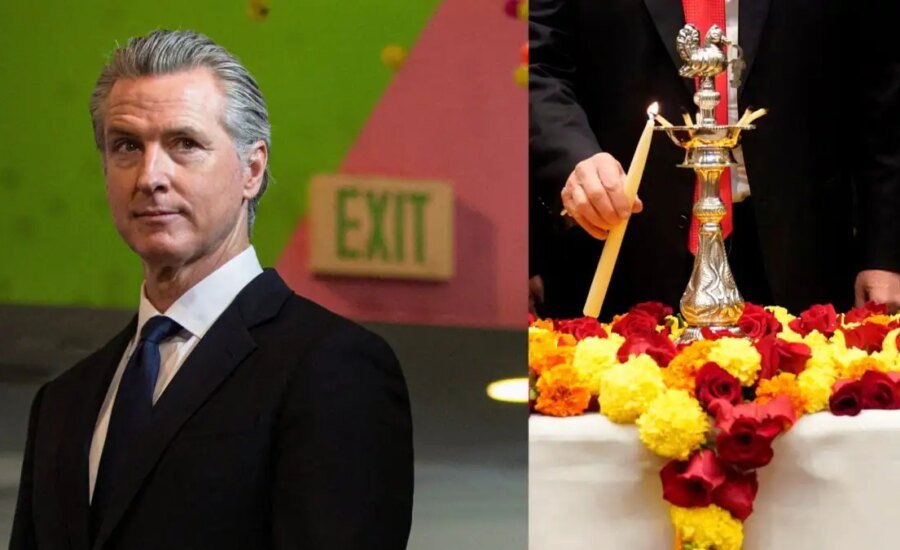
California Governor Gavin Newsom signed Assembly Bill 268 into law last year with it coming to effect on January 1 this year, making California the third US state to recognise the festival after Pennsylvania and Connecticut.
The court determined that AB 268 provided preferential treatment to Diwali based explicitly on its religious significance without presenting a sufficient secular rationale.
The decision has put the issue under the lens as many civil rights advocates and the Indian American community call for the ‘festival of lights’ to be integrated into public law.
What the July ruling means
In his decision, Acquisto found that the statutory language of AB 268 leaned heavily on the theological and spiritual heritage of the festival rather than framing it around secular, administrative, or civic grounds.
 More from Explainers
“The Court finds that AB 268 violates several provisions of the federal and state constitutions by giving Diwali special treatment expressly based on its religious importance without any significant secular considerations,” Acquisto wrote in his ruling.
Key details of the court decision:
- Constitutional conflict: The ruling centres on the Establishment Clause, which prohibits state governments from endorsing or giving legal preference to specific religions.
- Statutory scope: The decision strikes at amendments previously made to the California Government Code, Education Code, and Code of Civil Procedure.
- Immediate practical impact: Public school districts and community colleges that adjusted their academic calendars under AB 268 face legal ambiguity ahead of the upcoming fall term, while state employee leave policies tied to the specific statute are paused pending appeals.
The origin of California’s AB 268
Introduced by California State Assembly member Ash Kalra and signed into law by Newsom in October, AB 268 formally marked the state-level holiday recognition of Diwali.
| Provision category | Specific details under AB 268 | Current status (post-ruling) |
| State employee leave | Allowed eligible state employees to use paid leave specifically for Diwali. | Suspended/Subject to appeal |
| School closures | Permitted K-12 school districts & community colleges to close via union agreements. | Discretionary local decisions under review |
| Educational programmes | Incorporated Diwali cultural history into school curricula alongside Native American Day. | Enjoined under religious wording grounds |
| Judicial operations | Did not establish Diwali as a court-closed holiday (courts remained open). | Unchanged |
How the community reacted
The ruling triggered strong reactions across legal and advocacy groups representing South Asian Americans.
The Hindu American Foundation (HAF) expressed deep concern over the judgement, arguing that the court prioritised textual phrasing over the practical, civil purpose of the law.
HAF pointed out that the true intent of AB 268 was accommodation rather than endorsement — allowing students and employees to celebrate a central festival without incurring academic or professional penalties.
Legal experts noted that while Christmas is recognised as a federal and state holiday due to its long-standing secularised status under US case law (eg Lynch v Donnelly), newer legislative recognitions of religious festivals face stricter judicial scrutiny regarding secular justification.
Asian American legislative caucuses in Sacramento are evaluating whether to appeal the decision to the California Court of Appeal or introduce remedial legislation featuring modified, secularised language.
Diwali (Deepavali) is also officially recognised by Unesco on the Representative List of the Intangible Cultural Heritage of Humanity.
How Diwali is recognised across US states
California’s legal challenge stands in contrast to a growing movement across the United States to recognise Diwali, driven by the expanding Indian American demographic — the fastest-growing Asian diaspora group in the country.
- Pennsylvania: In 2023-2024, Pennsylvania officially passed legislation making Diwali a state holiday, recognising the state’s growing Hindu, Sikh, Jain, and Buddhist populations.
- Connecticut: Designated Diwali as an official public state holiday, granting state-level recognition.
- New York City (New York): Governor Kathy Hochul signed legislation in November 2023 establishing Diwali as a mandatory public school holiday in New York City, replacing another non-specified school day on the academic calendar.
- Los Angeles: LA County has officially recognised Diwali since 2022.
- Local school districts: Numerous school districts in New Jersey, Massachusetts, Texas, and Virginia give students an official day off for Diwali based on local school board decisions.
How US presidents observe Diwali
At the federal level, Diwali has gained massive ceremonial visibility over the past two decades, even as congressional efforts to declare it a federal public holiday remain under consideration.
- George W Bush administration (2003): Established the first official White House Diwali celebration.
- Barack Obama administration (2009-2016): Obama became the first sitting president to light a diya (lamp) in the Oval Office in 2016.
- Donald Trump administration: Continued the tradition, hosting annual reception events and Oval Office diya-lighting ceremonies with Indian American leaders.
- Joe Biden administration: Hosted the largest White House Diwali receptions in history, inviting diplomats, lawmakers, and community leaders to the East Room.
Federal lawmakers have periodically introduced the Diwali Day Act in the US House of Representatives.
Championed by lawmakers including Congresswoman Grace Meng and Congressman Raja Krishnamoorthi, the legislation seeks to add Diwali to the list of federally recognised holidays alongside Thanksgiving, Christmas, and Juneteenth.
What next for Diwali in California
With the July Superior Court order in place, state officials and advocacy organisations are preparing their next legal steps.
The state’s Department of Justice must determine whether to file an appeal before the California Court of Appeal or work alongside Kalra’s office to draft revised, secularised statutory text that conforms to legal precedent.
As California’s Indian American population continues to grow to almost a million, the resolution of this case will serve as an important legal benchmark for how non-Western cultural and religious traditions are recognised in American public life.
This year Diwali falls on Sunday, November 8.
With inputs from agencies