Photo: Xinhua
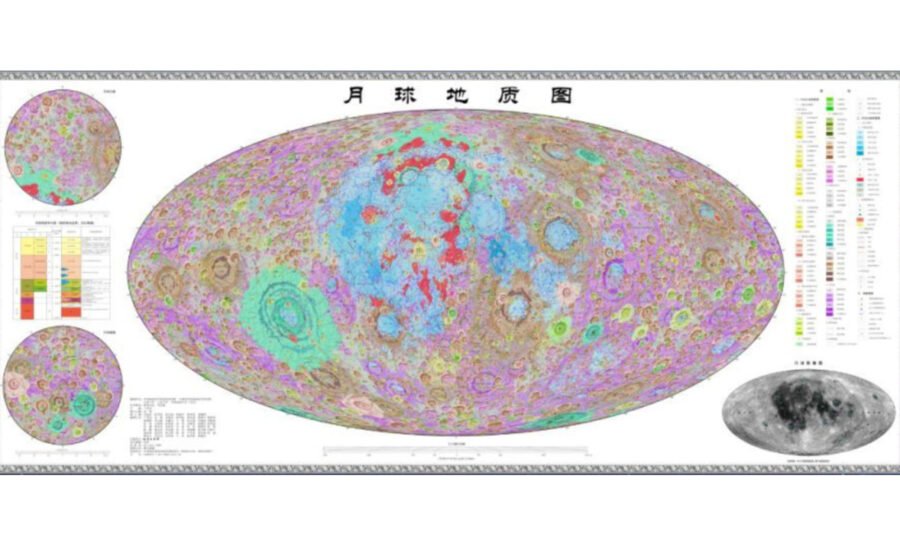
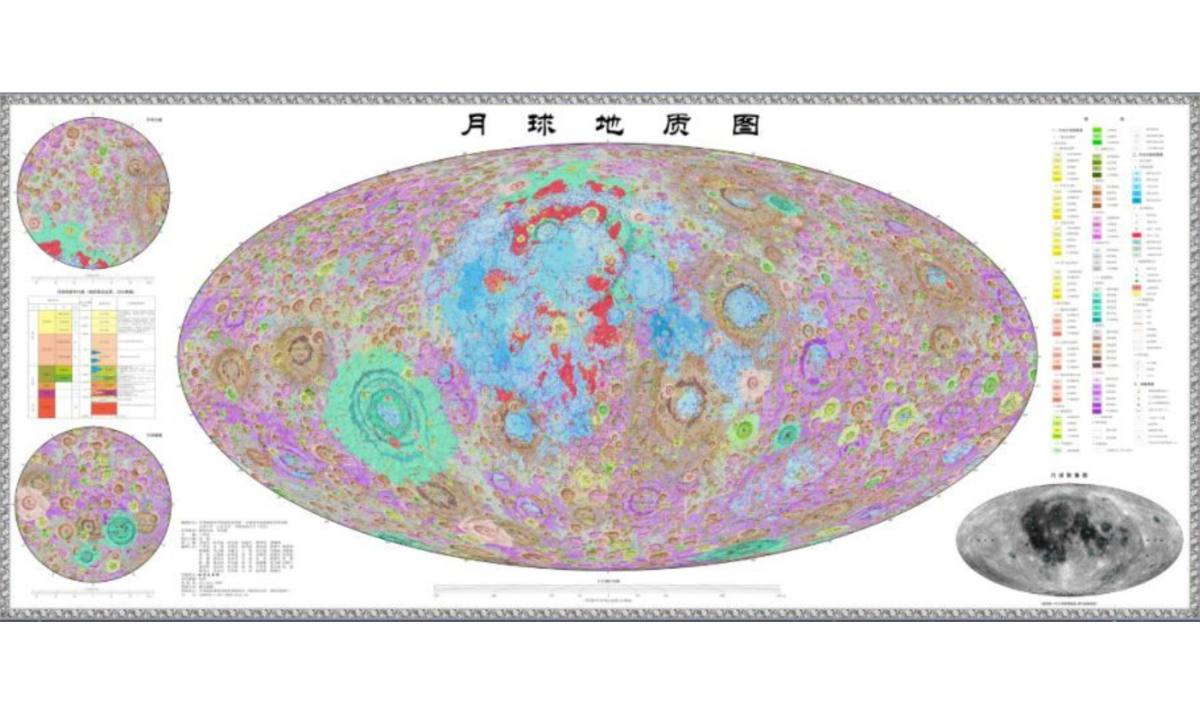
Using the latest data from the Chang’e lunar exploration program and other lunar exploration efforts, Chinese scientists have completed a 1:5,000,000 geological map of the entire moon, for the first time providing a more detailed global classification of the moon’s late-stage geological layers and key scientific support for China’s future lunar research station, landing site selection and deep-space exploration, while contributing to humanity’s exploration on the Solar System’s evolution, the Xinhua News Agency reported on Thursday.
Measuring approximately 280 centimeters in length and 120 centimeters in height, the lunar geological map includes detailed maps of the moon’s polar regions, precisely identifying over 13,000 impact craters and 81 basins, while classifying 14 geological structure types and 17 rock types.
According to the map’s compiling team from the Institute of Geology, Chinese Academy of Geological Sciences, the map has achieved systematic innovations in three key areas, based on the latest exploration data from the Chang’e lunar exploration program and other missions, and balancing scientific accuracy and accessibility.
The map updates the moon’s geological timescale, revising the starting ages of key periods. The starting ages of the Aitkenian Period and the Nectarian Period have been adjusted to 4.33 billion years and 4.17 billion years, respectively, while the starting age of the Imbrian Period has been slightly revised to 3.92 billion years. This map for the first time provides a more detailed global classification of the moon’s late-stage geological layers.
The map also updates the moon’s material inventory with high-resolution mineral distribution data and improved rock classifications. Findings from the Chang’e-4 and Chang’e-6 missions led to the identification of gabbronorite in the South Pole-Aitken (SPA) Basin, offering new insights into the moon’s deep interior.
The map introduces a customized visualization system for its 1:5,000,000 scale. To meet the requirements of the 1:5,000,000-scale mapping, researchers established differentiated minimum representation scales for various geological features. This ensures that the large-scale map maintains overall readability while preserving key geological characteristics of major scientific significance.
According to Yang Zhiming, director of Institute of Geology, the newly released lunar geological map will support China’s future lunar research station, landing site selection, and deep-space exploration, while contributing new Chinese insights into the study of Solar System evolution.
Global Times