Twelve days out from the BWF World Championships, the Indira Gandhi Indoor Stadium smells of fresh paint.
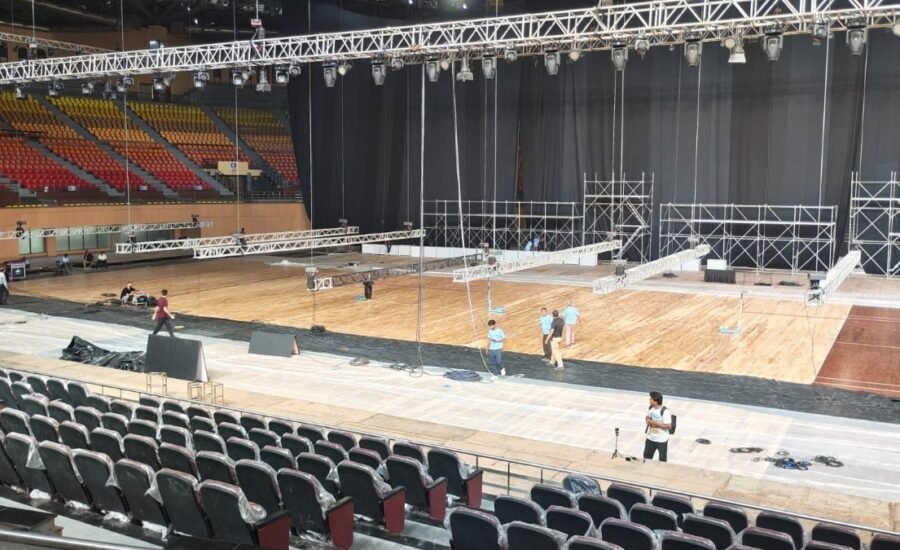
That is the first thing you notice walking in after Wednesday’s draw ceremony. The second is the sound: drills, not silence. Workers are laying new flooring in patches. The seats are already in, rows of them, looking factory-fresh, with the VIP section still wrapped in its covers.
At every entry point around the stadium, a glass enclosure is going up, part of a triple-door system that will keep matches free of distractions. New signage leans against a wall, still in its packaging. None of it looks finished. All of it looks deliberate.
It needs to. The last time the world’s badminton fraternity gathered here, in January, the story was a different one. Pigeons interrupted a second-round match between HS Prannoy and Loh Kean Yew, forcing play to be halted twice. Denmark’s Mia Blichfeldt called the practice conditions dirty and unhealthy.
Anders Antonsen withdrew and was fined for it. Players wore extra layers to stay warm, complained of Delhi’s smog thinning their lung capacity throughout the tournament, and BAI found itself fielding questions it could not fully answer. The Badminton World Federation eventually stepped in with a statement acknowledging cleanliness, hygiene and animal control issues at the venue, even as it defended the shift away from the old KD Jadhav Stadium.
Seven months on, BAI secretary Sanjay Mishra wants that episode remembered as the reason for what is now underway, not a shadow hanging over it.
“It was in Paris that India officially accepted the responsibility of hosting the Championship. It was a proud moment, but more importantly, it was a responsibility of bringing the World Championships to India after 17 years,” Sanjay Mishra said at the draw ceremony in Delhi on Wednesday, August 5.
“From that day onwards, every decision we have taken has been guided by one simple objective, to deliver a world championship that reflects the very best of Indian hospitality, our organisational excellence and global standards of our hosting.”
200 DAYS, Rs 20 CRORE
The numbers he offers are meant to back that up.
“More than 200 days of planning has gone into preparation, close to Rs 20 crore is being invested in transforming the Indira Gandhi Indoor Stadium into a world-class badminton venue. More than 1,200 professionals, including engineers, technicians, event specialists, volunteers and support staff behind the scene. We have also roped in international specialists, including lighting experts from Indonesia, to ensure every expectation of the standard of world championships is met.”
Walking the venue, the spending is visible rather than merely claimed. The seats are new and already fitted, the VIP block kept under wraps until it is needed. The floor, wooden and championship-grade, is being laid section by section. Overhead, riggers are working on the lighting rig, presumably the same brief that brought in the Indonesian specialists Mishra mentions. The triple-door glass system, unusual for an Indian sporting venue, is built around every entry point into the stadium: an enclosure the crowd must pass through before reaching the door proper, designed to keep entry authorised and controlled.
A worker on site, asked about the pace of the work, said it had begun roughly a week earlier and that the brief went beyond the World Championships alone. This was being treated as a full facelift for the stadium, not a temporary dressing-up.
Sanjay Mishra says the work has been a collective effort, one he believes will pay off when the World Championships begin.
“This is a collective effort of the BWF, BAI, the government of India, the Ministry of Youth Affairs and Sports, the Sports Authority of India, our sponsors and partners, our vendors and every member of the organising committee,” he said.
“I am 100 percent sure this World Championships will be one of the best.”
Pressed on the criticism in January specifically, he does not deflect.
“We faced problems at the India Open. Our preparation began right after the India Open. This is not a day’s work. It’s almost complete now. Work has been done on every single aspect. Walls, floors, false ceiling, roof, the cleanliness at the venue, we have worked on animal control, pigeon control,” he said.
“I think the problems that we faced in India Open, we will not face them now.”
THE AQI PROBLEM
Delhi’s air was the loudest complaint in January, and it remains the hardest one to simply renovate away. The city was deep in its winter smog season during the India Open, with AQI readings across the capital regularly climbing past 400, the kind of numbers that put the “very poor” tag on the day and had shuttlers reaching for masks between matches.
The picture in August is different by nature of the calendar alone: the monsoon has arrived, rain is washing the air rather than fog trapping it, and readings on the ground this week have mostly sat in the moderate-to-poor band, somewhere around the 100 mark rather than the 250 to 300 Delhi sees in December and January.
The cold that Blichfeldt, Michelle Li and Ratchanok Intanon all complained about in January is a non-issue by definition in August, and Mishra does not pretend otherwise.
“There is no cold. The January weather was a complaint,” he said, before turning to the other recurring gripe from that week. “There will be no toilet-related issues, I can assure you that. The toilets will be cleaner than the airport toilets.”
The practice venue remains the KD Jadhav Hall, the same facility that came under criticism during the India Open after Denmark’s Mia Blichfeldt described the conditions as dirty and unhealthy. This time, BAI says cleanliness at the venue has been a priority.
“The practice venue will be KD Jadhav Indoor Arena. Warm-up and matches will be at IGI Stadium. The mini hall at KD Jadhav has been made the practice venue,” Mishra said.
None of this is happening in a vacuum. More than 300 shuttlers from over 55 countries will compete across the seven days from 17 to 23 August, with the total contingent in Delhi, including support staff, international journalists and volunteers, expected to touch 800. It is India’s first time hosting the World Championships since 2009, and the first time ever in the capital. There is also a longer horizon to consider. India hosts the Commonwealth Games in 2030 and has placed a bid for the 2036 Olympics. A tournament of this scale, run in full view of the BWF and the wider Olympic movement, is as much an audition as it is an event.
Twelve days before the World Championships, the signs of change are hard to miss. The new seating is in place, the flooring is being laid and the entry points have been redesigned to improve security and crowd movement. BAI believes the problems that surfaced during the India Open have been addressed. Whether those improvements stand up to a week of world-class competition, however, will only become clear once the tournament begins on August 17.
– Ends