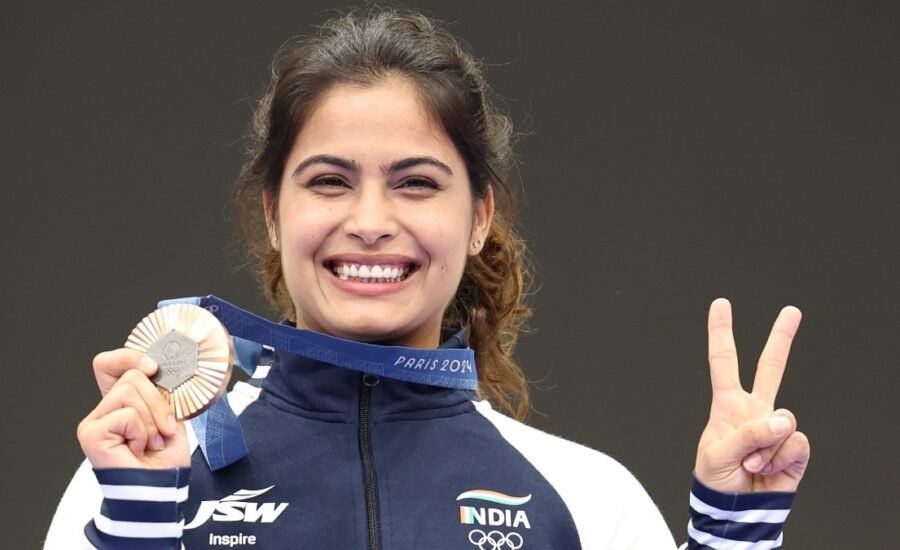
India’s youngest Olympic shooting medallist, Manu Bhaker, has weighed in on the growing normalisation of abusive language among young people, saying that “using bad language is not cool” and urging people to choose their words wisely. Bhaker’s remarks come days after videos from the Cockroach Janta Party (CJP) protest at New Delhi’s Jantar Mantar showed sections of protesters using profane slogans against Prime Minister Narendra Modi, sparking a wider debate over the limits of political expression and public discourse.
Prominent people have taken diverse stands on the issue and actors Anupam Kher and Ashutosh Rana separately joined in the debate.
Manu Bhaker, a two-time Olympic medallist, on Sunday (August 2) cautioned against the increasing acceptance of abusive language in everyday conversations, saying that the words people choose ultimately shape their personality and character.
“The language we choose reflects our personality and the kind of person we are. Choose your words wisely, because over time, you become what you think, what you speak, and what you practice,” Bhaker wrote in a post on X.
She stressed that profanity should not be mistaken for confidence or modernity. “Using bad language is not cool. Abusing is not cool,” she wrote.
Bhaker further said that true “coolness” lies in values rather than vocabulary.
“Let’s keep the definition of cool simple: being hardworking, kind, respectful towards others and yourself, striving to be successful through honesty, and making your parents and your country proud. That’s cool,” she added.
MANU BHAKER EXPLAINS WHY SHE SPOKE ON LANGUAGE ISSUE
Explaining why she chose to speak on the issue, the Olympian said abusive language had gradually become normalised, especially among the younger generation.
“I’m speaking about this because, over the past few years, the way we perceive abusive language has changed. For many, using such words has become so normal that it’s even considered ‘cool’. Without realising it, people casually use degrading and disrespectful language in everyday conversations,” Bhaker said.
While Bhaker did not mention any specific incident, her remarks came less than a week after the CJP agitation at Jantar Mantar concluded following Dharmendra Pradhan’s resignation as Union education minister on July 25. During the agitation, several videos circulated on social media showing younger participants using profane slogans directed at PM Modi.
PM Modi on Friday (July 31) shared a new video message on Instagram, saying he had forgiven the students who abused him during a recent protest at Jantar Mantar and urging society to guide them instead of seeking punishment.
“Children make mistakes, and childhood is also the time when they should be given a chance to correct those mistakes. I want to forgive those who abused me. I request society to accept my decision,” PM Modi said in the two-minute-long video message.
The debate over the language used during the protests has drawn reactions from several public figures.
ANUPAM KHER BACKS STUDENTS, CONDEMNS ABUSIVE LANGUAGE
Veteran actor Anupam Kher, while congratulating students on achieving their objective through the protest, said he was deeply disturbed by the abusive language directed at the Prime Minister.
“One thing has saddened me. The way the Prime Minister of India, Narendra Modi, was insulted and disrespected in front of the camera. Seeing that, I was upset,” Kher said in a video message posted on X after the protests ended on July 26.
Calling it an issue larger than politics, Kher said, “This is not just a question of one person. This is a question of the culture we want to leave for the coming generations.”
He emphasised that democracy protects the right to dissent but not the right to abuse.
“Democracy gives us the right to disagree, but not the right to disrespect. We can disagree with any leader. We can criticise their policies. We can ask them questions. This is the spirit of democracy. But when arguments end, and abuses begin, there is no debate. Only noise remains,” he said.
Kher also said that respecting the dignity of the office of the Prime Minister was essential regardless of political differences.
“It is not necessary that we agree with all his decisions. But it is our duty to respect the dignity of any elected Prime Minister,” he added.
ASHUTOSH RANA SLAMS BJP MP KANGANA RANAUT
Actor Ashutosh Rana also highlighted the importance of responsible public discourse. Rana was responding to the controversy over actor and BJP MP Kangana Ranaut’s remarks describing sections of Gen Z as a “gutter generation”.
Speaking to journalists on August 1, Rana distinguished movements and revolutions, arguing that young people must be encouraged to express themselves constructively.
“If our youth do not share their thoughts with us and do not tell us how they want to shape their future, then how will we understand their vision? In my view, there is a difference between a movement and a revolution. A movement is focused on a particular issue and lasts for a certain period. It makes elders in society aware and compels them to pay attention,” Rana said.
Using a metaphor to stress the importance of language, he added that “Lions roar, elephants trumpet and dogs bark. Every animal is recognised by its sound and the way it expresses itself. Our words decide whether we receive respect or shame.”
Earlier, BJP MP and actor Kangana Ranaut had criticised the language used by some young protesters, calling it “puke-inducing” and referring to sections of the generation as “gutter”.
The remarks by Bhaker, Kher, Rana and Kangana have added to the wider conversation on whether political dissent can remain forceful without descending into abuse, and whether the normalisation of profanity in public discourse is shaping the culture of India’s younger generation.
– Ends