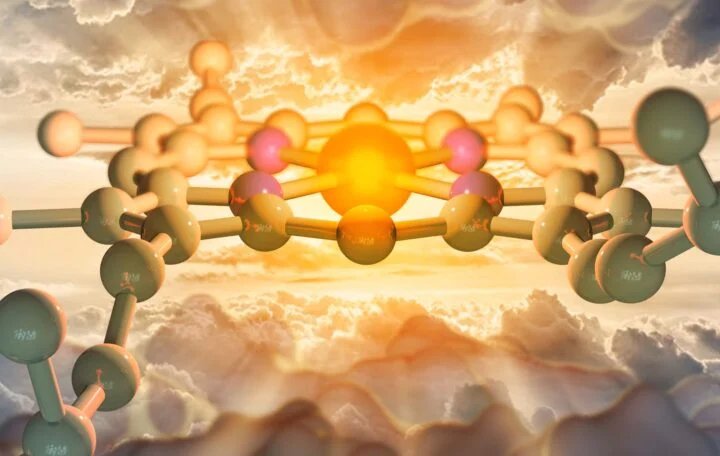
In their reaction, the researchers combine two different catalytic cycles in a cooperative process: a light-driven photoredox cycle and a metalloenzyme catalytic cycle. Both cycles create intermediates.
“The new discovery is that we can use photochemistry to generate very reactive radical intermediates,” Yang said, “and we couple these radical intermediates with an enzymatically formed iron carbenoid intermediates for an intermolecular carbon-carbon bond-forming reaction.”
Key to this reaction, according to the researchers, is the directed evolution of the metalloprotein catalyst, which is an engineered enzyme that has within its structure metal ions, in this case iron. It produces the iron carbene intermediate and the environment with which to control the highly reactive iron radical intermediate generated by the photocatalytic cycle and complete the “proton transfer” step that is fundamental to many organic chemistry reactions.
“If we didn’t work with this particular metalloprotein, this chemistry would essentially remain unknown,” Yang said.
This research, specifically the integration of photochemistry and metalloenzyme catalysis in a cooperative process, pushes the boundaries of transition metal carbene chemistry, according to Yang. This method for carbon-carbon bond forming reactions allows researchers to create molecules that have multiple stereogenic centers, which are fundamental to the structure and function of the often complex three-dimensional molecules found in products such as pharmaceuticals and agrochemicals.
“We think we have developed a fairly general type of carbon-carbon bond-forming reaction, so we’re generalizing this method to make a number of useful compounds.”
Source: UCSB