

If a monkey climbs onto a deer and sprawls across its back, perhaps it is simply an odd, one-off encounter. Then another monkey carefully grooms a dog. Elsewhere, a group accepts a baby from another species and cares for it for months.
To human eyes, these scenes look instantly familiar. We see play, affection, adoption and perhaps even friendship. But familiar-looking behavior does not necessarily reveal a familiar emotion. So, what’s really going on?
A study published in July 2026 brought together 427 reported cross-species interactions involving 88 primate species and 127 partner species. It’s the first comprehensive review of its kind, drawing on scientific literature, media reports and a global survey of primatologists. Some of the examples they looked at were outright surprising.
What Does Friendship Mean to a Monkey?
Scientists have to tread carefully when describing relationships between animals.
Call every gentle encounter a friendship, and we risk projecting human feelings onto behavior that may have a completely different cause. Refuse to consider the possibility of friendship, however, and we may overlook genuine social bonds simply because animals cannot describe them to us.

Researchers therefore concentrate on behaviour they can observe. Do the animals repeatedly seek one another out? Do they play, groom, rest together or provide care? Does each animal appear free to leave? Does the relationship last? They also focus on behavior that doesn’t provide immediate benefits. For instance, some animals are better at hunting together, so they have a partnership; that’s not the type of relationship we’re interested here.
Biologists call friendly, bond-building behaviour affiliative behaviour. In the 2026 review, play and grooming were the most common types of affiliative behavior. Primates initiated about two-thirds of the interactions in which researchers knew who made the first move. This suggests that monkeys do not merely tolerate other animals that happen to be nearby. Sometimes, they actively invite them into their social world.
Here are the some of the most striking examples.
Japanese Macaques Ride, Groom and Rest on Sika Deer

On the Japanese island of Yakushima, macaques and sika deer already have a practical reason to remain close.
The deer follow macaques feeding in the trees and eat the fruit, seeds and leaves that fall to the forest floor. They have also been observed eating macaque feces. This appears to benefit the deer, which gain access to additional food.
The monkeys, meanwhile, sometimes groom the deer or climb onto their backs. Why they do this is less clear.
It’s easy to look at them and imagine that monkeys are using the deer for transport or play, but recent research suggests that no single explanation fits every encounter.
In a study of this behavior 45 mounting sequences recorded at Yakushima and Minoh, researchers observed monkeys resting, playing, grooming and performing sexual behaviour on deer. Resting occurred most often, suggesting monkeys simply enjoy resting on the deer.
Some encounters clearly had a sexual element. Scientists have separately documented adult male and adolescent female macaques mounting deer and performing sexual movements or solicitations. Researchers have proposed several possibilities, including sexual practice, a lack of available monkey partners or a behaviour that spread socially. None fully explains every case.
The deer too, had their own preference.
Some tolerate the riders; others move away or attempt to dislodge them. That makes the relationship less like a simple friendship and more like an evolving negotiation between two species.
Wild Capuchins Adopted an Infant Marmoset

This is one of the wildest stories involving monkeys. In March 2004, researchers in Brazil noticed an unfamiliar infant travelling with a group of wild, black-striped capuchin monkeys. The youngster wasn’t a capuchin. It was a common marmoset — a much smaller monkey from a different genus.
Instead of rejecting it, the capuchins allowed the infant to remain. Two females even cared for it, successively acted as adoptive mothers, carrying it and providing other forms of care. The rest of the group tolerated the marmoset at close range, including while feeding.
The arrangement lasted for at least ten months. By the time researchers conducted systematic observations in January 2005, the marmoset appeared socially integrated into the group of monkeys.
This is one of the strongest documented cases of cross-species adoption among wild primates. It involved sustained care, not a fleeting touch or moment of curiosity. The capuchins accommodated an animal with a dramatically different body size, social system and communication style. The marmoset, in turn, adapted to life among much larger monkeys.
Yet the case also remains mysterious. Researchers do not know how the marmoset lost contact with its original family or how it first joined the capuchins.
Stump-Tailed Macaques Groom Domestic Dogs
At Khao Tao Mo in Thailand, stump-tailed macaques have been spotted gathering around a domestic dog and grooming its coat.
To us, the scene resembles a family fussing over a pet. But a photograph cannot reveal whether the animals had an enduring relationship or what motivated the contact.
Primates groom one another to remove dirt and parasites, but hygiene explains only part of the behaviour. Grooming also helps them maintain relationships, reduce tension and reinforce social bonds.
Directing that behaviour toward a dog therefore suggests that the macaques treated the dog as a suitable participant in a deeply familiar social ritual.
This isn’t the only monkey-dog interaction, either. Dogs appeared repeatedly in the 2026 review. The researchers recorded 26 wild or free-ranging encounters involving domestic dogs, while rhesus macaques and dogs formed one of the most frequently reported species pairings in the dataset.
Young Snub-Nosed Monkeys Play on Domestic Pigs

In China’s Yunnan Golden Monkey National Park, a young black-and-white snub-nosed monkey was photographed playing on the back of a domestic pig.
The encounter seems to be a playful one, not a practical deal.
Juvenile and infant monkeys were significantly more likely to play than groom, while adult females showed the opposite pattern. Play may offer young animals a relatively flexible way to test an unfamiliar partner. A chase, leap or playful climb can reveal whether the other animal responds with tolerance, enthusiasm or aggression.
The pig seems to serve as a moving platform, a playmate or simply an interesting animal willing to tolerate the attention.
A Langur Gently Strokes a Giant Squirrel

At Yala National Park in Sri Lanka, a tufted gray langur was spotted reaching towards a grizzled giant squirrel and stroking it.
The encounter is striking because monkeys and squirrels don’t share any social similarities. Their bodies, facial signals and normal social routines differ greatly.
For friendly contact to occur, each animal must avoid misreading the other. A hand reaching forward could signal curiosity or attack. Remaining still could indicate trust, uncertainty or fear.
This isn’t an isolated example, either. Lion-tailed macaques have been observed grooming an Indian giant squirrel, even though giant squirrels can also fall within the monkeys’ range of potential prey.
Capuchins Groom Spider Monkeys — And May Have Learned This from Each Other
Panamanian white-faced capuchins and black-handed spider monkeys were the most frequently recorded wild pairing in the 2026 review, appearing in 19 cases. In Costa Rica, females from the two species have even been seen grooming one another.
Their shared primate body language may help, but familiarity alone does not explain it. At one site, the behaviour was concentrated in a particular capuchin group and its social circle, while neighbouring groups showed little interest.
That suggests cross-species grooming may be a learned local tradition. One unusually tolerant monkey starts the habit; others watch and copy. Over time, a personal quirk becomes part of the group’s culture — while monkeys living nearby remain indifferent.
Young Capuchins Abducted Infant Howler Monkeys

Not every cross-species tradition is friendship.
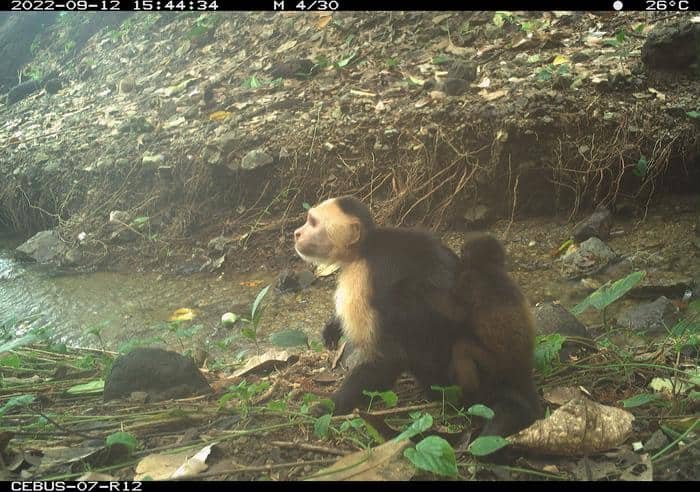
Between 2022 and 2023, camera traps on Panama’s Jicarón Island recorded young male white-faced capuchins carrying at least 11 infant howler monkeys. The behaviour appeared to begin with one subadult and then spread to four younger males — the first documented primate tradition centred on abducting another species.
The capuchins sometimes handled the infants gently, even carrying them while travelling and using stone tools. But they could not provide milk, and several infants died, likely from malnutrition.
What looked like adoption may have begun as curiosity or misplaced caregiving. Once copied, however, it became a deadly social fad — a reminder that gentle handling is not the same as care.
We’re Still Trying to Understand Such Behaviors
The temptation to humanize these encounters is powerful. Sometimes those impressions may point us in the right direction. Primates are socially flexible animals, and the behaviors they use to build relationships within their own species can spill across species boundaries.
But the same outward action can have many causes. It may reflect play, sexual behavior, curiosity, comfort, maternal instincts, social learning or a practical benefit. It may also harm the other animal, even when no aggression is visible.
The only thing we can say for sure is that, at least for some primates, the social world does not end at the boundary of their own species