
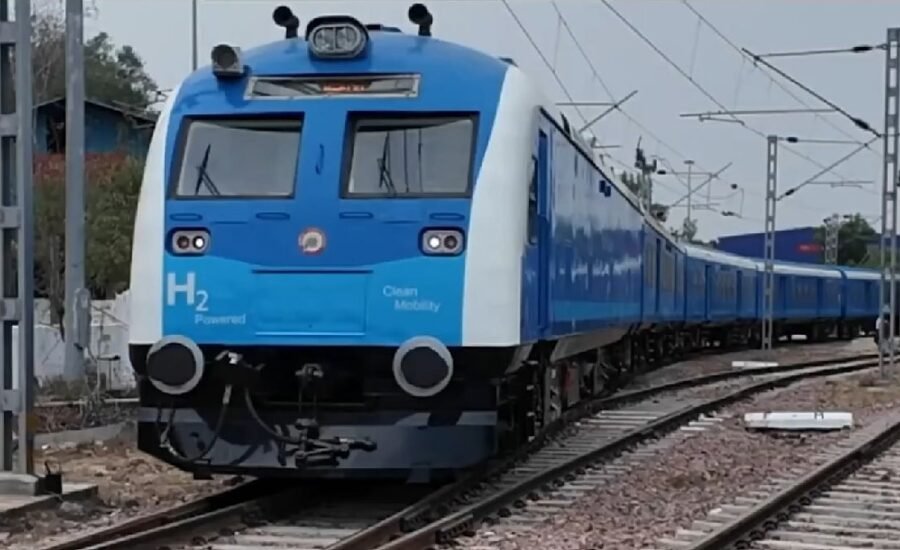
A hydrogen train is not a single technology. It is the successful integration of multiple advanced systems—hydrogen storage, fuel cells, lithium battery systems, power electronics, traction control, digital monitoring, railway safety and operations. Each of these technologies represents years of research and engineering. Bringing them together into a safe, reliable and commercially viable passenger train is an achievement in itself.
This integrated capability is perhaps the project’s greatest accomplishment.
Equally significant is its indigenous character.
The achievement lies not merely in manufacturing components within India, but in designing, engineering and integrating an entirely new propulsion architecture that meets the demanding operational and safety standards of the Indian Railways. Such capabilities create intellectual capital, strengthen domestic industry and develop highly skilled engineering talent capable of driving innovation across multiple sectors.
The implications extend far beyond transportation.
Every major technological breakthrough generates what economists describe as ‘spillover effects’. India’s space programme accelerated electronics, materials science and telecommunications. Nuclear technology advanced metallurgy, instrumentation and medical applications. Likewise, hydrogen technologies have the potential to catalyse innovation across a broad industrial landscape.
The expertise developed for railway fuel cells can find applications in heavy commercial vehicles, mining equipment, ports, inland waterways, defence logistics, stationary power generation and remote industrial installations. Advances in hydrogen storage, power electronics and safety systems will benefit an entire ecosystem rather than a single mode of transport.
This assumes even greater importance because India faces an enduring strategic challenge—energy security.
Despite remarkable progress in renewable electricity, the country continues to depend heavily on imported fossil fuels. Every geopolitical disruption serves as a reminder that energy security is inseparable from national security.
Green hydrogen offers a unique opportunity to diversify India’s energy basket while making productive use of abundant solar and wind resources. Surplus renewable electricity that might otherwise remain unutilised can be converted into hydrogen, stored for extended periods and transported to applications where direct electrification is difficult or uneconomical.
Hydrogen is therefore not merely another fuel. It is an energy carrier capable of linking renewable power generation with transportation and industry.
History also teaches another important lesson. Countries that master foundational technologies acquire advantages extending far beyond their original applications. Britain’s leadership in steam powered the Industrial Revolution. America’s dominance in semiconductors transformed the digital age. More recently, China’s sustained investment in batteries and electric mobility has given it a commanding position in global manufacturing.
Hydrogen technologies could become one of the defining industrial platforms of the 21st century. India’s entry into this field is therefore not simply an environmental initiative; it is an investment in future industrial competitiveness.
Indian Railways itself illustrates this philosophy.
Throughout its history, the Railways has served not merely as a transporter of passengers and freight but as one of India’s largest engineering laboratories. From indigenous steam locomotives and electric locomotives to modern coach manufacturing and the Vande Bharat programme, each technological milestone has strengthened India’s industrial capabilities. The hydrogen train represents the latest chapter in this continuing journey of innovation.