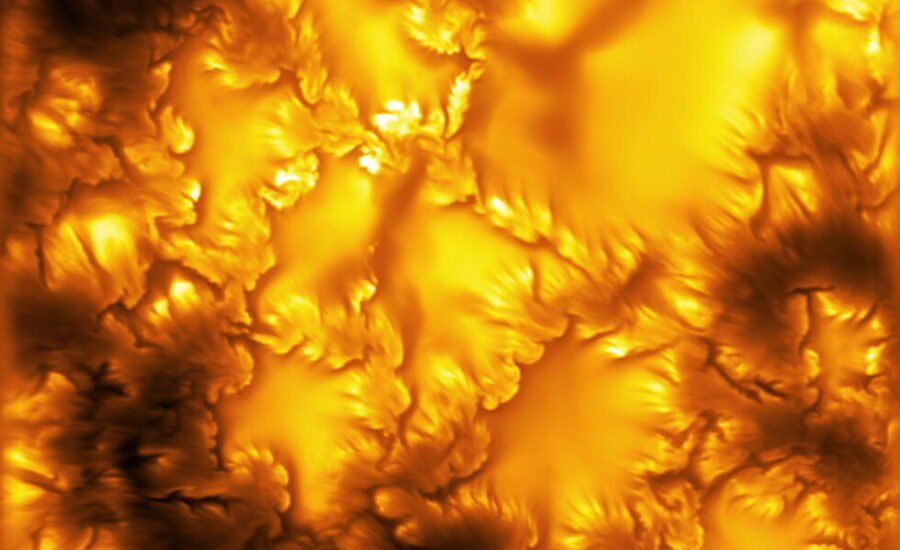
NEW YORK (AP) — Scientists have captured images of the sun’s surface in the finest detail yet, revealing a strange and dynamic facade.
It’s dangerous to look directly at the sun without proper eye protection. But researchers were able to peek at its scorching surface with the help of the National Science Foundation’s Daniel K. Inouye Solar Telescope, located on the island of Maui in Hawaii.
Scientists originally took the images for a different reason: to fine-tune and test the limits of the telescope. But when they looked at the results, they realized they’d photographed the sun’s bright outer shell at higher resolution than ever before.
What’s more, they saw strange feathery patterns rippling across the surface.
“That reminds me of famous paintings, like the swirling skies in Van Gogh’s Starry Night,” said solar physicist Ruizhu Chen with Stanford University, who was not involved with the new research.
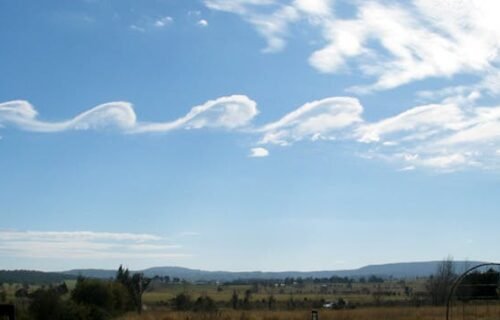
Researchers saw ripples of instability on the sun’s surface caused by bits of magnetized plasma moving past each other at different speeds — similar to waves that stir when a gust of wind blows over water. It’s a well-known phenomenon that guides how fluids move.
This has been glimpsed on Earth and other planets like Jupiter and Saturn, but “it has not been observed ever at that level on the solar surface,” according to study co-author Friedrich Wöger with the National Solar Observatory.
The findings were published Wednesday in the journal Nature.
Scientists are curious about the sun’s inner workings to better track massive bursts of energy called coronal mass ejections that can hurl toward Earth. When they hit, they can trigger solar storms, potentially scrambling GPS communications and producing colorful auroras.
___
The Associated Press Health and Science Department receives support from the Howard Hughes Medical Institute’s Department of Science Education and the Robert Wood Johnson Foundation. The AP is solely responsible for all content.