
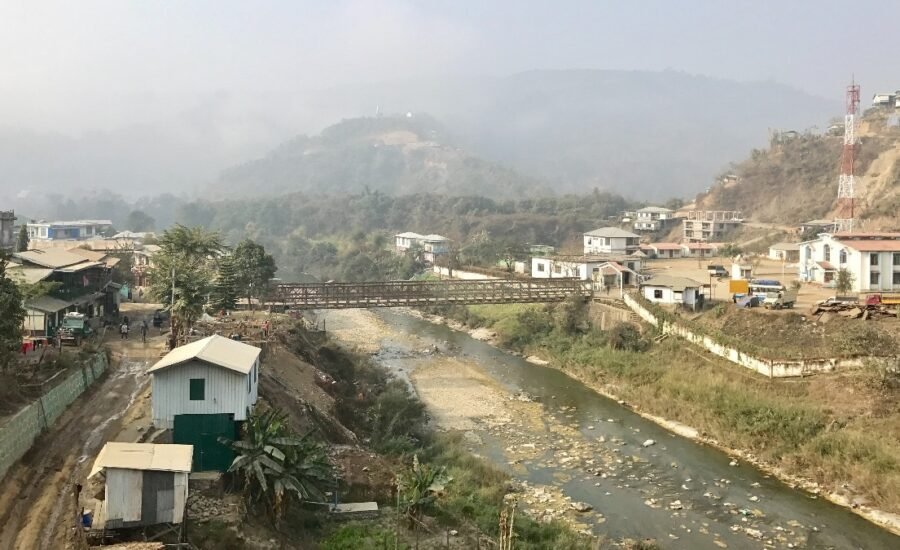
India and Myanmar are reportedly exploring a possible territorial exchange to settle a decades-old undemarcated section of their shared border along Manipur. Addressing a press conference in New Delhi on Tuesday, Ministry of External Affairs spokesperson Randhir Jaiswal said, “There are certain areas on the border which are yet to be settled. Discussions on those sectors are ongoing.”
Jaiswal was responding to a question about reports suggesting that India was considering a land swap with Myanmar along the Manipur border. While he stopped short of confirming the reports, he acknowledged that discussions were underway to resolve unsettled stretches of the boundary.
His remarks came weeks after US-based magazine The Diplomat reported that New Delhi was actively considering such a proposal. In a July 17 report citing an “official document”, the magazine said the Indian government was examining a “proposal” to complete the demarcation of the boundary between border pillars 65 and 68 along Manipur’s border with Myanmar by exchanging around 1.4 square miles of territory. The distance between pillars 65 and 68 is approximately 2.8 km in length.
The proposed area for exchange lies in Manipur’s Chandel district, adjoining Myanmar’s Kabaw Valley in the Sagaing Region. According to the “official document”, dated May 26, 2026, the demarcation exercise was expected to be completed within three months, meaning around August.
India and Myanmar share a 1,643-km-long international boundary that runs through Arunachal Pradesh, Nagaland, Manipur and Mizoram before entering Myanmar’s Sagaing Region and Chin State. Much of the frontier is mountainous, forested and porous, cutting across ethnic communities that have historically lived on both sides.
According to the Ministry of Home Affairs, around 1,472 km of the border has been demarcated through boundary pillars, while nearly 171 km remains unresolved, mainly in Arunachal Pradesh’s Lohit sector and Manipur’s Kabaw Valley.
WHY INDIA MIGHT BE CONSIDERING A TERRITORIAL SWAP WITH MYANMAR
According to The Diplomat, the primary rationale behind a possible territorial exchange is to expedite the demarcation of an unresolved stretch of the India-Myanmar border, enabling New Delhi to fence the frontier to curb illegal immigration, insurgent movement and other cross-border crimes.
In 2024, India had announced a plan to fence the entire 1,643-km-long international boundary while also scrapping the India-Myanmar border Free Movement Regime that had been in place since 2018 and allowed tribal communities living near the border to travel up to 16 km into each other’s territory without a visa using a border pass.
The current India-Myanmar boundary was defined under a 1967 bilateral agreement, but parts of it remain unsettled. In 2018, the government informed Parliament that the remaining unresolved stretches would be demarcated through a bilateral boundary mechanism, including the identification and erection of nine boundary pillars.
The most sensitive stretches in Manipur include the Molcham sector between border pillars 64 and 68, the Moreh sector between pillars 75 and 79, and the Choro Khunou sector between pillars 88 and 95. India has consistently maintained that there is no broader border dispute with Myanmar, but only nine unresolved boundary pillars that are being addressed through bilateral mechanisms.
Citing an unnamed government official, The Diplomat reported that the issue was discussed during Myanmar leader Min Aung Hlaing’s visit to India last month. According to the report, both sides considered erecting auxiliary and new boundary pillars in the Molcham sector between border pillars 65 and 68, while also examining a 2017 Ministry of External Affairs proposal on the alignment of the border in the area.
Territorial exchanges with neighbouring countries are not unprecedented. In 2015, India and Bangladesh ratified the Land Boundary Agreement, under which New Delhi transferred 111 enclaves within its territory to Dhaka and received 51 Bangladeshi enclaves in return, bringing an end to a 41-year-old boundary dispute.
TERRITORY EXCHANGE PROPOSAL SPARKS PUSHBACK IN MANIPUR
The reported proposal has already drawn opposition in Manipur. Following the publication of The Diplomat report, The Imphal Times reported that the Coordinating Committee on Manipur Integrity (COCOMI) was warning the Government of India against ceding even a small portion of the state’s territory to Myanmar, saying it would launch a strong public response if such a proposal were implemented.
COCOMI, a joint body of Meitei civil society organisations formed in 2019 during the Centre’s peace talks with Naga insurgent groups, said on July 27 (10 days after The Diplomat report was published), “If the contents of the report are true and the proposal is translated into action, COCOMI will not remain a silent spectator.”
Describing Manipur’s territorial integrity as non-negotiable, the organisation said the state’s existing boundaries had been inherited from previous generations and defended over time. It argued that Manipur had already lost parts of its historical territory since its merger with the Indian Union in 1949 and warned that any further reduction in the state’s geographical boundaries would be unacceptable, reported The Imphal Times.
The organisation further cautioned that New Delhi should not “play with fire” by taking any decision affecting Manipur’s territorial integrity without the consent of its people.
– Ends