Astronomers have captured the death of a massive star from its first faint flash of X-rays, revealing an unusual explosion that may bridge the gap between ordinary supernovas and more extreme, gamma-ray-burst-producing stellar explosions
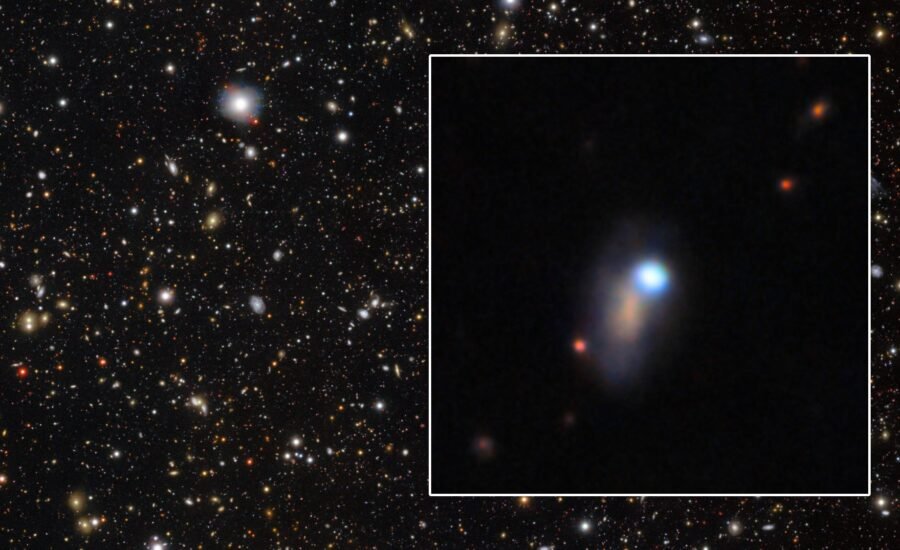
The event began in March 2026, when China’s Einstein Probe spacecraft detected a brief X-ray flash from a galaxy about 500 million light-years away. Follow-up observations identified the source, initially designated EP260321a and later named supernova SN 2026gzf, as a broad-lined Type Ic supernova.
Such explosions occur when massive stars that have lost their outer layers of hydrogen and helium collapse. They are often associated with narrow, powerful jets traveling near the speed of light and, in some cases, brilliant gamma-ray bursts. But SN 2026gzf produced neither.

Instead, the initial X-ray signal appears to have been a “shock breakout” — the moment the blast wave generated by a collapsing star reaches its surface and releases its first burst of radiation. The flash was the faintest shock breakout yet linked to a broad-lined Type Ic supernova, according to the research team.
Because shock breakouts generally last only seconds to hours, astronomers rarely detect them. In this case, rapid observations by a network of space- and ground-based telescopes, including a number of NSF NOIRLab observatories, allowed researchers to follow the supernova across multiple wavelengths throughout its early life.
“Our observations allowed us to study the physics of three pieces of this explosion: the X-ray shock breakout, the accompanying supernova, and the interaction of the supernova with material previously cast out by the dying star,” Jillian Rastinejad, who led one study on the event, said in a statement. “With this information we were able to map out the structure of the material surrounding the star and understand the star’s violent lifestyle before it collapsed.”

The observations suggest that the progenitor was a Wolf-Rayet star born with about 20 times the mass of the sun. Before exploding, it had shed its hydrogen and helium, leaving behind a core composed largely of carbon and oxygen.
Researchers also found evidence of multiple shells of material surrounding the star. Those shells were likely expelled during turbulent bouts of mass loss shortly before the explosion, giving astronomers an unusually detailed view of the star’s final stages.
The discovery suggests that energetic, broad-lined Type Ic supernovas do not always produce gamma-ray bursts or relativistic jets. Instead, massive stars may reach similar-looking explosions through a wider variety of pathways than astronomers previously recognized.
“Going forward, I’m excited to observe more shock breakout events in similar detail to test if all stripped stars have a similar ‘lifestyle’ prior to collapse and what, if any, differences we see,” said Gokul Srinivasaragavan, a member of Rastinejad’s team.