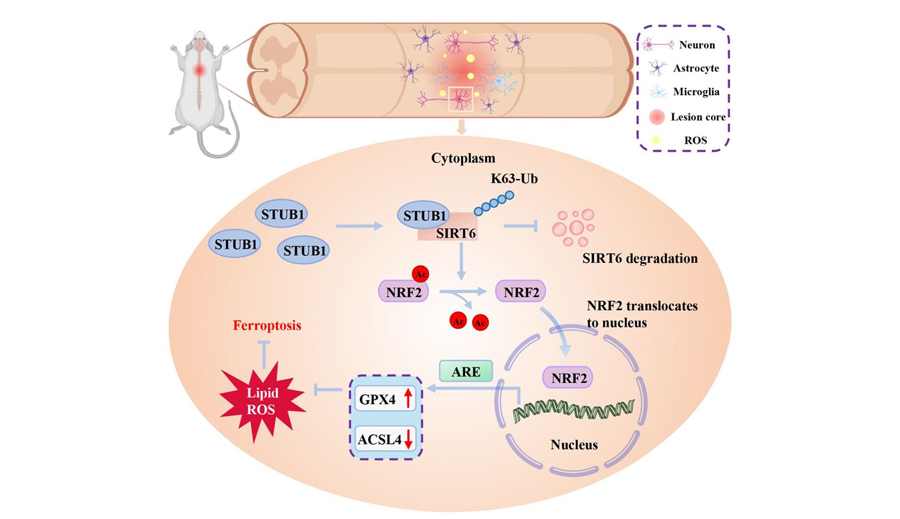

STUB1–SIRT6–NRF2 signaling protects neurons after spinal cord injury.
FAYETTEVILLE, GA, UNITED STATES, August 5, 2026 /EINPresswire.com/ — A research team has identified a protein-based defense pathway that helps neurons resist ferroptosis, an iron-dependent form of cell death, after traumatic spinal cord injury (SCI). The study shows that STIP1 homology and U-box containing protein 1 (STUB1) preserves sirtuin 6 (SIRT6), enabling it to activate nuclear factor erythroid 2-related factor 2 (NRF2), a central antioxidant transcription factor.
Spinal cord injury begins with immediate mechanical damage, but much of the lasting neurological loss develops during the secondary phase, when inflammation, oxidative stress and disrupted metabolism continue to injure surviving tissue. Ferroptosis has emerged as an important contributor because iron accumulation and lipid peroxidation can overwhelm neuronal defenses and damage mitochondria. Nuclear factor erythroid 2-related factor 2 (NRF2) can switch on antioxidant programs, yet the upstream processes that determine whether this protection remains active after injury are still poorly understood. Existing treatments can stabilize the spine and support rehabilitation, but they do not reliably stop secondary neuronal death. Based on these challenges, in-depth research is needed to uncover the molecular controls of ferroptosis after spinal cord injury.
Researchers led by the First Affiliated Hospital of the University of Science and Technology of China and the First Affiliated Hospital of Nanjing Medical University, with collaborating institutions in Nanjing, Taizhou, Shanghai and Chongqing, published (DOI: 10.1093/burnst/tkag047) the study online on July 6, 2026, in Burns & Trauma. Using cultured primary neurons, a mouse model of spinal cord injury and mice lacking NRF2, the team mapped how STUB1 stabilizes SIRT6, how SIRT6 promotes NRF2-dependent antioxidant defenses, and how this signaling pathway influences neuronal survival and motor recovery. The study combined gain- and loss-of-function tests to establish causality rather than correlation.
The researchers first tracked ferroptosis after injury and found early increases in iron, lipid peroxidation and oxidative stress, alongside reduced SIRT6 levels. Treatment with ferrostatin-1, a ferroptosis inhibitor, also improved functional measures, supporting ferroptosis as a modifiable driver of secondary injury. Raising SIRT6 in primary neurons limited ferroptotic damage, preserved mitochondrial structure and improved cell survival; reducing SIRT6 had the opposite effect. In injured mice, neuron-targeted adeno-associated virus (AAV) delivery of SIRT6 improved Basso Mouse Scale scores, rotarod performance, walking patterns and motor evoked potentials, while increasing surviving neurons and axons near the lesion. Mechanistic experiments using immunoprecipitation coupled with mass spectrometry and co-immunoprecipitation showed that SIRT6 binds to NRF2 and removes acetyl groups, promoting NRF2 movement into the nucleus and activation of antioxidant genes. The team then identified STUB1 as an upstream SIRT6 partner. Rather than marking SIRT6 for destruction, STUB1 attached lysine 63 (K63)-linked ubiquitin chains that stabilized the protein and protected it from proteasomal degradation. STUB1 overexpression reduced ferroptosis and improved recovery, but these benefits weakened when SIRT6 was suppressed and disappeared in mice lacking NRF2, confirming the pathway’s dependence on both proteins.
The authors said the study reveals how a coordinated protein pathway may help neurons withstand the oxidative pressure that follows spinal cord injury. “Rather than acting only at the final stage of ferroptosis, STUB1 preserves SIRT6, which enables NRF2 to enter the nucleus and activate antioxidant defenses,” they said in summarizing the findings. “The loss-of-function experiments were especially important because the recovery benefits were greatly reduced when SIRT6 was suppressed and were absent without NRF2, directly connecting the molecular mechanism to neuronal protection and motor outcomes.” This pathway therefore links molecular preservation to measurable recovery after injury.
The STUB1–SIRT6–NRF2 pathway could provide several starting points for future therapies, including approaches that stabilize SIRT6, enhance protective K63-linked ubiquitination or strengthen NRF2-driven antioxidant activity during the early secondary-injury window. However, the work remains preclinical and was conducted mainly in cultured neurons and mice. Ferroptosis also operates alongside apoptosis, pyroptosis, inflammation and other injury processes that were not compared systematically. The chemical model used in cells cannot fully reproduce the complex environment of an injured spinal cord, and additional electrophysiological testing is needed. Future studies must determine treatment timing, delivery methods, long-term safety and whether targeting this pathway improves outcomes in larger animals before clinical translation can be considered. Human spinal cord tissue studies will also be essential.
References
DOI
10.1093/burnst/tkag047
Original Source URL
https://doi.org/10.1093/burnst/tkag047
Funding Information
This work was sponsored by the National Natural Science Foundation of China (82402787, 82172426), the National Postdoctoral Program for Innovative Talents (BX20240359), the Foundation of State Key Laboratory of Trauma and Chemical Poisoning (SKL0202402), the Anhui Provincial Natural Science Foundation (2508085Y056), the China Postdoctoral Science Foundation (2024M753138), the Anhui Provincial Health and Health Research Project (AHWJ2024Aa30336), the Anhui Provincial Department of Education University Natural Science Research Project (2024AH052056), and the Key Projects of Youth Innovation and Scientific Research Fund of the Affiliated Jiangning Hospital with Nanjing Medical University (JNYYZXKY202401).
Lucy Wang
BioDesign Research
email us here
Legal Disclaimer:
EIN Presswire provides this news content “as is” without warranty of any kind. We do not accept any responsibility or liability
for the accuracy, content, images, videos, licenses, completeness, legality, or reliability of the information contained in this
article. If you have any complaints or copyright issues related to this article, kindly contact the author above.