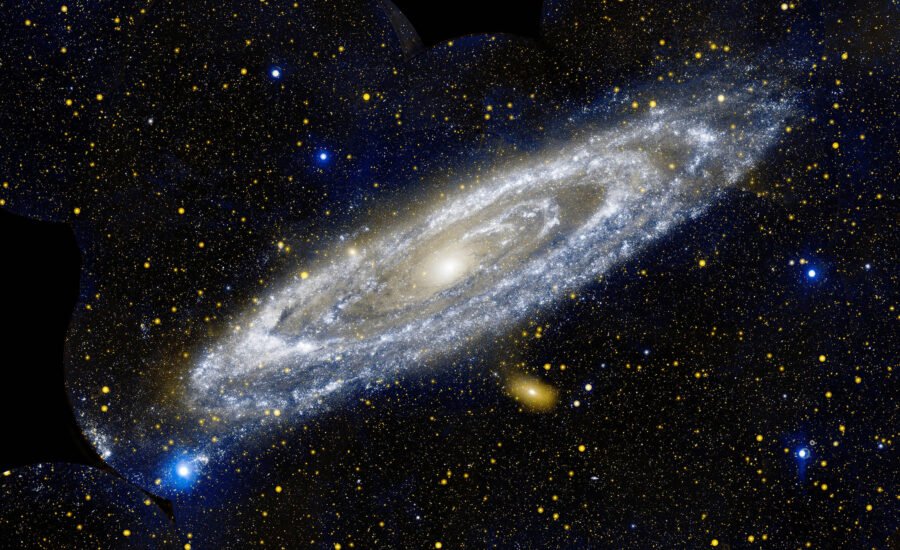
Andromeda is one of the only galaxies you can see without a telescope, provided you find a stretch of sky dark enough.
It’s the nearest large spiral galaxy to the Milky Way, roughly the same size as our own, and about 2.5 million light-years away.

That distance sounds enormous, but in galactic terms it’s close enough for astronomers to resolve hundreds of millions of individual stars.
A new study built on that proximity. It found that Andromeda’s star formation has been declining for 500 million years, with the slowdown becoming much steeper over the last 40 million years.
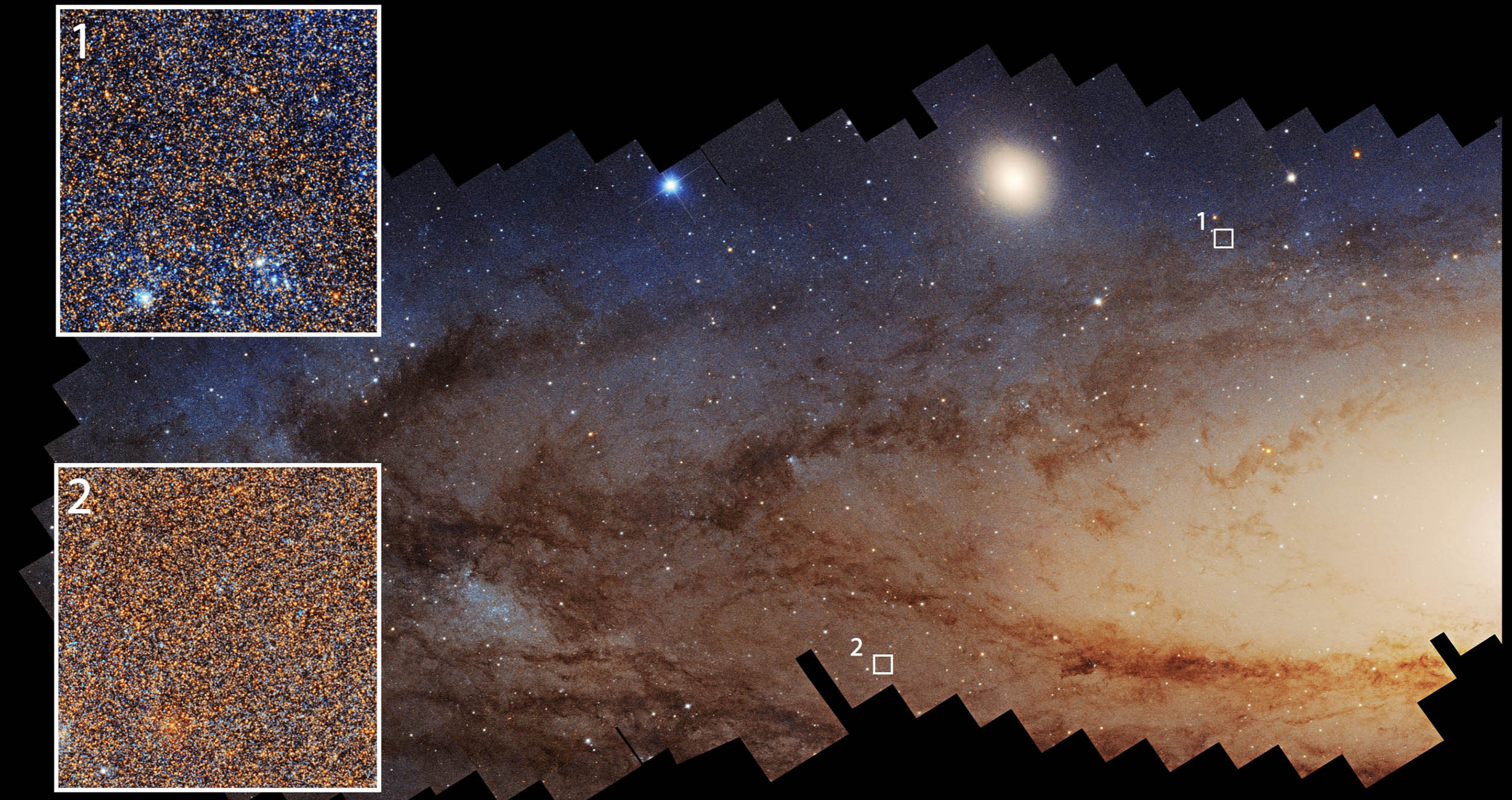
Tobin Wainer, an astronomer at the University of Washington, led the study. His team combined two Hubble Space Telescope surveys, the Panchromatic Hubble Andromeda Treasury and its southern counterpart, to map two-thirds of Andromeda’s disk in sharp detail.
Counting 200 million stars
The team measured about 200 million individual stars across the galaxy. Each one carries a clue about when it was born. Heavier stars burn blue and die young. Lighter stars burn red and last much longer.
A patch of sky with lots of blue stars has made stars recently. A redder patch has not. Researchers split the Hubble images into thousands of squares, each one spanning 300 light-years on a side, and worked out the star-formation history square by square.
“We need to measure the individual stars because they are the fossil record of the galaxy’s formation,” said study co-author Ben Williams, an astronomer at the University of Washington.
“Hubble is the only telescope that can give you high enough spatial resolution over a large enough area to be able to do that in Andromeda.”
Measuring Andromeda’s slowdown
Earlier research had already shown that Andromeda went through a burst of star formation about 2 billion years ago.
That burst was likely triggered by a collision or close pass with another galaxy, and star formation has been declining ever since.
Wainer’s team attached numbers to the recent part of that decline. Around 500 million years ago, Andromeda turned gas and dust into new stars at a rate equal to about one Sun’s worth of mass every year.
By 40 million years ago, that rate had fallen to about half a solar mass a year. Today the rate is down to roughly one-fifth of a solar mass a year.
A galaxy takes a breather
The team also investigated whether a smaller companion galaxy, M32, had anything to do with the slowdown. M32 appears about 16,000 light-years from Andromeda in the plane of the sky.
Its exact three-dimensional position is unknown, so nobody knows for certain when, or even if, it passed through Andromeda’s disk.
Using the southern survey data, the team found that star formation near M32 began slowing around 60 million years ago, a timeline that aligns with the galaxy-wide decline.
“We can’t explicitly say that we are seeing a decrease in star formation because of M32. But it’s right there, and it’s definitely the most likely suspect,” said Wainer.
A possible cosmic culprit
The team also checked whether a smaller companion galaxy, M32, had anything to do with the slowdown. M32 is separated from Andromeda by about 16,000 light-years across the sky.
Its exact three-dimensional position is unknown, though, so nobody knows for certain when, or if, it passed through Andromeda’s disk.
Using the southern survey data, the team found that star formation near M32 began slowing around 60 million years ago, a timeline that lines up with the galaxy-wide decline.
“We can’t explicitly say that we are seeing a decrease in star formation because of M32. But it’s right there, and it’s definitely the most likely suspect,” said Wainer.
The next look at Andromeda
The team plans to keep working through the Hubble data and combine it with observations from ground-based telescopes to add to what is known about Andromeda’s history.
“There’s a strong scientific value to this archival data,” said study co-author Raja GuhaThakurta, a professor of astronomy at the University of California, Santa Cruz.
“Andromeda is important because it’s a neighbor that is close enough that we can see it in great detail while also getting a global perspective.”
An even wider view could come soon from NASA’s Nancy Grace Roman Space Telescope, set to launch as early as August 30, 2026.
Roman’s camera can cover at least 100 times as much sky as Hubble does in a single near-infrared image.
A newly approved observing program will use it to image the entirety of Andromeda’s disk and the halo around it, adding hundreds of millions more stars to the count.
—–
Like what you read? Subscribe to our newsletter for engaging articles, exclusive content, and the latest updates.
Check us out on EarthSnap, a free app brought to you by Eric Ralls and Earth.com.
—–