
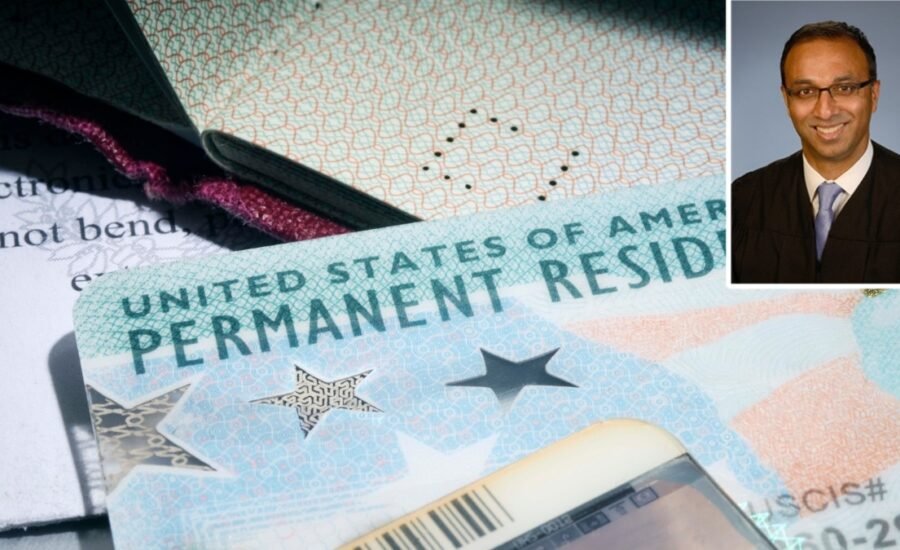
An Indian-origin US federal judge has ruled that the Donald Trump administration’s policy of freezing Green Card processing for applicants from 75 countries is unlawful, while holding that the State Department exceeded its legal authority by taking away visa decision-making powers from designated consular officers.
This comes even as the US Labor Department is also planning changes that could increase the cost of sponsoring foreign workers for H-1B visas and employment-based Green Cards.
According to a report in Bloomberg Law published on August 3 (Monday), Indian-origin US District Judge Amit Mehta, who serves in the District Court for the District of Colombia found that the “public charge” policy introduced by Secretary of State Marco Rubio in January this year conflicts with the Immigration and Nationality Act (INA).
The “public charge” policy in question, which was adopted by the Trump Administration this year, halted the processing of several family-sponsored immigrant visas and employment-based Green Cards for applicants from over 75 countries across the world, including Nigeria, Colombia, Russia and Egypt over concerns that they could become dependent on US public dependents.
The Immigration and Nationality Act (INA), meanwhile, which was passed in 1952, governs visas, Green Cards, citizenship, deportation proceedings, and the grounds on which foreign nationals may be denied entry or permanent residence.
According to the Bloomberg Law report, Indian-origin Justice Mehta, who was appointed by the Barack Obama administration, held in his July 31 opinion that the US State Department has exercised powers that had been withheld from its jurisdiction by the US Congress through the INA act.
He wrote that the January policy freezing Green Card processing for applicants from 75 countries, gave US State Secretary Marco Rubio the power to control individual visa decisions, despite the fact that the INA Act had restricted that responsibility to consular officers who are required to evaluate each Green Card application on its own merits.
Bloomberg Law reported that the ruling came in a lawsuit filed by a Brazilian national, whose Green Card Application under the EB-5 immigrant investor visa programme was put on hold because of the policy. The plaintiff has alleged that the State Department violated the Administrative Procedure Act by unlawfully withholding a decision on his application and implementing a policy that was contrary to federal law.
Justice Mehta agreed, saying the policy wrongly took away consular officers’ authority to independently decide visa applications by effectively deciding outcomes in advance. He also ruled that the case could be reviewed by the court because it challenged a broader State Department policy, not just an individual visa decision.
As part of his order, Mehta barred the State Department from applying the public charge policy to the plantiff’s application and directed officials to adjudicate his immigrant visa once a consular officer determines that the application is complete.
The decision is the latest legal challenge to the administration’s immigration policies. Bloomberg Law reported that multiple lawsuits contesting the same State Department policy are pending in federal courts in Washington, DC, and New York.
Separately, the Department of Homeland Security has tightened its own public charge regulations through final rules issued last month. The rules allow US immigration authorities to deny certain visa or Green Card applications if they determine an applicant is likely to rely heavily on government benefits, reflecting the administration’s broader push for stricter immigration screening.
The State Department declined to comment directly on the litigation. However, a department spokesperson told Bloomberg Law that the Trump administration is committed to maintaining “the highest standards of screening and vetting of visa applicants.”
– Ends