South Korea is targeting a 2031 launch for a science probe that will observe solar activity in the space between Earth and the Moon. The mission significantly expands space environment monitoring beyond low-Earth orbit into the Earth-Moon region, laying the groundwork for analyzing how solar wind affects satellites, communications, and power grids.
The Korea AeroSpace Administration (KASA) announced on August 4 that it will present South Korea’s heliospheric exploration plan at the COSPAR 2026 General Assembly, being held from August 1-9 (local time) at the Fortezza da Basso in Florence, Italy. The detailed exploration roadmap is scheduled to be unveiled on August 7.
The heliosphere refers to the vast region of space influenced by particles and magnetic fields emitted from the Sun. Solar wind and space radiation generated by solar eruptions can cause satellite malfunctions, GPS errors, aircraft communication disruptions, and power grid failures, making space environment monitoring increasingly critical. However, the cislunar region between Earth and the Moon — while heavily influenced by solar activity — has relatively scarce long-term observational data.
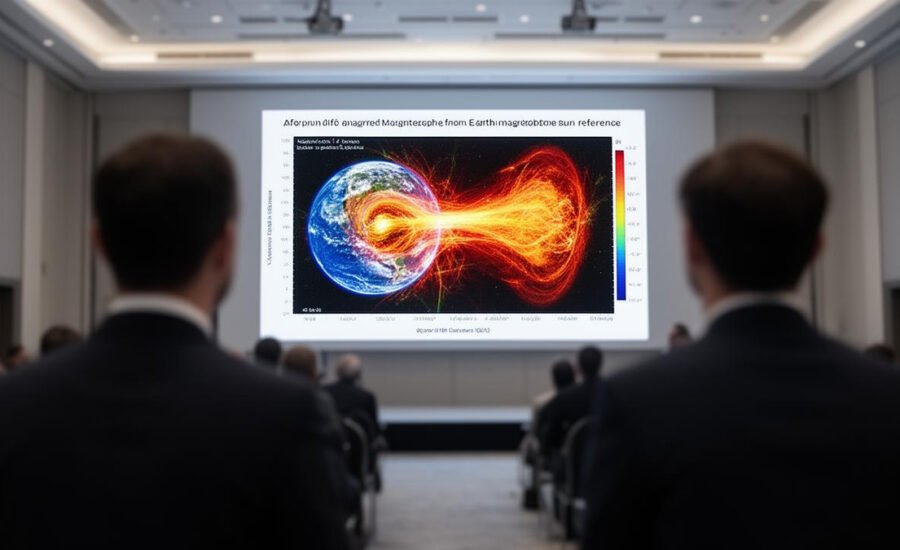
The core objective of this project is to close observation gaps using an Earth-Moon science probe. KASA expects the probe to enable broader observation of how solar particles and magnetic fields alter the space environment around Earth. In particular, the agency plans to observe the “magnetotail” — the elongated extension of Earth’s magnetic field pushed away from the Sun by solar wind — to secure foundational data for space weather forecasting. This data will support predictions of space weather phenomena affecting satellite operations and communication systems, while also enhancing the safety of future lunar missions.
“KASA plans to expand space environment observation from low-Earth orbit to the Earth-Moon region,” said Oh Tae-seok, Administrator of the Korea AeroSpace Administration. “We will establish an observation infrastructure capable of analyzing how solar activity impacts satellites, communications, and power grids.” He added, “Space radiation and solar wind from solar eruptions can cause damage directly tied to people’s daily lives, including satellite failures, GPS errors, aircraft communication disruptions, and power grid anomalies.”
The project is also expected to create new opportunities for South Korea’s space industry. Expanding technological capabilities from low-Earth and geostationary orbits into deep space will help secure foundational technologies across launch vehicles, spacecraft, and payloads, with spillover benefits expected from joint industry development.
During the assembly, KASA will hold bilateral meetings with space agencies from eight countries, including NASA and the European Space Agency (ESA), to discuss collaboration across space science and exploration — covering heliospheric exploration, lunar missions, and space telescopes. At a roundtable of space agency leaders held on August 3, KASA also introduced its development plan for the Korea Space Situational Awareness System (K-SSA), a national integrated space surveillance framework launched this year to detect risks of space object re-entry and satellite collisions at an early stage.
This year’s COSPAR General Assembly, co-hosted by COSPAR and Italy’s National Institute for Astrophysics (INAF), is themed “Sustainable Space Research for Earth.” The event features approximately 150 scientific sessions, keynote lectures, and meetings of space agency leaders from major countries.