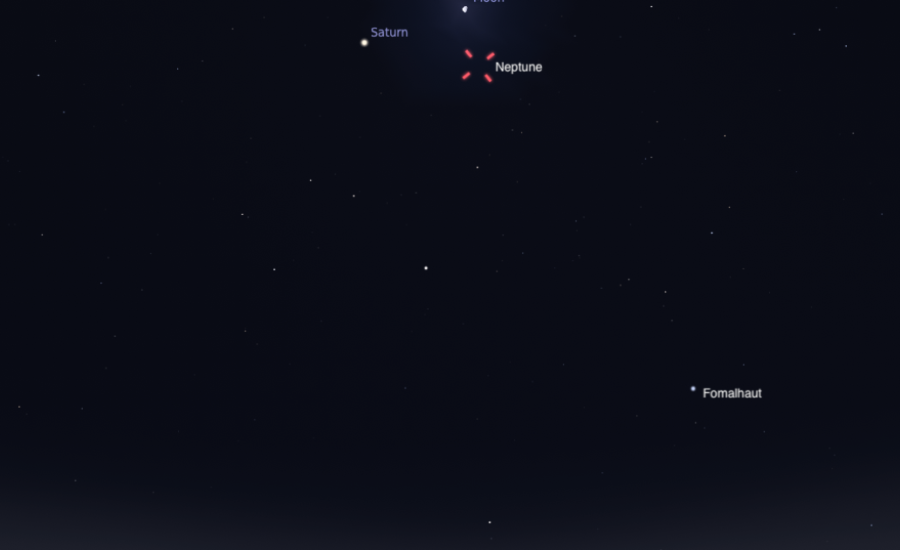
The waning Moon steps up to form a triangle in the early-morning sky with two distant planets: Saturn and Neptune.
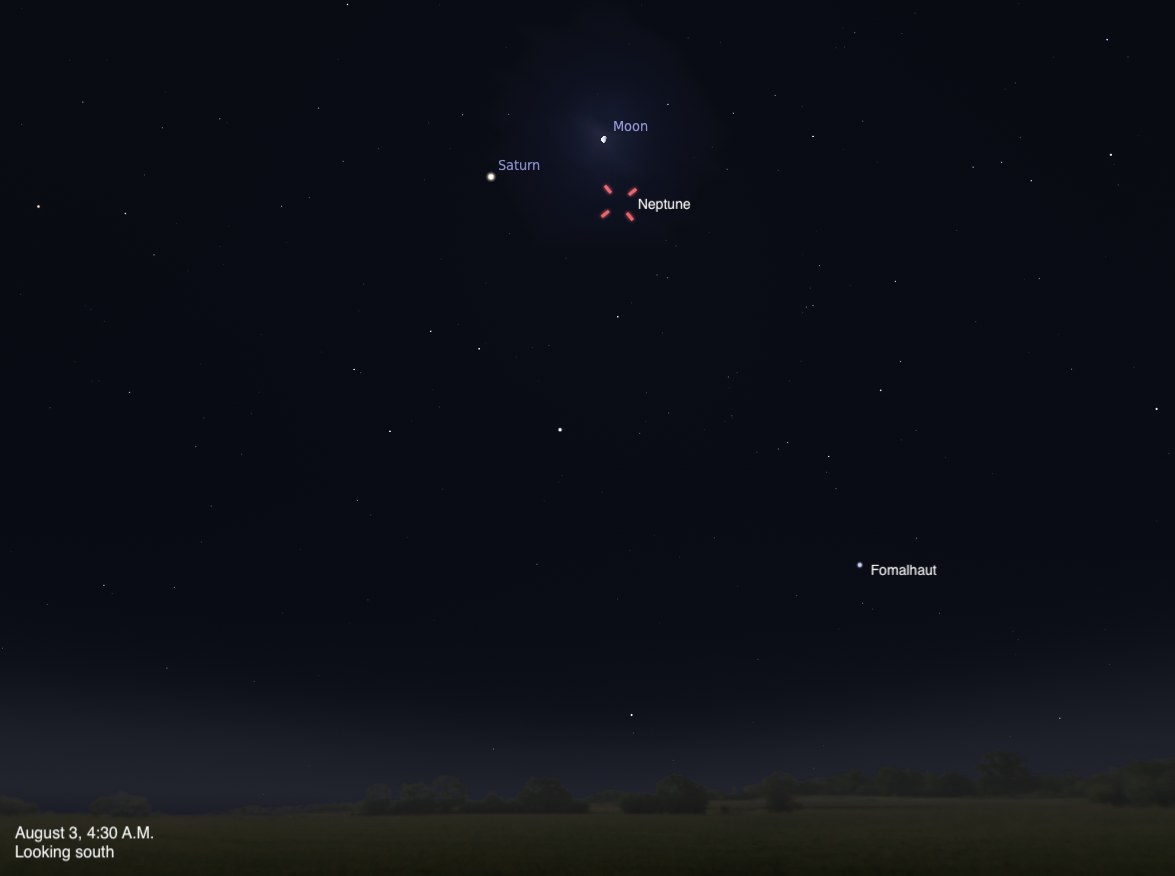
The Moon forms a triangle in the southern sky with the planets Saturn and Neptune on the morning of August 3. Note that while Saturn is visible to the naked eye, Neptune (marked by the red crosshairs) will require optical aid to view, and may be challenging with the bright Moon so nearby. Credit: Stellarium/USGS/Celestia/Clementine
Looking for a sky event this week? Check out our full Sky This Week column.
August 2: Mercury at greatest western elongation
The Moon passes 5° north of Neptune at 4 A.M. EDT, with Saturn standing nearby. The best time to catch the trio is early in the morning around 4:30 A.M. local daylight time, when they are highest in the southern sky.
The bright Moon is unmissable, anchoring the apex of the triangle. To its left is magnitude 0.5 Saturn, the brightest point of light in this part of the sky, outshining any of the surrounding stars. Below and just right of the Moon is Neptune, but the distant ice giant is not visible to the naked eye. You can try finding it with binoculars or a telescope, 4.8° south of the Moon and 10.5° southwest of Saturn. From its great distance, the planet’s disk appears just 2” wide in the sky, and may have a bluish or grayish hue compared to any background stars.
By contrast, Saturn’s disk stretches 18” across in a telescope, with its rings just over twice that diameter. Its brightest moon, Titan, is about 2.5’ to the planet’s east, while several fainter 10th-magnitude moons cluster closer. You may have a hard time spotting these, however, in the moonlight.
The Moon will then pass 7° due north of Saturn at midnight EDT tonight.
Sunrise: 6:00 A.M.
Sunset: 8:11 P.M.
Moonrise: 10:31 P.M.
Moonset: 11:09 A.M.
Moon Phase: Waning gibbous (71%)
*Times for sunrise, sunset, moonrise, and moonset are given in local time from 40° N 90° W. The Moon’s illumination is given at 10 P.M. local time from the same location.
Alison Klesman is senior editor of Astronomy magazine. She holds a Ph.D. in astronomy and has studied a variety of topics, from minor planets to supermassive black holes.