Argonne National Laboratory researchers have mapped atomic-level flaws that impact the performance of silicon qubits, a crucial step toward building practical quantum computers. The team used the Chicago Quantum Computing Testbed, the first full-stack, solid-state qubit testbed located at a U.S. facility, to study industrial-grade silicon wafers and pinpoint the origin of qubit failure.
Their work reveals that inconsistencies in the silicon quantum well layers directly affect valley splitting, the energy difference impacting electron stability. According to a staff scientist at the Q-NEXT National Quantum Information Science Research Center, this study transforms valley splitting from an unexplained obstacle into a materials engineering challenge.
Atomic-Scale Disorder Drives Valley Splitting Variability
Silicon spin qubits are a leading contender in the race to build practical, large-scale quantum computers because of their compatibility with existing semiconductor manufacturing processes. However, inconsistencies in the performance of these qubits have long presented a significant hurdle. Researchers now pinpoint atomic-level disorder within the silicon quantum well layers as a primary driver of variability in a crucial property called valley splitting. This discovery, enabled by the unique capabilities of the Chicago Quantum Computing Testbed at Argonne National Laboratory, shifts the focus from unexplained quantum behavior to a concrete materials science problem.
The facility provided the means to meticulously analyze industrial-grade silicon wafers and identify the origins of qubit failure. By shifting the position of a quantum dot within the well, they constructed a nanoscale map revealing how valley splitting changes across the material.
This detailed analysis revealed that random fluctuations at the atomic scale within the alloyed quantum well are the dominant source of variability in valley splitting. These fluctuations directly impact the electron’s quantum state, potentially causing leakage into unwanted energy levels and introducing errors into calculations. The team’s work demonstrates that even minor imperfections in the silicon layers have a disproportionately large effect on qubit fidelity.
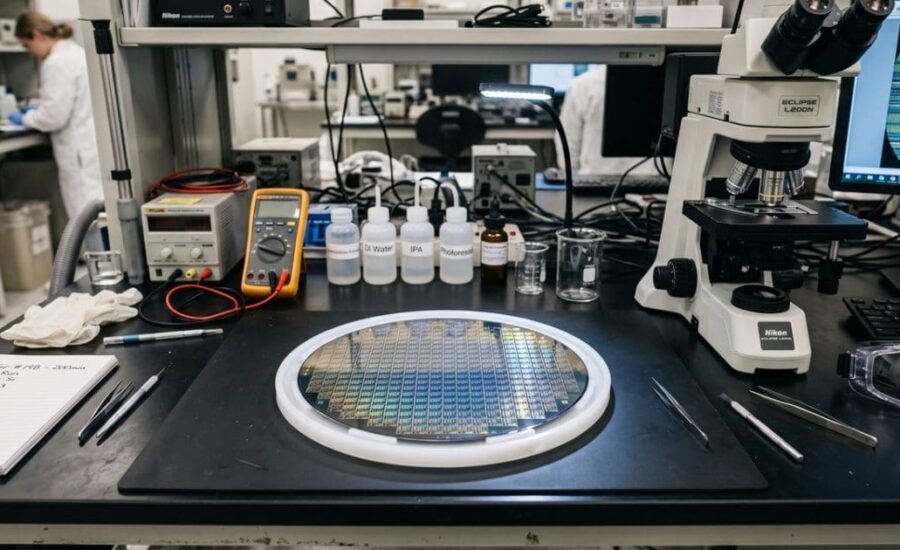
The study was a collaborative effort between Argonne National Laboratory and Intel, combining national laboratory expertise in quantum measurement with Intel’s manufacturing capabilities. Researchers examined a 12-qubit silicon quantum dot processor fabricated by Intel, leveraging the Chicago Quantum Computing Testbed to assess its performance. This partnership allowed for the study of devices built using industrial processes, providing insights directly relevant to scaling up quantum computing technology.
James Clarke, Director of Quantum Hardware at Intel, emphasized the importance of this collaboration in addressing the challenges of building reliable qubits. Previously, variations in valley splitting were observed from device to device, but the underlying cause remained elusive. This research clarifies that the disorder isn’t a systemic issue with the fundamental physics, but rather a consequence of imperfections in the material itself. J.C.
Marcks and colleagues explained in their Nature Communications publication that the research focused on “valley splitting correlations across a silicon quantum well containing germanium.” The implications of this finding extend beyond simply identifying a problem; it provides a clear path toward improving silicon qubit performance. By controlling and minimizing atomic-scale disorder during the manufacturing process, it may be possible to create more consistent and reliable qubits. This represents a significant step toward building scalable quantum computers capable of tackling complex problems beyond the reach of classical machines.
The U.S. Department of Energy, Office of Science, National Quantum Information Science Research Centers provided funding for the research as part of the Q-NEXT center, highlighting the national importance of advancing quantum computing technology. The ability to pinpoint the source of variability in valley splitting offers a tangible target for materials engineers seeking to optimize silicon qubit fabrication and unlock the full potential of this promising quantum platform.
See today’s quantum computing news on Quantum Zeitgeist for the latest breakthroughs in qubits, hardware, algorithms, and industry deals.