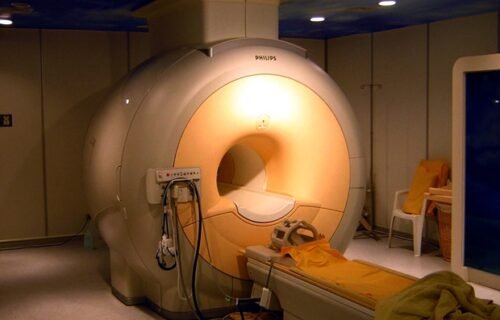
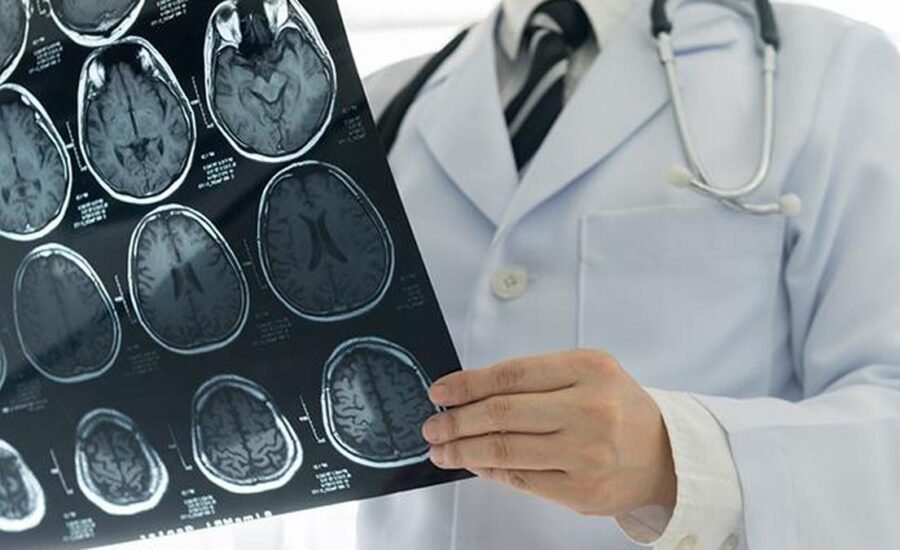

Doctor check up x-ray film of the brain by mri or ct scan brain at patient room hospital. medical concept.
| Photo Credit: utah778
Despite decades of research, Glioblastoma multiforme (GBM) still remains one of the deadliest types of brain cancers. While treatments including surgery, radiotherapy, and chemotherapy exist and have improved over time, the outcomes for patients remain generally poor. One of the major obstacles to treatment lies in the brain’s natural protection – the blood-brain barrier (BBB) that restricts the passage of anticancer drugs into the tumour.
What new research says
Recently published research in the scientific journal Oncoscience has sparked some excitement with a unique approach to targeting glioblastoma cells using a novel variant of vitamin B12. While the research is still in its early stages and has not left the preclinical phase yet, it offers a promising new approach to drug delivery in brain tumours.
A very significant consideration that should be highlighted here is that the current research does not involve the use of vitamin B12 supplements for the treatment of brain cancers. The scientists used a modified analogue of vitamin B12 known as nitrosylcobalamin (NO-Cbl) that was specifically designed to include nitric oxide, a substance that can kill tumour cells selectively. The compound was created by the scientists based on their knowledge about the presence of a high amount of transcobalamin II receptor (CD320) in many cancer cells, such as glioblastomas. This receptor is involved in the uptake of vitamin B12 into cells.
The most important thing to be highlighted from the experiment conducted was the ability of NO-Cbl to pass through the blood-brain barrier in experimental animals.
The transport of medicines has always been one of the biggest barriers in treating glioblastomas because the BBB serves as a very selective barrier: while protecting the brain it also prevents many cancer drugs from penetrating. In the experiment, researchers found that in the rats with glioblastoma, NO-Cbl accumulated in the tumour cells. After 24 hours of drug administration, the levels of nitrate, the marker of NO delivery, were still high in the tumour cells while falling in normal ones.
The study used NO-Cbl together with temozolomide, the chemotherapy drug used in the treatment of glioblastomas, and TRAIL, another anticancer treatment. The synergy was seen in laboratory tests, whereby it was shown that the two treatments together were more effective in suppressing tumours than each on its own. This is especially significant since one of the problems with the use of temozolomide is the issue of resistance to it.
The use of vitamin B12 offers a promising model because tumour cells that proliferate quickly require greater amounts of nutrients such as cobalamin. The approach involves delivering drugs directly to the tumour cells through the natural biological system rather than administering the entire body with higher drug levels.
The approach has potential to lower toxicity while increasing efficacy of the therapy, but this still needs further verification in humans.

What patients should know
The treatment of cancer is increasingly leaning towards precision medicine that involves targeting tumour cells alone, leaving other parts of the body untouched.
While the results are promising it is also critical not to misinterpret them.
At present, the study in question can be classified as preclinical, as it included experimental and animal studies. In their own summary, the researchers themselves describe the study as a pilot translational study. It does not prove the effectiveness or safety of NO-Cbl in the treatment of glioblastoma in human patients.
In order to become a clinically accepted treatment option, the therapy will have to go through a well-designed series of clinical trials.

What this means for the future
Though this finding is unlikely to impact present medical treatment protocols, it marks a major proof of concept. Rather than simply trying to make chemotherapy agents more effective, scientists have begun to look at more efficient delivery methods of reaching cancers hidden behind the blood-brain barrier.
Should subsequent clinical trials validate this research, vitamin B12 delivery systems for medication could eventually be incorporated into combination treatments for glioblastoma and possibly other neurological cancers.
The work holds promise for patients and physicians who hope to see one of the hardest problems in neuro-oncology — getting to the tumours — becoming possible in the coming years.
(Dr. Swaroop Gopal is group director, Aster International Institute of Neurosciences and Spine Care, Aster Whitefield Hospital, Bengaluru. swaroopdr@gmail.com)
Published – August 05, 2026 03:13 pm IST