On 1 July 2025, a robotic sky survey in Rio Hurtado, Chile, called ATLAS flagged a faint point of light moving in a way nothing native to our solar system moves. Archived images later traced it back to 14 June 2025. Follow-up observations confirmed what the discovery team suspected: the object, since named 3I/ATLAS, was only the third comet ever confirmed to have arrived here from outside our solar system, after ‘Oumuamua in 2017 and Borisov in 2019.
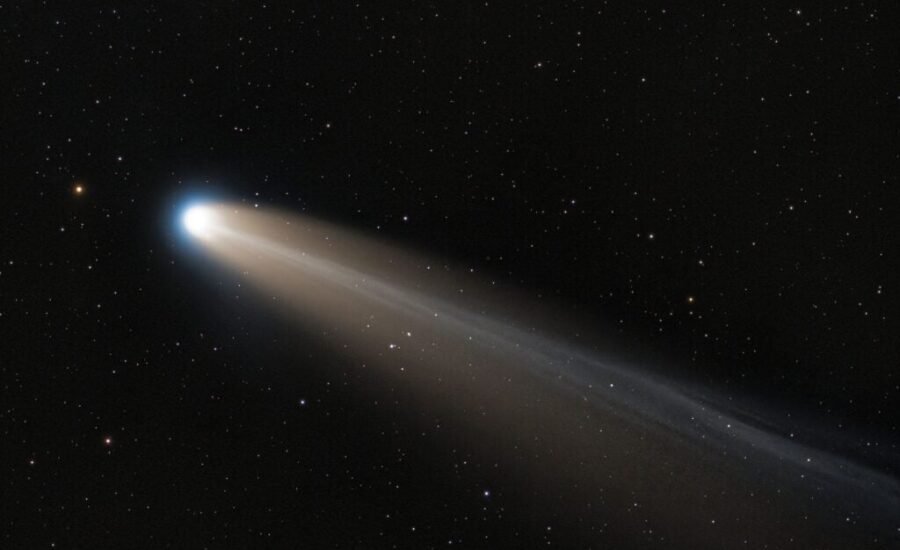
The “I” in its name stands for interstellar, and it earns that label from its orbit rather than its appearance. Every native comet and planet loops around the Sun in a closed ellipse. 3I/ATLAS instead follows a hyperbolic path, meaning it arcs through the solar system once and leaves for good, on a trajectory that traces back to somewhere else in the galaxy. It reached its closest point to the Sun on about 30 October 2025, at roughly 210 million kilometres, just inside Mars’s orbit, and never came within about 270 million kilometres of Earth. NASA’s own estimates put its icy nucleus anywhere from about 440 metres to 5.6 kilometres across, wrapped in a teardrop-shaped haze of dust, water, carbon dioxide, methane and organic molecules picked up by Hubble, Webb and several other missions that happened to have a clear line of sight.
What its water turned out to be made of
The detail I found most interesting is not that 3I/ATLAS has water. Most comets do. It is what that water is made of. A team led by Luis Salazar Manzano, a doctoral student at the University of Michigan, with Teresa Paneque-Carreño as co-leader, used the MDM Observatory in Arizona to first detect gas coming off the comet, then turned the Atacama Large Millimeter/submillimeter Array in Chile on it to separate ordinary water from its heavier cousin, deuterated water. The ratio of deuterium to ordinary hydrogen came out roughly 30 times higher than in comets that formed in our own solar system, and about 40 times higher than in Earth’s ocean water.
This is one study, not settled consensus, and it is worth saying so plainly. But the interpretation the researchers offer is a reasonable one: a water molecule’s deuterium ratio tends to reflect how cold and how irradiated the environment was when the ice first formed. A ratio this high points to a birthplace far colder, and considerably less bathed in radiation, than the disc of gas and dust that eventually became our Sun and planets. The paper appeared in Nature Astronomy in May 2026, with funding from NASA, the US National Science Foundation and Chile’s national research agency, ANID, and was covered in detail by ScienceDaily. If the reading holds up, it is a rare, direct measurement of conditions in a planetary system that is not our own, carried here by an object that formed nowhere near it.
Do not read the radio search as evidence of anything artificial
Because 3I/ATLAS came from outside the solar system, it also drew attention from the SETI Institute, which pointed the Allen Telescope Array at Hat Creek in Northern California at the comet for more than seven hours, scanning frequencies between 1 and 9 gigahertz. The lead researcher, Dr Sofia Sheikh, put the reasoning plainly: understanding what a natural interstellar object looks like is what would let anyone eventually recognise an artificial one, if such a thing ever turned up.
The scan picked up around 74 million narrowband signals in total. After filtering out obvious interference and keeping only signals that matched the comet’s own motion across the sky, roughly 200 candidates remained, and every one of them traced back to a transmitter on Earth or in Earth orbit. Nothing in the data suggested a signal actually coming from 3I/ATLAS. The scan does let researchers say something useful in the negative: any radio transmitter riding along with the comet would have to be weaker than about 10 to 110 watts, roughly the output of a household appliance. That is a constraint on what is not there, not a discovery of what is.
It is worth separating that finding from a different kind of attention 3I/ATLAS has attracted. The Harvard astronomer Avi Loeb has published a series of public essays, including one titled around “22 mysterious anomalies,” arguing the comet’s behaviour deserves closer scrutiny as a possible sign of artificial origin. Loeb is a real astronomer with a genuine publication record, and he is entitled to ask the question. But his essays are not peer-reviewed findings, and the peer-reviewed and observational work actually done on 3I/ATLAS, the isotope measurement, the radio scan, the imaging from half a dozen missions, has so far turned up a comet that behaves like a comet, just one that appears to have formed somewhere unusually cold. I would rather report what the instruments actually measured than borrow the framing of “anomalies” from someone reading the same data and reaching for a bigger claim.
Where this fits with what came before
‘Oumuamua, the first interstellar object spotted in 2017, was strange enough in its own way: it tumbled without an obvious cometary tail and its acceleration puzzled astronomers for years before most settled on outgassing as the likely, unglamorous explanation. Borisov, in 2019, behaved much more like a familiar comet. 3I/ATLAS sits closer to Borisov’s end of that spectrum: an ordinary-looking icy body, just one whose chemistry carries a signature from a part of the galaxy we cannot otherwise sample. I wrote a while back about how Voyager 1 reached true interstellar space back in 2012, a probe of ours leaving the solar system after decades of travel. 3I/ATLAS is close to the mirror image of that, a piece of somewhere else arriving briefly in ours, then leaving again just as fast.
By the time this runs, 3I/ATLAS will already be well on its way back out, fading as it goes, its perihelion behind it. What is left is the data already collected, and the slower work of arguing over what it means. The isotope result will get checked against future interstellar visitors, when and if any turn up. The radio non-detection stands as one data point in a search that has, so far, always come back empty. Neither of those things is a small result. It is just a quieter one than the version with anomalies in the headline.