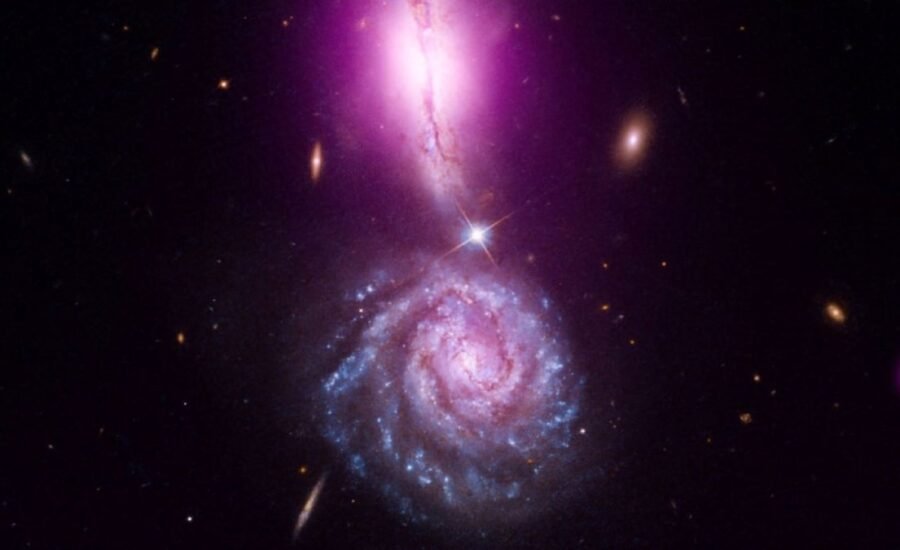
Known to astronomers as Arp 302, the pair is in the early stages of a massive galactic collision. Over the next few million years, these two stellar systems will continue to pull on each other until they eventually merge into one single galaxy.
Sharing the striking image, the National Aeronautics and Space Administration (NASA) wrote “Our @nasachandraxray and @nasahubble telescopes combined their data to make this image, which shows two galaxies in the early stages of interacting. From this angle, the galaxy pair looks like an exclamation mark!”
NASA also revealed stunning details received from both space telescopes. Chandra’s X-ray vision detected a rapidly growing supermassive black hole inside the top galaxy (the stem of the exclamation mark). This gravitational giant is heavily obscured behind thick layers of space dust and gas.
While they are locked in the same gravitational dance, data from Hubble shows that the two interacting galaxies are aging and evolving at very different rates.
When the Hubble’s visible light images (showing blues, greens, and reds) are combined with Chandra’s purple X-ray data, scientists can look through cosmic dust to better understand how galaxies transform during such collisions.
ALSO READ | NASA astronaut shares stunning Milky Way galaxy photo; explains how it was taken
Social media reactions
The post quickly gained traction online, with many social media users expressing how enchanted they were looking at this image.
“Romance might just be gravity with patience. Millions of years, and still moving toward one another,” read a comment.
Another wrote, “To me, it looks like a magic wand paired with a heavenly rose! A perfect blend of wonder and beauty in the cosmos. Truly enchanting.”
“It’s truly so beautiful that I can’t even find the words to describe it,” posted a user.
An individual commented, “Galactic collisions are a beautiful thing.”
“This is Beautiful and Absolutely Spectacular,” added another.
Astronaut Spots Heart-Shaped Lake From Space
[???????? version FR ????] Day 171 orbit 2649 — It always makes me happy to see hearts in nature: my brain knows it’s just a trick, a pareidolia, but my heart feels like Earth is sending me a message.
Summertime might be less carefree than it once was, but this heart-shaped lake feels… pic.twitter.com/BgDdQOTbiR
— Adenot Sophie (@Soph_astro) August 3, 2026
A day ago, astronaut Sophie Adenot spotted what appeared to be a heart-shaped lake in nature. She shared the image on X (formerly Twitter), saying it reminded her of the beauty that can still be found in the world.
In her post, Adenot wrote that seeing hearts in nature always makes her happy. She acknowledged that her brain knows it’s “just a trick, a pareidolia,” but her heart feels like Earth is sending her a message.
“Summertime might be less carefree than it once was, but this heart-shaped lake feels like a gentle reminder that there is still plenty worth caring for—and fighting for,” she further added.