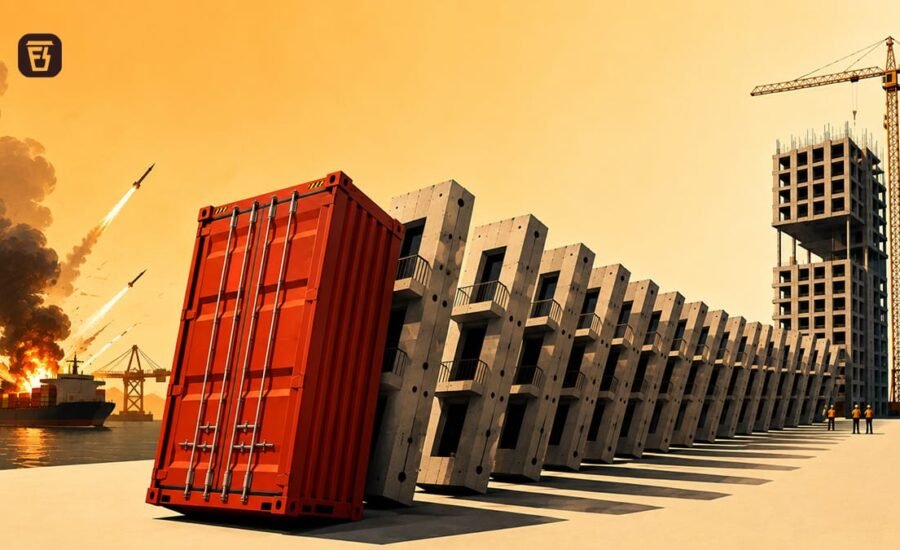
In today’s Finshots, we explain why a prolonged conflict in West Asia is slowing down India’s real estate industry.
But here’s a quick sidenote before we begin. Your 30s and 40s are peak earning years. They’re also the years most people fly without an insurance safety net.
Between EMIs, school fees, and ageing parents, there’s always something more urgent. But one medical emergency or unexpected loss of income can unravel everything you’ve built.
Our 2-day Insurance Masterclass will help you put that safety net in place.
📅 Tomorrow (Tuesday), 4th August at 6:30 PM: Life Insurance
📅 Wednesday, 5th August at 6:30 PM: Health Insurance
👉🏽Click here to save your spot.
Now onto today’s story.
The Story
On Friday, the Ministry of Housing and Urban Affairs (MoHUA) issued an advisory that real estate developers across India had been waiting months for.
It directed every state’s Real Estate Regulatory Authority (RERA) — the body that regulates builders by monitoring project timelines and protecting homebuyers, to grant a blanket four-month extension to any registered housing project whose completion deadline falls on or after February 28, 2026.
Now, this wasn’t a random act of generosity. It is something the government is required to do under the RERA Act, which allows project deadlines to be extended in cases of something called “force majeure” or simply events that are genuinely beyond a developer’s control.
And this time, that event was the ongoing West Asia crisis.
Back in April 2026, the Finance Ministry had formally classified the conflict as a war. And that meant developer bodies like CREDAI and NAREDCO, which had been lobbying for such an extension for months, could finally breathe a huge sigh of relief, as builders no longer had to worry about being penalised for delayed project deliveries.
But then, why is a war thousands of kilometres away forcing India’s real estate developers to ask for more time, you ask?
Well, to understand that, you first have to see what this faraway war has been doing to construction sites across India for months.
It all starts with rising crude oil prices, which sit at the centre of this entire story.
Now, it’s not as if the raw materials used to build homes in India are mostly imported. Many are made right here. But there’s a catch. A lot of them still depend on energy or petrochemicals during the manufacturing process.
Take tiles, for instance. Ceramic and porcelain tiles have to be baked at extremely high temperatures, and that requires fuels like natural gas and propane. But the problem is that India relies heavily on West Asia for its natural gas imports. So when supplies tighten, production takes a hit.
That’s exactly what happened in Gujarat’s Morbi district, one of India’s biggest ceramic and tile manufacturing hubs, where some factories had to temporarily shut down.
And tiles are just one example. The same story plays out across steel, cement, PVC pipes, electrical components and several other construction materials. Even if they’re manufactured in India, higher energy costs and supply disruptions push up production costs and slow deliveries. So builders aren’t just waiting longer for materials to arrive; they’re also paying more for them.
The numbers back this up. According to rating agency ICRA, crude oil is expected to average around $95 a barrel in FY27, nearly 30% higher than last year. That has already pushed up the cost of key inputs such as petcoke, diesel and polypropylene for cement manufacturers, nudging many companies to raise cement prices by ₹10–12 per bag in April 2026.
Steel is facing a similar issue. As the conflict disrupted shipping near the Strait of Hormuz, shipping costs jumped from roughly $9.80 to $12.20 per tonne within weeks of March 2026. That has made imported coking coal and iron ore more expensive, further increasing costs for India’s steelmakers.
And that meant a record 5.4 lakh homes scheduled for completion across India’s top seven cities in 2026 were at risk of being delayed. Nearly 70% of them are in Mumbai, Pune and Bengaluru — cities that have been hit the hardest by these disruptions.
So if you see, this extension gives developers some much-needed respite. Without it, delays could have invited monetary penalties, while homebuyers would have been entitled to claim delayed-possession interest or even seek a full refund.
It also protects developers’ balance sheets since a RERA default can complicate bank loan classifications and project financing arrangements. By avoiding a default, developers can keep their credit lines and construction financing intact.
But here’s the thing. The extension only buys time. It doesn’t solve the underlying problem or make cement, steel or diesel any cheaper. Nor does it magically fix supply chain bottlenecks. It simply sits on top of a market that was already grappling with a different set of challenges.
The biggest one being premium and luxury housing. For context, even before the conflict, homes priced above roughly ₹2 crore or more were piling up as unsold inventory because developers were launching projects faster than genuine buyer demand could keep up.
And this segment has traditionally depended on one very specific buyer: Gulf-based NRIs or precisely the buyer pool that’s now stepping back. An Equirus Wealth survey of over 8,300 Gulf-based NRIs found that Indian real estate is seeing broad-based selling, with nearly 40% of respondents reducing their exposure and shifting money into equities and mutual funds instead.
And it’s not hard to see why. A stock portfolio can be managed from anywhere in the world with just a phone. A property, on the other hand, is fixed in one place and far harder to sell quickly if a crisis escalates.
Another factor is that many NRIs traditionally viewed buying a home in India as an emotional purchase — a place to return to during retirement. But the current uncertainty is making many of them think differently. Instead of locking their money into property, they’re choosing to build up their savings, pay down existing debt, or invest in globally diversified financial markets instead.
So developers, especially in major cities are now being squeezed from both sides. Construction costs are rising, project timelines are stretching, and at the same time, one of their biggest buyer groups is becoming more cautious.
Then there are the homebuyers who booked these homes years ago and are still waiting for the keys.
For many of them, this could feel eerily familiar. During the COVID-19 pandemic, regulators also granted developers a six-month force majeure extension. While neither builders nor buyers were at fault, buyers couldn’t claim delayed-possession interest during that period — even though many continued paying interest on their home loans, since loan repayments were only deferred through temporary moratoriums rather than waived.
So what does all of this actually mean for India’s real estate sector?
Well, the short answer is that the sector isn’t falling apart.
If anything, the numbers tell a different story. Institutional and domestic investors poured $2.9 billion into Indian real estate in the second quarter of 2026 alone, up nearly 70% year-on-year. That pushed total institutional investment for the first half of 2026 to $4.5 billion — the highest in six years. So while Gulf-based NRIs are turning cautious about buying homes, large institutional investors clearly still see Indian real estate as a long-term bet, not one a regional conflict can derail.
Commercial real estate is holding up especially well. Office buildings, warehouses and data centres barely depend on Gulf-based buyers. Rather they run on business leasing, Global Capability Centers (GCCs) expanding across India, and institutional capital instead. So even if parts of the housing market slow down, commercial real estate could keep the broader sector standing.
The real worry is what developers have been building. Even before this conflict, they leaned hard into luxury homes, since they carry fatter margins and builders bet demand would eventually catch up. That bet now looks shakier. Across the market, the share of ready-to-move-in homes has fallen from nearly 75% in 2017 to about 55% today. Meaning more homes than ever are being sold on a promise, right as one of the biggest buyer pools for premium property turns cautious.
And that tilt toward luxury comes at a cost elsewhere. With developers chasing margins at the top end, there’s little being built for everyone else. As an NDTV story recently put it, it’s creating “a squeeze for the middle class and no homes left for them”, with even households earning around ₹1 lakh a month struggling to find an affordable home.
So while you could say the West Asia conflict hasn’t derailed India’s real estate story, it has exposed the parts of it that were already fragile. The sector will likely keep growing, but unevenly with different corners of the housing market grappling with problems of their own.
Ultimately, two things will decide how this plays out. How long the conflict and high oil prices last. And whether Gulf-based NRIs return to Indian property once things settle, or permanently shift their money into easier-to-exit assets like stocks and mutual funds. Because if that shift turns out to be permanent, it could reshape India’s luxury housing market long after the headlines from West Asia have faded.
Until then…
If you liked this story, feel free to share it with your friends, family or even strangers on WhatsApp, LinkedIn, and X.
Also, if you’re someone who loves keeping tabs on the world of business and finance, hit subscribe if you haven’t already. And if you’re already a subscriber, thank you! Maybe forward this to someone who’d enjoy our stories but hasn’t discovered us yet.