How readily a cell divides and how well it survives is fundamental to life, shaping everything from organ size to the body’s ability to withstand disease.
That combination, known as cell fitness, isn’t the same for everyone. Differences in genetics and environment can tip the scales toward developmental disorders, tissue degeneration and cancer. Pinning down those differences could help explain why some people are more vulnerable than others to a given disease or toxic exposure – and eventually guide more personalized treatment and prevention.
But measuring cell fitness across many genetic backgrounds has long been difficult. Donor diversity is limited, and growing each person’s cells in a separate dish is slow, costly and vulnerable to tiny differences in handling from one well to the next.
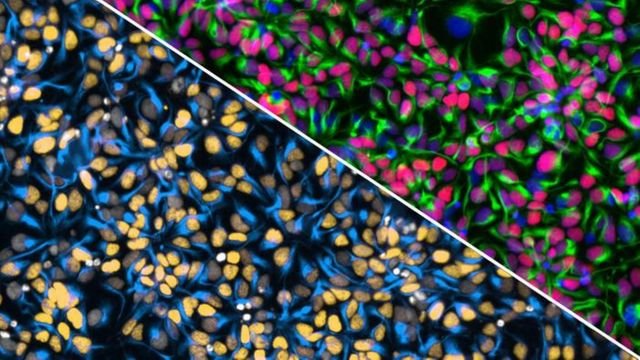
In a study published in the American Journal of Human Genetics, UCLA scientists tackle this with a cell village approach: pooling neural progenitor cells – the early cells that build the developing brain – from dozens of genetically distinct donors into a single shared culture, where every donor’s cells grow under identical conditions.
“By using cell villages, we eliminate a lot of the technical noise that can mask real biology, and it means we can include far more genetic diversity in a single experiment,” said co-senior author Dr. Michael F. Wells, assistant professor of human genetics at the David Geffen School of Medicine at UCLA and a member of the UCLA Broad Stem Cell Research Center, who pioneered the platform.
Pooling cells generates complex, tangled data, so the team built a companion statistical tool, Townlet, that gives researchers a reliable readout of each donor’s fitness within the crowd.
Why cell villages beat separate dishes for spotting genetic differences
Cultured in separate wells, cells are subject to tiny variations in oxygen, temperature and handling that can bury subtle but important biological differences.
“A cell village throws everybody into the same well, so whatever differences we see between cells from person A and person B are much more likely to be driven by genetics or some other meaningful biological factor,” Wells said.
To measure fitness, the team tracked what share of the village each donor’s cells claimed over time, using DNA sequencing as a running census.
“The growth rates of donors mixed into a village match what we see when we culture those same donors separately,” said co-first author Tim Derebenskiy, a graduate student in the Wells lab. “We get the same result every time we build a village – it’s remarkably reproducible and more precise than the traditional format.”
Creating a new tool to untangle a math problem
Tracking each donor’s share of the dish creates a statistical trap. Because every share is a slice of a fixed whole, one donor’s gain automatically forces the others to shrink.
“The readout is proportional data – essentially a pie chart changing over time,” said co-senior author Dr. Harold Pimentel, assistant professor of computational medicine, computer science and human genetics at the Geffen School of Medicine. “When one slice grows, the others have to shrink to make room, because everything has to sum to one. But most standard statistical tools assume each slice doesn’t know about the others.”
That’s a serious problem because the entire point of the experiment is to find real biological differences between donors – whose cells grow faster, whose are more vulnerable to lead exposure. Most statistical tools would mistake that forced shrinkage for genuine biology, potentially sending researchers chasing a genetic vulnerability that never existed.
Townlet was built to tell the difference between the two – a share that shrinks because of the math and one that shrinks because of meaningful biology.
Settling a mystery behind autism-linked head overgrowth
The team first turned the platform on a contested puzzle in autism research: chromosome 16p11.2 deletion, a genetic change that raises the risk of autism and, in some carriers, is linked to macrocephaly, or an unusually large head that could indicate a larger brain.
“There’s been a lot of debate about why a subset of individuals with autism present with macrocephaly,” Wells said. “It sounds trivial, but head circumference in the first year of life is one of the best early predictors of an autism diagnosis.”
Pooling neural progenitor cells from 12 people with the deletion and 11 without it – the largest study of its kind to date – the team landed on a clear answer: The deletion-carrying cells consistently divided faster. That points to early brain cell overgrowth as a key driver of the larger heads seen in some people with autism.
Because an oversized head often shows up in a baby’s first year, well before behavioral signs, tying it to a specific cellular cause gives researchers an early, mechanistic foothold for understanding how autism takes root.
Two genes, two kinds of fitness
Scanning the genomes of 35 donors in a larger village, the team traced natural variation in how fast brain cells grow to a stretch of DNA near ZFHX3, a known brake on cell division in the developing brain – then confirmed the link in a separate, independent group of donors.
Survival told a different story. When the team exposed a 39-donor village to lead, a well-established threat to the developing brain, the damage varied enormously from person to person.
“Some donors’ cells showed about a 20% drop in viability after a week of exposure, and others showed a 90% drop, with everything in between,” Wells said. “Lead can be found in older housing paint, aging water service lines and contaminated soil, which is exactly why we chose it as our model neurotoxin.”
The team traced part of that difference in survival to a region near ARNT2, a gene that protects cells from stress – pointing toward two future possibilities: identifying people whose genetics make their cells more vulnerable to lead exposure and developing therapies that could shield them from harm.
Why it matters, and what’s next
Chloe Hanson, a co-first author and graduate student in the Pimentel lab who helped build Townlet, sees the approach as part of a broader shift: “Cell villages give us a way to study effects on human biology directly, while reducing reliance on animal studies,” she said.